

566
M. Lamont et al.
Effective cross section
Effective cross section
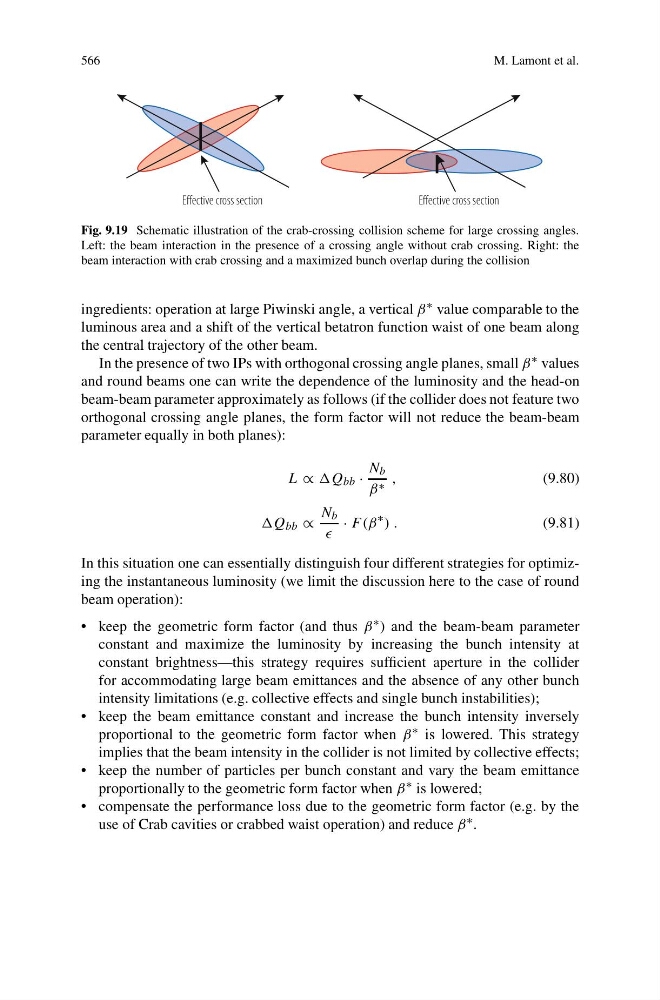
Fig. 9.19 Schematic illustration of the crab-crossing collision scheme for large crossing angles.
Left: the beam interaction in the presence of a crossing angle without crab crossing. Right: the
beam interaction with crab crossing and a maximized bunch overlap during the collision
ingredients: operation at large Piwinski angle, a vertical β ∗ value comparable to the
luminous area and a shift of the vertical betatron function waist of one beam along
the central trajectory of the other beam.
In the presence of two IPs with orthogonal crossing angle planes, small β ∗ values
and round beams one can write the dependence of the luminosity and the head-on
beam-beam parameter approximately as follows (if the collider does not feature two
orthogonal crossing angle planes, the form factor will not reduce the beam-beam
parameter equally in both planes):
L ∝ Q bb ·
N b
β ∗ ,
(9.80)
Q bb ∝
N b
· F (β
∗ ) .
(9.81)
In this situation one can essentially distinguish four different strategies for optimizing the instantaneous luminosity (we limit the discussion here to the case of round
beam operation):
• keep the geometric form factor (and thus β ∗ ) and the beam-beam parameter
constant and maximize the luminosity by increasing the bunch intensity at
constant brightness—this strategy requires sufficient aperture in the collider
for accommodating large beam emittances and the absence of any other bunch
intensity limitations (e.g. collective effects and single bunch instabilities);
• keep the beam emittance constant and increase the bunch intensity inversely
proportional to the geometric form factor when β ∗ is lowered. This strategy
implies that the beam intensity in the collider is not limited by collective effects;
• keep the number of particles per bunch constant and vary the beam emittance
proportionally to the geometric form factor when β ∗ is lowered;
• compensate the performance loss due to the geometric form factor (e.g. by the
use of Crab cavities or crabbed waist operation) and reduce β ∗ .
M. Lamont et al.
Effective cross section
Effective cross section
Fig. 9.19 Schematic illustration of the crab-crossing collision scheme for large crossing angles.
Left: the beam interaction in the presence of a crossing angle without crab crossing. Right: the
beam interaction with crab crossing and a maximized bunch overlap during the collision
ingredients: operation at large Piwinski angle, a vertical β ∗ value comparable to the
luminous area and a shift of the vertical betatron function waist of one beam along
the central trajectory of the other beam.
In the presence of two IPs with orthogonal crossing angle planes, small β ∗ values
and round beams one can write the dependence of the luminosity and the head-on
beam-beam parameter approximately as follows (if the collider does not feature two
orthogonal crossing angle planes, the form factor will not reduce the beam-beam
parameter equally in both planes):
L ∝ Q bb ·
N b
β ∗ ,
(9.80)
Q bb ∝
N b
· F (β
∗ ) .
(9.81)
In this situation one can essentially distinguish four different strategies for optimizing the instantaneous luminosity (we limit the discussion here to the case of round
beam operation):
• keep the geometric form factor (and thus β ∗ ) and the beam-beam parameter
constant and maximize the luminosity by increasing the bunch intensity at
constant brightness—this strategy requires sufficient aperture in the collider
for accommodating large beam emittances and the absence of any other bunch
intensity limitations (e.g. collective effects and single bunch instabilities);
• keep the beam emittance constant and increase the bunch intensity inversely
proportional to the geometric form factor when β ∗ is lowered. This strategy
implies that the beam intensity in the collider is not limited by collective effects;
• keep the number of particles per bunch constant and vary the beam emittance
proportionally to the geometric form factor when β ∗ is lowered;
• compensate the performance loss due to the geometric form factor (e.g. by the
use of Crab cavities or crabbed waist operation) and reduce β ∗ .