

9 Accelerator Operations
567
9.8.6 Maximizing the Integrated Luminosity
Several effects can lead to an intensity decrease of the colliding beams over the
length of a physics store:
• the loss of particles via the actual collisions (beam burn off);
• particle losses via collisions with the rest gas and photons in the vacuum system;
• loss of particles via resonances (e.g. driven by the beam-beam interaction);
• particle losses through the Touschek effect;
• particle losses through aperture restrictions (relevant for colliders where the
beam distribution is an equilibrium distribution determined by the synchrotron
radiation and were any part of the distribution (e.g. the tails of the Gaussian
distribution) lost through aperture restrictions will be repopulated).
In addition, several effects can lead to an increase of the beam size via an emittance
blow-up:
• resonances in the machine (e.g. driven by the beam-beam interaction);
• noise in machine equipment (e.g. kicker and RF elements);
• intra beam scattering (IBS).
All the above effects together result in a reduction of the luminosity with time and
require the preparation of a new fill with fresh beams once the performance dropped
too much. The integrated luminosity depends then on the luminosity lifetime, the run
length and the ‘turnaround’ time required for preparing a new fill in the collider. The
turnaround time is defined as the time interval between the end of one fill and the
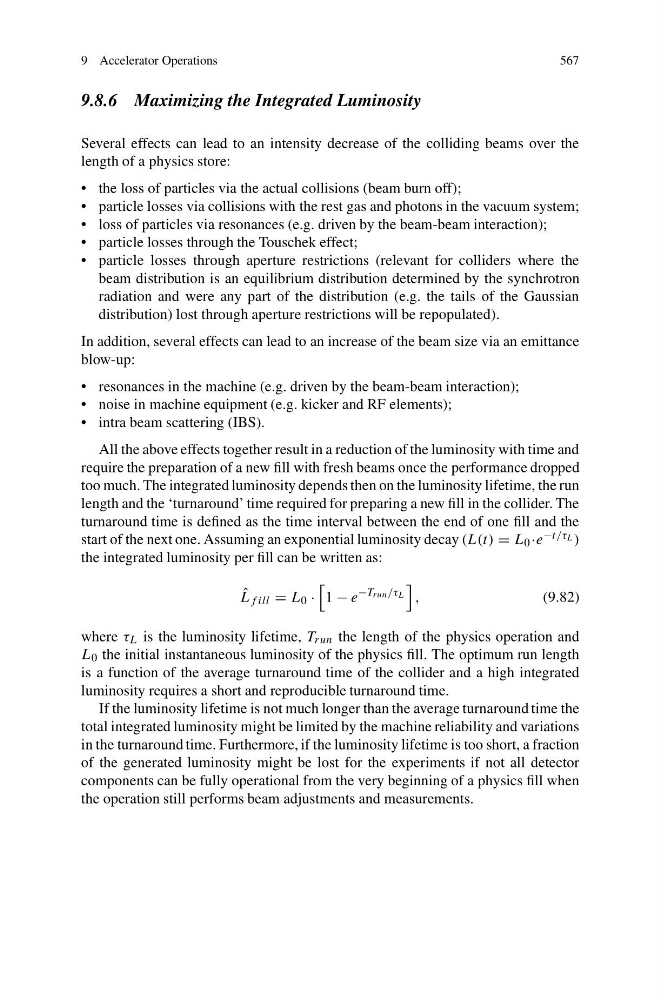
start of the next one. Assuming an exponential luminosity decay (L(t) = L 0 ·e −t/τ L )
the integrated luminosity per fill can be written as:
ˆ
L f ill = L 0 ·
1 − e
−T run /τ L
,
(9.82)
where τ L is the luminosity lifetime, T run the length of the physics operation and
L 0 the initial instantaneous luminosity of the physics fill. The optimum run length
is a function of the average turnaround time of the collider and a high integrated
luminosity requires a short and reproducible turnaround time.
If the luminosity lifetime is not much longer than the average turnaround time the
total integrated luminosity might be limited by the machine reliability and variations
in the turnaround time. Furthermore, if the luminosity lifetime is too short, a fraction
of the generated luminosity might be lost for the experiments if not all detector
components can be fully operational from the very beginning of a physics fill when
the operation still performs beam adjustments and measurements.
567
9.8.6 Maximizing the Integrated Luminosity
Several effects can lead to an intensity decrease of the colliding beams over the
length of a physics store:
• the loss of particles via the actual collisions (beam burn off);
• particle losses via collisions with the rest gas and photons in the vacuum system;
• loss of particles via resonances (e.g. driven by the beam-beam interaction);
• particle losses through the Touschek effect;
• particle losses through aperture restrictions (relevant for colliders where the
beam distribution is an equilibrium distribution determined by the synchrotron
radiation and were any part of the distribution (e.g. the tails of the Gaussian
distribution) lost through aperture restrictions will be repopulated).
In addition, several effects can lead to an increase of the beam size via an emittance
blow-up:
• resonances in the machine (e.g. driven by the beam-beam interaction);
• noise in machine equipment (e.g. kicker and RF elements);
• intra beam scattering (IBS).
All the above effects together result in a reduction of the luminosity with time and
require the preparation of a new fill with fresh beams once the performance dropped
too much. The integrated luminosity depends then on the luminosity lifetime, the run
length and the ‘turnaround’ time required for preparing a new fill in the collider. The
turnaround time is defined as the time interval between the end of one fill and the
start of the next one. Assuming an exponential luminosity decay (L(t) = L 0 ·e −t/τ L )
the integrated luminosity per fill can be written as:
ˆ
L f ill = L 0 ·
1 − e
−T run /τ L
,
(9.82)
where τ L is the luminosity lifetime, T run the length of the physics operation and
L 0 the initial instantaneous luminosity of the physics fill. The optimum run length
is a function of the average turnaround time of the collider and a high integrated
luminosity requires a short and reproducible turnaround time.
If the luminosity lifetime is not much longer than the average turnaround time the
total integrated luminosity might be limited by the machine reliability and variations
in the turnaround time. Furthermore, if the luminosity lifetime is too short, a fraction
of the generated luminosity might be lost for the experiments if not all detector
components can be fully operational from the very beginning of a physics fill when
the operation still performs beam adjustments and measurements.