

9 Accelerator Operations
565
R
0.8
0.6
0.4
0.2
0
1
2
0
4
6
8
1 0
0.9
0.8
0.7
0.6
0.5
0.4
0.3
0.2
0.1
0
1
1
0.8
0.6
0.4
0
0.2
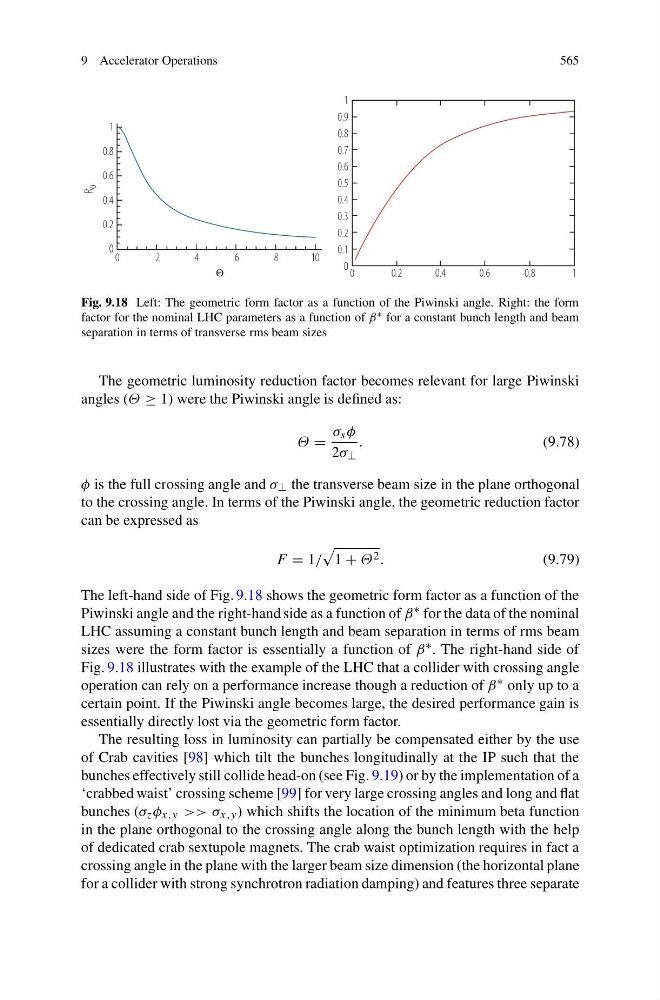
Fig. 9.18 Left: The geometric form factor as a function of the Piwinski angle. Right: the form
factor for the nominal LHC parameters as a function of β ∗ for a constant bunch length and beam
separation in terms of transverse rms beam sizes
The geometric luminosity reduction factor becomes relevant for large Piwinski
angles (Θ ≥ 1) were the Piwinski angle is defined as:
Θ =
σ s φ
2σ ⊥
.
(9.78)
φ is the full crossing angle and σ ⊥ the transverse beam size in the plane orthogonal
to the crossing angle. In terms of the Piwinski angle, the geometric reduction factor
can be expressed as
F = 1/
1 + Θ 2 .
(9.79)
The left-hand side of Fig. 9.18 shows the geometric form factor as a function of the
Piwinski angle and the right-hand side as a function of β ∗ for the data of the nominal
LHC assuming a constant bunch length and beam separation in terms of rms beam
sizes were the form factor is essentially a function of β ∗ . The right-hand side of
Fig. 9.18 illustrates with the example of the LHC that a collider with crossing angle
operation can rely on a performance increase though a reduction of β ∗ only up to a
certain point. If the Piwinski angle becomes large, the desired performance gain is
essentially directly lost via the geometric form factor.
The resulting loss in luminosity can partially be compensated either by the use
of Crab cavities [98] which tilt the bunches longitudinally at the IP such that the
bunches effectively still collide head-on (see Fig. 9.19) or by the implementation of a
‘crabbed waist’ crossing scheme [99] for very large crossing angles and long and flat
bunches (σ z φ x,y >> σ x,y ) which shifts the location of the minimum beta function
in the plane orthogonal to the crossing angle along the bunch length with the help
of dedicated crab sextupole magnets. The crab waist optimization requires in fact a
crossing angle in the plane with the larger beam size dimension (the horizontal plane
for a collider with strong synchrotron radiation damping) and features three separate
565
R
0.8
0.6
0.4
0.2
0
1
2
0
4
6
8
1 0
0.9
0.8
0.7
0.6
0.5
0.4
0.3
0.2
0.1
0
1
1
0.8
0.6
0.4
0
0.2
Fig. 9.18 Left: The geometric form factor as a function of the Piwinski angle. Right: the form
factor for the nominal LHC parameters as a function of β ∗ for a constant bunch length and beam
separation in terms of transverse rms beam sizes
The geometric luminosity reduction factor becomes relevant for large Piwinski
angles (Θ ≥ 1) were the Piwinski angle is defined as:
Θ =
σ s φ
2σ ⊥
.
(9.78)
φ is the full crossing angle and σ ⊥ the transverse beam size in the plane orthogonal
to the crossing angle. In terms of the Piwinski angle, the geometric reduction factor
can be expressed as
F = 1/
1 + Θ 2 .
(9.79)
The left-hand side of Fig. 9.18 shows the geometric form factor as a function of the
Piwinski angle and the right-hand side as a function of β ∗ for the data of the nominal
LHC assuming a constant bunch length and beam separation in terms of rms beam
sizes were the form factor is essentially a function of β ∗ . The right-hand side of
Fig. 9.18 illustrates with the example of the LHC that a collider with crossing angle
operation can rely on a performance increase though a reduction of β ∗ only up to a
certain point. If the Piwinski angle becomes large, the desired performance gain is
essentially directly lost via the geometric form factor.
The resulting loss in luminosity can partially be compensated either by the use
of Crab cavities [98] which tilt the bunches longitudinally at the IP such that the
bunches effectively still collide head-on (see Fig. 9.19) or by the implementation of a
‘crabbed waist’ crossing scheme [99] for very large crossing angles and long and flat
bunches (σ z φ x,y >> σ x,y ) which shifts the location of the minimum beta function
in the plane orthogonal to the crossing angle along the bunch length with the help
of dedicated crab sextupole magnets. The crab waist optimization requires in fact a
crossing angle in the plane with the larger beam size dimension (the horizontal plane
for a collider with strong synchrotron radiation damping) and features three separate