

2 Beam Dynamics
47
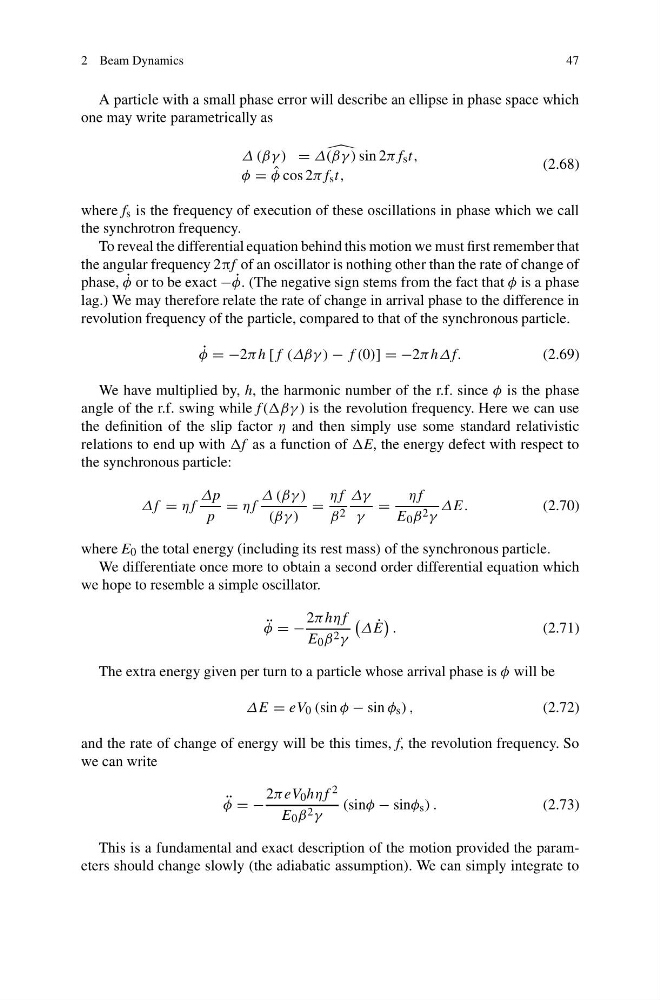
A particle with a small phase error will describe an ellipse in phase space which
one may write parametrically as
Δ (βγ ) = Δ
(βγ ) sin 2πf s t,
φ = ˆ
φ cos 2πf s t,
(2.68)
where f s is the frequency of execution of these oscillations in phase which we call
the synchrotron frequency.
To reveal the differential equation behind this motion we must first remember that
the angular frequency 2πf of an oscillator is nothing other than the rate of change of
phase, ˙
φ or to be exact − ˙
φ. (The negative sign stems from the fact that φ is a phase
lag.) We may therefore relate the rate of change in arrival phase to the difference in
revolution frequency of the particle, compared to that of the synchronous particle.
˙
φ = −2πh [f (Δβγ ) − f (0)] = −2πhΔf.
(2.69)
We have multiplied by, h, the harmonic number of the r.f. since φ is the phase
angle of the r.f. swing while f (βγ ) is the revolution frequency. Here we can use
the definition of the slip factor η and then simply use some standard relativistic
relations to end up with as a function of the energy defect with respect to
the synchronous particle:
Δf = ηf
Δp
p
= ηf
Δ (βγ )
(βγ )
=
ηf
β 2
Δγ
γ
=
ηf
E 0 β 2 γ
ΔE.
(2.70)
where E 0 the total energy (including its rest mass) of the synchronous particle.
We differentiate once more to obtain a second order differential equation which
we hope to resemble a simple oscillator.
¨
φ = −
2πhηf
E 0 β 2 γ
Δ ˙
E
.
(2.71)
The extra energy given per turn to a particle whose arrival phase is φ will be
ΔE = eV 0 (sin φ − sin φ s ) ,
(2.72)
and the rate of change of energy will be this times, f, the revolution frequency. So
we can write
¨
φ = −
2πeV 0 hηf 2
E 0 β 2 γ
(sinφ − sinφ s ) .
(2.73)
This is a fundamental and exact description of the motion provided the parameters should change slowly (the adiabatic assumption). We can simply integrate to
47
A particle with a small phase error will describe an ellipse in phase space which
one may write parametrically as
Δ (βγ ) = Δ
(βγ ) sin 2πf s t,
φ = ˆ
φ cos 2πf s t,
(2.68)
where f s is the frequency of execution of these oscillations in phase which we call
the synchrotron frequency.
To reveal the differential equation behind this motion we must first remember that
the angular frequency 2πf of an oscillator is nothing other than the rate of change of
phase, ˙
φ or to be exact − ˙
φ. (The negative sign stems from the fact that φ is a phase
lag.) We may therefore relate the rate of change in arrival phase to the difference in
revolution frequency of the particle, compared to that of the synchronous particle.
˙
φ = −2πh [f (Δβγ ) − f (0)] = −2πhΔf.
(2.69)
We have multiplied by, h, the harmonic number of the r.f. since φ is the phase
angle of the r.f. swing while f (βγ ) is the revolution frequency. Here we can use
the definition of the slip factor η and then simply use some standard relativistic
relations to end up with as a function of the energy defect with respect to
the synchronous particle:
Δf = ηf
Δp
p
= ηf
Δ (βγ )
(βγ )
=
ηf
β 2
Δγ
γ
=
ηf
E 0 β 2 γ
ΔE.
(2.70)
where E 0 the total energy (including its rest mass) of the synchronous particle.
We differentiate once more to obtain a second order differential equation which
we hope to resemble a simple oscillator.
¨
φ = −
2πhηf
E 0 β 2 γ
Δ ˙
E
.
(2.71)
The extra energy given per turn to a particle whose arrival phase is φ will be
ΔE = eV 0 (sin φ − sin φ s ) ,
(2.72)
and the rate of change of energy will be this times, f, the revolution frequency. So
we can write
¨
φ = −
2πeV 0 hηf 2
E 0 β 2 γ
(sinφ − sinφ s ) .
(2.73)
This is a fundamental and exact description of the motion provided the parameters should change slowly (the adiabatic assumption). We can simply integrate to