

46
E. Wilson and B. J. Holzer
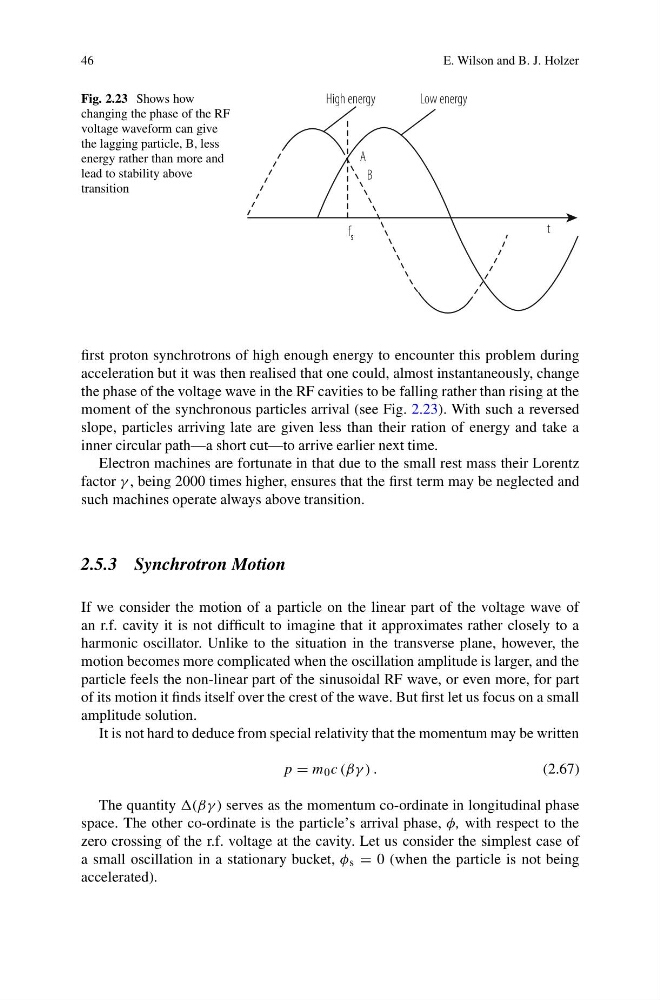
Fig. 2.23 Shows how
changing the phase of the RF
voltage waveform can give
the lagging particle, B, less
energy rather than more and
lead to stability above
transition
first proton synchrotrons of high enough energy to encounter this problem during
acceleration but it was then realised that one could, almost instantaneously, change
the phase of the voltage wave in the RF cavities to be falling rather than rising at the
moment of the synchronous particles arrival (see Fig. 2.23). With such a reversed
slope, particles arriving late are given less than their ration of energy and take a
inner circular path—a short cut—to arrive earlier next time.
Electron machines are fortunate in that due to the small rest mass their Lorentz
factor γ , being 2000 times higher, ensures that the first term may be neglected and
such machines operate always above transition.
2.5.3 Synchrotron Motion
If we consider the motion of a particle on the linear part of the voltage wave of
an r.f. cavity it is not difficult to imagine that it approximates rather closely to a
harmonic oscillator. Unlike to the situation in the transverse plane, however, the
motion becomes more complicated when the oscillation amplitude is larger, and the
particle feels the non-linear part of the sinusoidal RF wave, or even more, for part
of its motion it finds itself over the crest of the wave. But first let us focus on a small
amplitude solution.
It is not hard to deduce from special relativity that the momentum may be written
p = m 0 c (βγ ) .
(2.67)
The quantity (βγ ) serves as the momentum co-ordinate in longitudinal phase
space. The other co-ordinate is the particle’s arrival phase, φ, with respect to the
zero crossing of the r.f. voltage at the cavity. Let us consider the simplest case of
a small oscillation in a stationary bucket, φ s = 0 (when the particle is not being
accelerated).
E. Wilson and B. J. Holzer
Fig. 2.23 Shows how
changing the phase of the RF
voltage waveform can give
the lagging particle, B, less
energy rather than more and
lead to stability above
transition
first proton synchrotrons of high enough energy to encounter this problem during
acceleration but it was then realised that one could, almost instantaneously, change
the phase of the voltage wave in the RF cavities to be falling rather than rising at the
moment of the synchronous particles arrival (see Fig. 2.23). With such a reversed
slope, particles arriving late are given less than their ration of energy and take a
inner circular path—a short cut—to arrive earlier next time.
Electron machines are fortunate in that due to the small rest mass their Lorentz
factor γ , being 2000 times higher, ensures that the first term may be neglected and
such machines operate always above transition.
2.5.3 Synchrotron Motion
If we consider the motion of a particle on the linear part of the voltage wave of
an r.f. cavity it is not difficult to imagine that it approximates rather closely to a
harmonic oscillator. Unlike to the situation in the transverse plane, however, the
motion becomes more complicated when the oscillation amplitude is larger, and the
particle feels the non-linear part of the sinusoidal RF wave, or even more, for part
of its motion it finds itself over the crest of the wave. But first let us focus on a small
amplitude solution.
It is not hard to deduce from special relativity that the momentum may be written
p = m 0 c (βγ ) .
(2.67)
The quantity (βγ ) serves as the momentum co-ordinate in longitudinal phase
space. The other co-ordinate is the particle’s arrival phase, φ, with respect to the
zero crossing of the r.f. voltage at the cavity. Let us consider the simplest case of
a small oscillation in a stationary bucket, φ s = 0 (when the particle is not being
accelerated).