

558
M. Lamont et al.
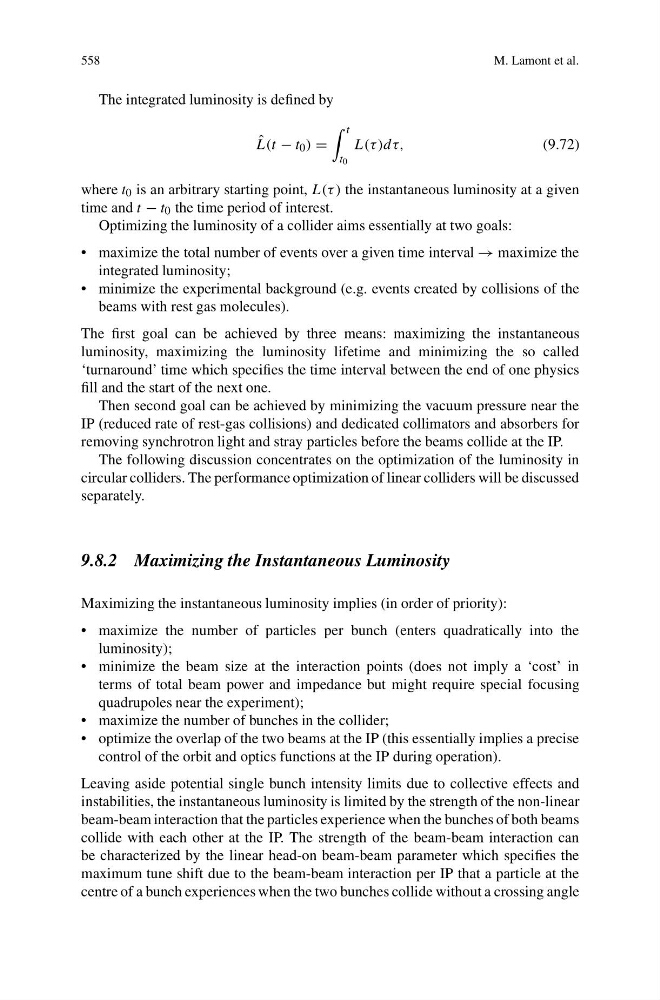
The integrated luminosity is defined by
ˆ
L(t − t 0 ) =
t
t 0
L(τ )dτ,
(9.72)
where t 0 is an arbitrary starting point, L(τ ) the instantaneous luminosity at a given
time and t − t 0 the time period of interest.
Optimizing the luminosity of a collider aims essentially at two goals:
• maximize the total number of events over a given time interval → maximize the
integrated luminosity;
• minimize the experimental background (e.g. events created by collisions of the
beams with rest gas molecules).
The first goal can be achieved by three means: maximizing the instantaneous
luminosity, maximizing the luminosity lifetime and minimizing the so called
‘turnaround’ time which specifies the time interval between the end of one physics
fill and the start of the next one.
Then second goal can be achieved by minimizing the vacuum pressure near the
IP (reduced rate of rest-gas collisions) and dedicated collimators and absorbers for
removing synchrotron light and stray particles before the beams collide at the IP.
The following discussion concentrates on the optimization of the luminosity in
circular colliders. The performance optimization of linear colliders will be discussed
separately.
9.8.2 Maximizing the Instantaneous Luminosity
Maximizing the instantaneous luminosity implies (in order of priority):
• maximize the number of particles per bunch (enters quadratically into the
luminosity);
• minimize the beam size at the interaction points (does not imply a ‘cost’ in
terms of total beam power and impedance but might require special focusing
quadrupoles near the experiment);
• maximize the number of bunches in the collider;
• optimize the overlap of the two beams at the IP (this essentially implies a precise
control of the orbit and optics functions at the IP during operation).
Leaving aside potential single bunch intensity limits due to collective effects and
instabilities, the instantaneous luminosity is limited by the strength of the non-linear
beam-beam interaction that the particles experience when the bunches of both beams
collide with each other at the IP. The strength of the beam-beam interaction can
be characterized by the linear head-on beam-beam parameter which specifies the
maximum tune shift due to the beam-beam interaction per IP that a particle at the
centre of a bunch experiences when the two bunches collide without a crossing angle
M. Lamont et al.
The integrated luminosity is defined by
ˆ
L(t − t 0 ) =
t
t 0
L(τ )dτ,
(9.72)
where t 0 is an arbitrary starting point, L(τ ) the instantaneous luminosity at a given
time and t − t 0 the time period of interest.
Optimizing the luminosity of a collider aims essentially at two goals:
• maximize the total number of events over a given time interval → maximize the
integrated luminosity;
• minimize the experimental background (e.g. events created by collisions of the
beams with rest gas molecules).
The first goal can be achieved by three means: maximizing the instantaneous
luminosity, maximizing the luminosity lifetime and minimizing the so called
‘turnaround’ time which specifies the time interval between the end of one physics
fill and the start of the next one.
Then second goal can be achieved by minimizing the vacuum pressure near the
IP (reduced rate of rest-gas collisions) and dedicated collimators and absorbers for
removing synchrotron light and stray particles before the beams collide at the IP.
The following discussion concentrates on the optimization of the luminosity in
circular colliders. The performance optimization of linear colliders will be discussed
separately.
9.8.2 Maximizing the Instantaneous Luminosity
Maximizing the instantaneous luminosity implies (in order of priority):
• maximize the number of particles per bunch (enters quadratically into the
luminosity);
• minimize the beam size at the interaction points (does not imply a ‘cost’ in
terms of total beam power and impedance but might require special focusing
quadrupoles near the experiment);
• maximize the number of bunches in the collider;
• optimize the overlap of the two beams at the IP (this essentially implies a precise
control of the orbit and optics functions at the IP during operation).
Leaving aside potential single bunch intensity limits due to collective effects and
instabilities, the instantaneous luminosity is limited by the strength of the non-linear
beam-beam interaction that the particles experience when the bunches of both beams
collide with each other at the IP. The strength of the beam-beam interaction can
be characterized by the linear head-on beam-beam parameter which specifies the
maximum tune shift due to the beam-beam interaction per IP that a particle at the
centre of a bunch experiences when the two bunches collide without a crossing angle