

9 Accelerator Operations
559
and transverse offset. The beam-beam parameter is given by
ξ x,y =
N b · r p · β ∗
x,y
2π · γ · σ x,y · (σ x + σ y )
,
(9.73)
where β ∗
x,y are the horizontal and vertical beta functions at the IP and r p is the
classical radius r p = e 2 /(4ππ 0 mc 2 ) for the colliding particles.
It is worthwhile underlining that for round beams with equal beam emittances in
both planes the beam-beam force is independent of the transverse beta-functions at
the IP and depends only on the normalized beam emittance. For such round beams
the beam-beam parameter can be written
ξ =
N b r p
4ππγ
,
(9.74)
where γ is the normalized emittance n in a Hadron storage ring.
The beam-beam force provides additional focusing for colliders with beams of
opposite charge (e.g. particle anti-particle colliders like LEP) and an additional
defocusing strength for beam collisions between particles of the same charge (e.g.
particle-particle colliders like the LHC). In either case, the non-linear beam-beam
force generates an amplitude growth of the particle oscillations within a bunch
which eventually limits the maximum collider performance.
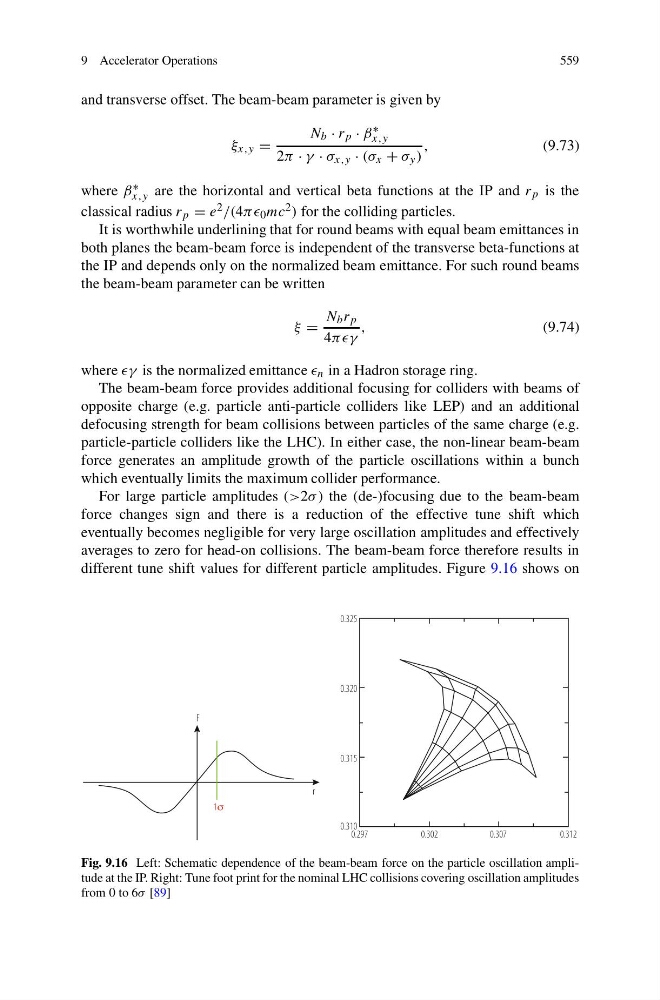
For large particle amplitudes (>2σ ) the (de-)focusing due to the beam-beam
force changes sign and there is a reduction of the effective tune shift which
eventually becomes negligible for very large oscillation amplitudes and effectively
averages to zero for head-on collisions. The beam-beam force therefore results in
different tune shift values for different particle amplitudes. Figure 9.16 shows on
F
r
1
0.325
0.320
0.315
0.310
0.297
0.302
0.307
0.312
Fig. 9.16 Left: Schematic dependence of the beam-beam force on the particle oscillation amplitude at the IP. Right: Tune foot print for the nominal LHC collisions covering oscillation amplitudes
from 0 to 6σ [89]
559
and transverse offset. The beam-beam parameter is given by
ξ x,y =
N b · r p · β ∗
x,y
2π · γ · σ x,y · (σ x + σ y )
,
(9.73)
where β ∗
x,y are the horizontal and vertical beta functions at the IP and r p is the
classical radius r p = e 2 /(4ππ 0 mc 2 ) for the colliding particles.
It is worthwhile underlining that for round beams with equal beam emittances in
both planes the beam-beam force is independent of the transverse beta-functions at
the IP and depends only on the normalized beam emittance. For such round beams
the beam-beam parameter can be written
ξ =
N b r p
4ππγ
,
(9.74)
where γ is the normalized emittance n in a Hadron storage ring.
The beam-beam force provides additional focusing for colliders with beams of
opposite charge (e.g. particle anti-particle colliders like LEP) and an additional
defocusing strength for beam collisions between particles of the same charge (e.g.
particle-particle colliders like the LHC). In either case, the non-linear beam-beam
force generates an amplitude growth of the particle oscillations within a bunch
which eventually limits the maximum collider performance.
For large particle amplitudes (>2σ ) the (de-)focusing due to the beam-beam
force changes sign and there is a reduction of the effective tune shift which
eventually becomes negligible for very large oscillation amplitudes and effectively
averages to zero for head-on collisions. The beam-beam force therefore results in
different tune shift values for different particle amplitudes. Figure 9.16 shows on
F
r
1
0.325
0.320
0.315
0.310
0.297
0.302
0.307
0.312
Fig. 9.16 Left: Schematic dependence of the beam-beam force on the particle oscillation amplitude at the IP. Right: Tune foot print for the nominal LHC collisions covering oscillation amplitudes
from 0 to 6σ [89]