

9 Accelerator Operations
557
9.8 Luminosity Optimization
O. Brüning and M. Hostettler
9.8.1 Introduction
The performance of a collider can be characterized by three main parameters:
• the centre of mass collision energy E CM (in the following we will assume two
beams with equal beam energies → E CM = 2 · E beam );
• the instantaneous luminosity specifying the rate at which certain events are
generated in the beam collisions (number of events per second = L(t) · σ event
with σ event being the cross section of the event of interest);
• the integrated luminosity specifying the total number of events that are produced
over a time interval t − t 0 .
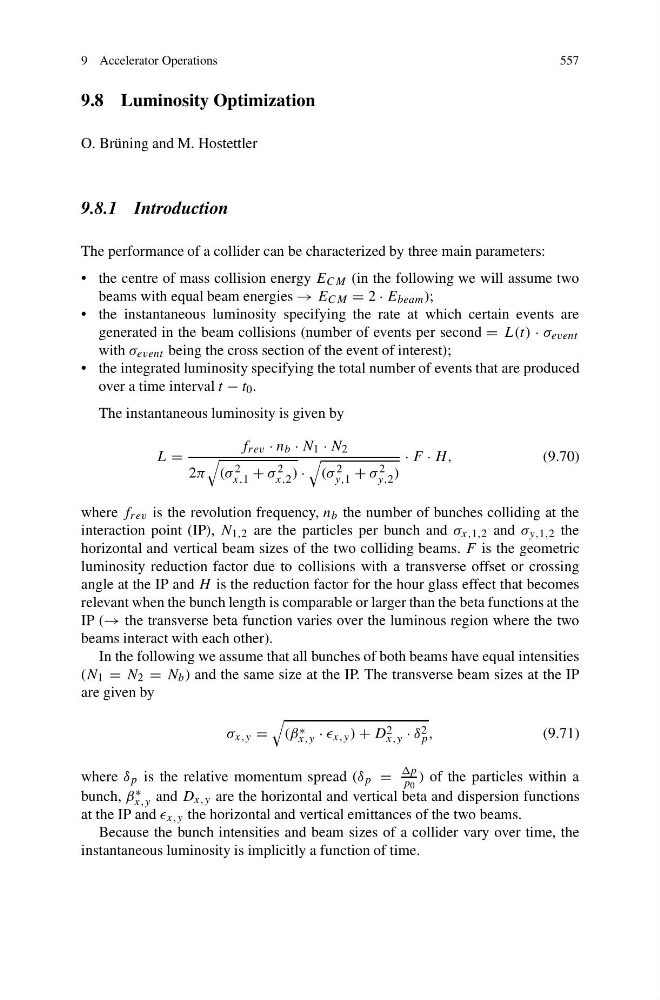
The instantaneous luminosity is given by
L =
f rev · n b · N 1 · N 2
2π
(σ 2
x,1 + σ 2
x,2 ) ·
(σ 2
y,1 + σ 2
y,2 )
· F · H,
(9.70)
where f rev is the revolution frequency, n b the number of bunches colliding at the
interaction point (IP), N 1,2 are the particles per bunch and σ x,1,2 and σ y,1,2 the
horizontal and vertical beam sizes of the two colliding beams. F is the geometric
luminosity reduction factor due to collisions with a transverse offset or crossing
angle at the IP and H is the reduction factor for the hour glass effect that becomes
relevant when the bunch length is comparable or larger than the beta functions at the
IP (→ the transverse beta function varies over the luminous region where the two
beams interact with each other).
In the following we assume that all bunches of both beams have equal intensities
(N 1 = N 2 = N b ) and the same size at the IP. The transverse beam sizes at the IP
are given by
σ x,y =
(β ∗
x,y · x,y ) + D 2
x,y · δ 2
p ,
(9.71)
where δ p is the relative momentum spread (δ p =
p
p 0
) of the particles within a
bunch, β ∗
x,y and D x,y are the horizontal and vertical beta and dispersion functions
at the IP and x,y the horizontal and vertical emittances of the two beams.
Because the bunch intensities and beam sizes of a collider vary over time, the
instantaneous luminosity is implicitly a function of time.
557
9.8 Luminosity Optimization
O. Brüning and M. Hostettler
9.8.1 Introduction
The performance of a collider can be characterized by three main parameters:
• the centre of mass collision energy E CM (in the following we will assume two
beams with equal beam energies → E CM = 2 · E beam );
• the instantaneous luminosity specifying the rate at which certain events are
generated in the beam collisions (number of events per second = L(t) · σ event
with σ event being the cross section of the event of interest);
• the integrated luminosity specifying the total number of events that are produced
over a time interval t − t 0 .
The instantaneous luminosity is given by
L =
f rev · n b · N 1 · N 2
2π
(σ 2
x,1 + σ 2
x,2 ) ·
(σ 2
y,1 + σ 2
y,2 )
· F · H,
(9.70)
where f rev is the revolution frequency, n b the number of bunches colliding at the
interaction point (IP), N 1,2 are the particles per bunch and σ x,1,2 and σ y,1,2 the
horizontal and vertical beam sizes of the two colliding beams. F is the geometric
luminosity reduction factor due to collisions with a transverse offset or crossing
angle at the IP and H is the reduction factor for the hour glass effect that becomes
relevant when the bunch length is comparable or larger than the beta functions at the
IP (→ the transverse beta function varies over the luminous region where the two
beams interact with each other).
In the following we assume that all bunches of both beams have equal intensities
(N 1 = N 2 = N b ) and the same size at the IP. The transverse beam sizes at the IP
are given by
σ x,y =
(β ∗
x,y · x,y ) + D 2
x,y · δ 2
p ,
(9.71)
where δ p is the relative momentum spread (δ p =
p
p 0
) of the particles within a
bunch, β ∗
x,y and D x,y are the horizontal and vertical beta and dispersion functions
at the IP and x,y the horizontal and vertical emittances of the two beams.
Because the bunch intensities and beam sizes of a collider vary over time, the
instantaneous luminosity is implicitly a function of time.