

556
M. Lamont et al.
Relative loss measurement
0.0001
0.001
1e-05
1e-06
1e-07
1e-08
0.01
0.1
1
0
5000
10000
Longitudinal ring position [m]
15000
20000
25000
IR2
IR4
IR5
IR8
IR1
Momentrum-cleaning
Dump protection
Betatron cleaning
Beam
Super-conducting regions
Collimators
Room temperature regions
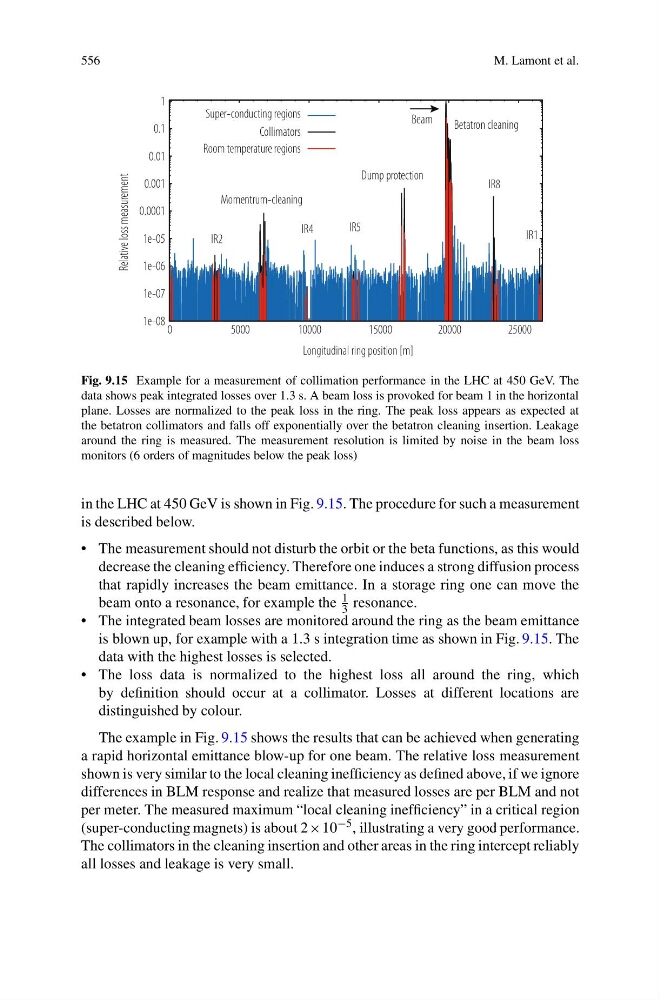
Fig. 9.15 Example for a measurement of collimation performance in the LHC at 450 GeV. The
data shows peak integrated losses over 1.3 s. A beam loss is provoked for beam 1 in the horizontal
plane. Losses are normalized to the peak loss in the ring. The peak loss appears as expected at
the betatron collimators and falls off exponentially over the betatron cleaning insertion. Leakage
around the ring is measured. The measurement resolution is limited by noise in the beam loss
monitors (6 orders of magnitudes below the peak loss)
in the LHC at 450 GeV is shown in Fig. 9.15. The procedure for such a measurement
is described below.
• The measurement should not disturb the orbit or the beta functions, as this would
decrease the cleaning efficiency. Therefore one induces a strong diffusion process
that rapidly increases the beam emittance. In a storage ring one can move the
beam onto a resonance, for example the
1
3 resonance.
• The integrated beam losses are monitored around the ring as the beam emittance
is blown up, for example with a 1.3 s integration time as shown in Fig. 9.15. The
data with the highest losses is selected.
• The loss data is normalized to the highest loss all around the ring, which
by definition should occur at a collimator. Losses at different locations are
distinguished by colour.
The example in Fig. 9.15 shows the results that can be achieved when generating
a rapid horizontal emittance blow-up for one beam. The relative loss measurement
shown is very similar to the local cleaning inefficiency as defined above, if we ignore
differences in BLM response and realize that measured losses are per BLM and not
per meter. The measured maximum “local cleaning inefficiency” in a critical region
(super-conducting magnets) is about 2×10 −5 , illustrating a very good performance.
The collimators in the cleaning insertion and other areas in the ring intercept reliably
all losses and leakage is very small.
M. Lamont et al.
Relative loss measurement
0.0001
0.001
1e-05
1e-06
1e-07
1e-08
0.01
0.1
1
0
5000
10000
Longitudinal ring position [m]
15000
20000
25000
IR2
IR4
IR5
IR8
IR1
Momentrum-cleaning
Dump protection
Betatron cleaning
Beam
Super-conducting regions
Collimators
Room temperature regions
Fig. 9.15 Example for a measurement of collimation performance in the LHC at 450 GeV. The
data shows peak integrated losses over 1.3 s. A beam loss is provoked for beam 1 in the horizontal
plane. Losses are normalized to the peak loss in the ring. The peak loss appears as expected at
the betatron collimators and falls off exponentially over the betatron cleaning insertion. Leakage
around the ring is measured. The measurement resolution is limited by noise in the beam loss
monitors (6 orders of magnitudes below the peak loss)
in the LHC at 450 GeV is shown in Fig. 9.15. The procedure for such a measurement
is described below.
• The measurement should not disturb the orbit or the beta functions, as this would
decrease the cleaning efficiency. Therefore one induces a strong diffusion process
that rapidly increases the beam emittance. In a storage ring one can move the
beam onto a resonance, for example the
1
3 resonance.
• The integrated beam losses are monitored around the ring as the beam emittance
is blown up, for example with a 1.3 s integration time as shown in Fig. 9.15. The
data with the highest losses is selected.
• The loss data is normalized to the highest loss all around the ring, which
by definition should occur at a collimator. Losses at different locations are
distinguished by colour.
The example in Fig. 9.15 shows the results that can be achieved when generating
a rapid horizontal emittance blow-up for one beam. The relative loss measurement
shown is very similar to the local cleaning inefficiency as defined above, if we ignore
differences in BLM response and realize that measured losses are per BLM and not
per meter. The measured maximum “local cleaning inefficiency” in a critical region
(super-conducting magnets) is about 2×10 −5 , illustrating a very good performance.
The collimators in the cleaning insertion and other areas in the ring intercept reliably
all losses and leakage is very small.