

9 Accelerator Operations
555
BLM
BLM
BLM
BLM
COLL
COLL
COLL
COLL
beam & halo
BLM
BLM
BLM
BLM
COLL
COLL
COLL
COLL
beam & halo
BLM
BLM
BLM
BLM
COLL
COLL
COLL
COLL
beam & halo
I)
II)
III)
1
x = n –2
x = n 1 –
x = n 1
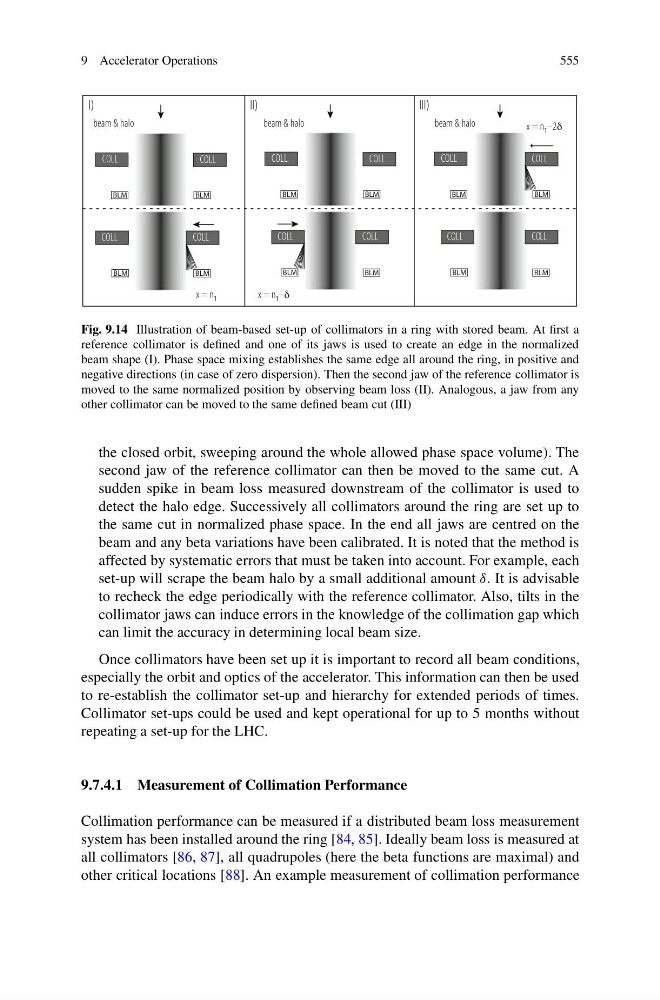
Fig. 9.14 Illustration of beam-based set-up of collimators in a ring with stored beam. At first a
reference collimator is defined and one of its jaws is used to create an edge in the normalized
beam shape (I). Phase space mixing establishes the same edge all around the ring, in positive and
negative directions (in case of zero dispersion). Then the second jaw of the reference collimator is
moved to the same normalized position by observing beam loss (II). Analogous, a jaw from any
other collimator can be moved to the same defined beam cut (III)
the closed orbit, sweeping around the whole allowed phase space volume). The
second jaw of the reference collimator can then be moved to the same cut. A
sudden spike in beam loss measured downstream of the collimator is used to
detect the halo edge. Successively all collimators around the ring are set up to
the same cut in normalized phase space. In the end all jaws are centred on the
beam and any beta variations have been calibrated. It is noted that the method is
affected by systematic errors that must be taken into account. For example, each
set-up will scrape the beam halo by a small additional amount δ. It is advisable
to recheck the edge periodically with the reference collimator. Also, tilts in the
collimator jaws can induce errors in the knowledge of the collimation gap which
can limit the accuracy in determining local beam size.
Once collimators have been set up it is important to record all beam conditions,
especially the orbit and optics of the accelerator. This information can then be used
to re-establish the collimator set-up and hierarchy for extended periods of times.
Collimator set-ups could be used and kept operational for up to 5 months without
repeating a set-up for the LHC.
9.7.4.1 Measurement of Collimation Performance
Collimation performance can be measured if a distributed beam loss measurement
system has been installed around the ring [84, 85]. Ideally beam loss is measured at
all collimators [86, 87], all quadrupoles (here the beta functions are maximal) and
other critical locations [88]. An example measurement of collimation performance
555
BLM
BLM
BLM
BLM
COLL
COLL
COLL
COLL
beam & halo
BLM
BLM
BLM
BLM
COLL
COLL
COLL
COLL
beam & halo
BLM
BLM
BLM
BLM
COLL
COLL
COLL
COLL
beam & halo
I)
II)
III)
1
x = n –2
x = n 1 –
x = n 1
Fig. 9.14 Illustration of beam-based set-up of collimators in a ring with stored beam. At first a
reference collimator is defined and one of its jaws is used to create an edge in the normalized
beam shape (I). Phase space mixing establishes the same edge all around the ring, in positive and
negative directions (in case of zero dispersion). Then the second jaw of the reference collimator is
moved to the same normalized position by observing beam loss (II). Analogous, a jaw from any
other collimator can be moved to the same defined beam cut (III)
the closed orbit, sweeping around the whole allowed phase space volume). The
second jaw of the reference collimator can then be moved to the same cut. A
sudden spike in beam loss measured downstream of the collimator is used to
detect the halo edge. Successively all collimators around the ring are set up to
the same cut in normalized phase space. In the end all jaws are centred on the
beam and any beta variations have been calibrated. It is noted that the method is
affected by systematic errors that must be taken into account. For example, each
set-up will scrape the beam halo by a small additional amount δ. It is advisable
to recheck the edge periodically with the reference collimator. Also, tilts in the
collimator jaws can induce errors in the knowledge of the collimation gap which
can limit the accuracy in determining local beam size.
Once collimators have been set up it is important to record all beam conditions,
especially the orbit and optics of the accelerator. This information can then be used
to re-establish the collimator set-up and hierarchy for extended periods of times.
Collimator set-ups could be used and kept operational for up to 5 months without
repeating a set-up for the LHC.
9.7.4.1 Measurement of Collimation Performance
Collimation performance can be measured if a distributed beam loss measurement
system has been installed around the ring [84, 85]. Ideally beam loss is measured at
all collimators [86, 87], all quadrupoles (here the beta functions are maximal) and
other critical locations [88]. An example measurement of collimation performance