

9 Accelerator Operations
553
The retraction values can become quite small. For example, in LHC at 7 TeV
retraction values can be smaller than 1 σ z . At the same time emittance at high energy
becomes very small (0.5 nm for the LHC at 7 TeV) and the transverse beam size σ z
can be as small as 140 μm. The smallest collimator retraction values can therefore
be in the range of 100 μm, imposing strict operational tolerances.
Various imperfections can reduce the available collimator retraction [78]:
• Beam loss deposits energy on the collimator jaws. The resulting heating can lead
to transient jaw deformations.
• If off-momentum beta beating is not or insufficiently corrected, the retraction
becomes a function of particle momentum and can be different for particles inside
a bunch. See discussion in [74].
• Inaccuracies in beam-based set-up for collimators in different families. See
discussion in next section.
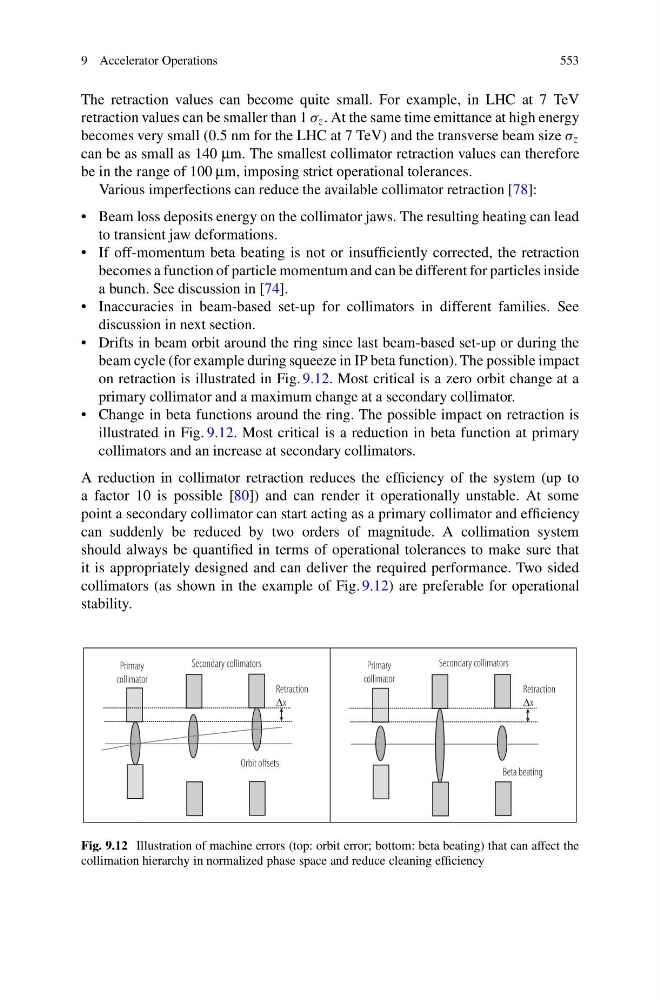
• Drifts in beam orbit around the ring since last beam-based set-up or during the
beam cycle (for example during squeeze in IP beta function). The possible impact
on retraction is illustrated in Fig. 9.12. Most critical is a zero orbit change at a
primary collimator and a maximum change at a secondary collimator.
• Change in beta functions around the ring. The possible impact on retraction is
illustrated in Fig. 9.12. Most critical is a reduction in beta function at primary
collimators and an increase at secondary collimators.
A reduction in collimator retraction reduces the efficiency of the system (up to
a factor 10 is possible [80]) and can render it operationally unstable. At some
point a secondary collimator can start acting as a primary collimator and efficiency
can suddenly be reduced by two orders of magnitude. A collimation system
should always be quantified in terms of operational tolerances to make sure that
it is appropriately designed and can deliver the required performance. Two sided
collimators (as shown in the example of Fig. 9.12) are preferable for operational
stability.
Primary
collimator
Secondary collimators
Orbit offsets
Beta beating
Retraction
x
Primary
collimator
Secondary collimators
Retraction
x
Fig. 9.12 Illustration of machine errors (top: orbit error; bottom: beta beating) that can affect the
collimation hierarchy in normalized phase space and reduce cleaning efficiency
553
The retraction values can become quite small. For example, in LHC at 7 TeV
retraction values can be smaller than 1 σ z . At the same time emittance at high energy
becomes very small (0.5 nm for the LHC at 7 TeV) and the transverse beam size σ z
can be as small as 140 μm. The smallest collimator retraction values can therefore
be in the range of 100 μm, imposing strict operational tolerances.
Various imperfections can reduce the available collimator retraction [78]:
• Beam loss deposits energy on the collimator jaws. The resulting heating can lead
to transient jaw deformations.
• If off-momentum beta beating is not or insufficiently corrected, the retraction
becomes a function of particle momentum and can be different for particles inside
a bunch. See discussion in [74].
• Inaccuracies in beam-based set-up for collimators in different families. See
discussion in next section.
• Drifts in beam orbit around the ring since last beam-based set-up or during the
beam cycle (for example during squeeze in IP beta function). The possible impact
on retraction is illustrated in Fig. 9.12. Most critical is a zero orbit change at a
primary collimator and a maximum change at a secondary collimator.
• Change in beta functions around the ring. The possible impact on retraction is
illustrated in Fig. 9.12. Most critical is a reduction in beta function at primary
collimators and an increase at secondary collimators.
A reduction in collimator retraction reduces the efficiency of the system (up to
a factor 10 is possible [80]) and can render it operationally unstable. At some
point a secondary collimator can start acting as a primary collimator and efficiency
can suddenly be reduced by two orders of magnitude. A collimation system
should always be quantified in terms of operational tolerances to make sure that
it is appropriately designed and can deliver the required performance. Two sided
collimators (as shown in the example of Fig. 9.12) are preferable for operational
stability.
Primary
collimator
Secondary collimators
Orbit offsets
Beta beating
Retraction
x
Primary
collimator
Secondary collimators
Retraction
x
Fig. 9.12 Illustration of machine errors (top: orbit error; bottom: beta beating) that can affect the
collimation hierarchy in normalized phase space and reduce cleaning efficiency