

552
M. Lamont et al.
9.7.3 Operational Settings and Tolerances
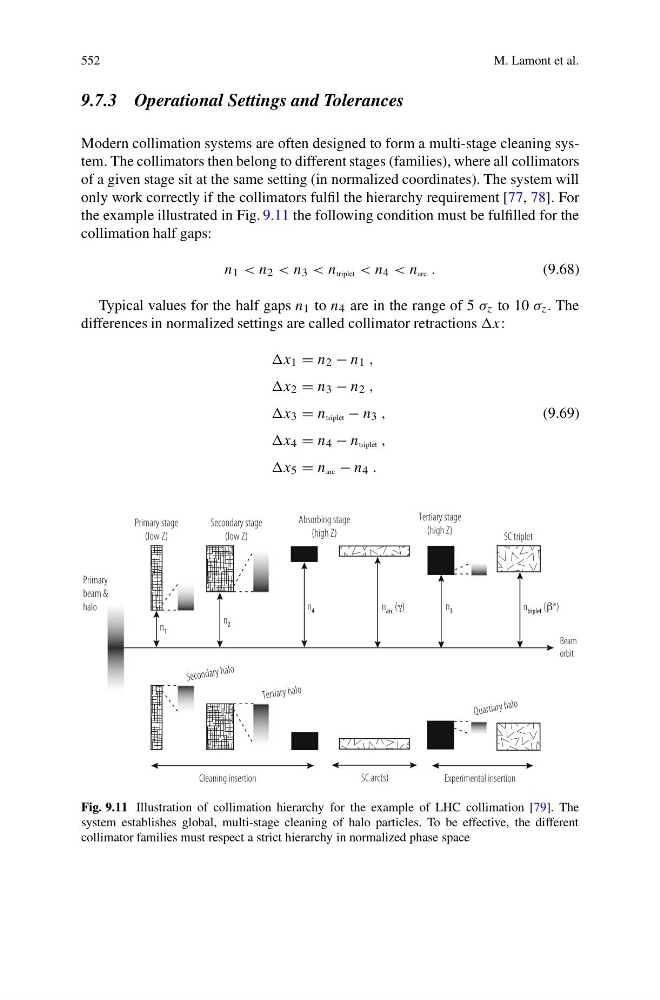
Modern collimation systems are often designed to form a multi-stage cleaning system. The collimators then belong to different stages (families), where all collimators
of a given stage sit at the same setting (in normalized coordinates). The system will
only work correctly if the collimators fulfil the hierarchy requirement [77, 78]. For
the example illustrated in Fig. 9.11 the following condition must be fulfilled for the
collimation half gaps:
n 1 < n 2 < n 3 < n triplet < n 4 < n arc .
(9.68)
Typical values for the half gaps n 1 to n 4 are in the range of 5 σ z to 10 σ z . The
differences in normalized settings are called collimator retractions x:
x 1 = n 2 − n 1 ,
x 2 = n 3 − n 2 ,
x 3 = n triplet − n 3 ,
(9.69)
x 4 = n 4 − n triplet ,
x 5 = n arc − n 4 .
Primary stage
(low Z)
Secondary stage
(low Z)
Absorbing stage
(high Z)
Tertiary stage
(high Z)
SC triplet
n 3
n 4
n 2
n 1
Primary
beam &
halo
Sec ond ary hal o
Ter tiar y hal o
Cleaning insertion
Experimental insertion
Qu art iar y hal o
SC arc(s)
Beam
orbit
n triplet ( *)
n arc ( )
Fig. 9.11 Illustration of collimation hierarchy for the example of LHC collimation [79]. The
system establishes global, multi-stage cleaning of halo particles. To be effective, the different
collimator families must respect a strict hierarchy in normalized phase space
M. Lamont et al.
9.7.3 Operational Settings and Tolerances
Modern collimation systems are often designed to form a multi-stage cleaning system. The collimators then belong to different stages (families), where all collimators
of a given stage sit at the same setting (in normalized coordinates). The system will
only work correctly if the collimators fulfil the hierarchy requirement [77, 78]. For
the example illustrated in Fig. 9.11 the following condition must be fulfilled for the
collimation half gaps:
n 1 < n 2 < n 3 < n triplet < n 4 < n arc .
(9.68)
Typical values for the half gaps n 1 to n 4 are in the range of 5 σ z to 10 σ z . The
differences in normalized settings are called collimator retractions x:
x 1 = n 2 − n 1 ,
x 2 = n 3 − n 2 ,
x 3 = n triplet − n 3 ,
(9.69)
x 4 = n 4 − n triplet ,
x 5 = n arc − n 4 .
Primary stage
(low Z)
Secondary stage
(low Z)
Absorbing stage
(high Z)
Tertiary stage
(high Z)
SC triplet
n 3
n 4
n 2
n 1
Primary
beam &
halo
Sec ond ary hal o
Ter tiar y hal o
Cleaning insertion
Experimental insertion
Qu art iar y hal o
SC arc(s)
Beam
orbit
n triplet ( *)
n arc ( )
Fig. 9.11 Illustration of collimation hierarchy for the example of LHC collimation [79]. The
system establishes global, multi-stage cleaning of halo particles. To be effective, the different
collimator families must respect a strict hierarchy in normalized phase space