

546
M. Lamont et al.
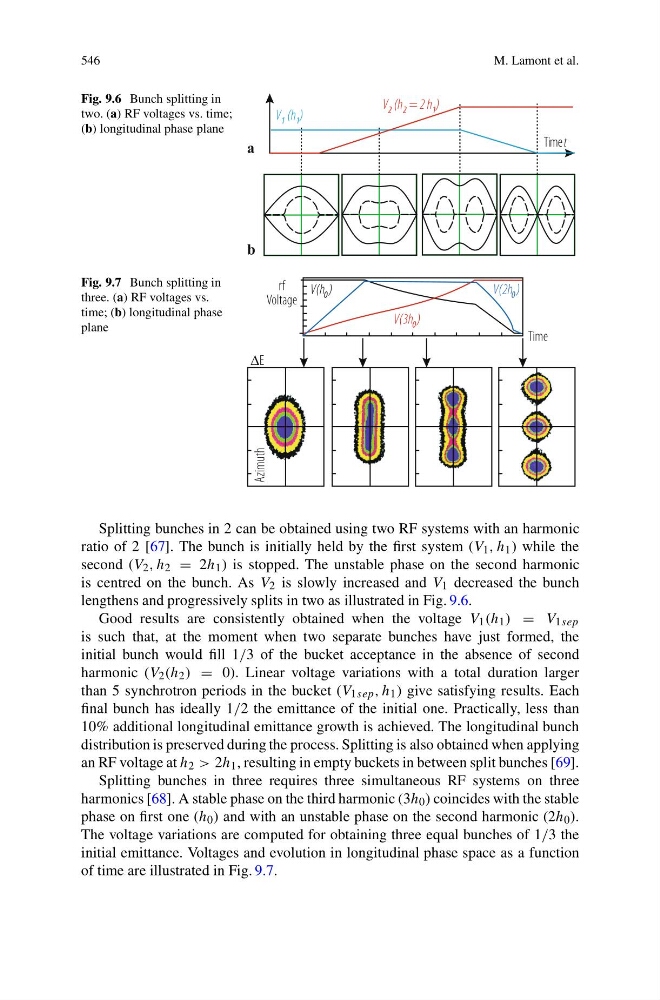
Fig. 9.6 Bunch splitting in
two. (a) RF voltages vs. time;
(b) longitudinal phase plane
V 1 (h 1 )
V 2 (h 2 = 2 h 1 )
Time t
a
b
Fig. 9.7 Bunch splitting in
three. (a) RF voltages vs.
time; (b) longitudinal phase
plane
rf
Voltage
E
Time
Azimuth
V(h 0 )
V(2h 0 )
V(3h 0 )
Splitting bunches in 2 can be obtained using two RF systems with an harmonic
ratio of 2 [67]. The bunch is initially held by the first system (V 1 , h 1 ) while the
second (V 2 , h 2 = 2h 1 ) is stopped. The unstable phase on the second harmonic
is centred on the bunch. As V 2 is slowly increased and V 1 decreased the bunch
lengthens and progressively splits in two as illustrated in Fig. 9.6.
Good results are consistently obtained when the voltage V 1 (h 1 ) = V 1sep
is such that, at the moment when two separate bunches have just formed, the
initial bunch would fill 1/3 of the bucket acceptance in the absence of second
harmonic (V 2 (h 2 ) = 0). Linear voltage variations with a total duration larger
than 5 synchrotron periods in the bucket (V 1sep , h 1 ) give satisfying results. Each
final bunch has ideally 1/2 the emittance of the initial one. Practically, less than
10% additional longitudinal emittance growth is achieved. The longitudinal bunch
distribution is preserved during the process. Splitting is also obtained when applying
an RF voltage at h 2 > 2h 1 , resulting in empty buckets in between split bunches [69].
Splitting bunches in three requires three simultaneous RF systems on three
harmonics [68]. A stable phase on the third harmonic (3h 0 ) coincides with the stable
phase on first one (h 0 ) and with an unstable phase on the second harmonic (2h 0 ).
The voltage variations are computed for obtaining three equal bunches of 1/3 the
initial emittance. Voltages and evolution in longitudinal phase space as a function
of time are illustrated in Fig. 9.7.
M. Lamont et al.
Fig. 9.6 Bunch splitting in
two. (a) RF voltages vs. time;
(b) longitudinal phase plane
V 1 (h 1 )
V 2 (h 2 = 2 h 1 )
Time t
a
b
Fig. 9.7 Bunch splitting in
three. (a) RF voltages vs.
time; (b) longitudinal phase
plane
rf
Voltage
E
Time
Azimuth
V(h 0 )
V(2h 0 )
V(3h 0 )
Splitting bunches in 2 can be obtained using two RF systems with an harmonic
ratio of 2 [67]. The bunch is initially held by the first system (V 1 , h 1 ) while the
second (V 2 , h 2 = 2h 1 ) is stopped. The unstable phase on the second harmonic
is centred on the bunch. As V 2 is slowly increased and V 1 decreased the bunch
lengthens and progressively splits in two as illustrated in Fig. 9.6.
Good results are consistently obtained when the voltage V 1 (h 1 ) = V 1sep
is such that, at the moment when two separate bunches have just formed, the
initial bunch would fill 1/3 of the bucket acceptance in the absence of second
harmonic (V 2 (h 2 ) = 0). Linear voltage variations with a total duration larger
than 5 synchrotron periods in the bucket (V 1sep , h 1 ) give satisfying results. Each
final bunch has ideally 1/2 the emittance of the initial one. Practically, less than
10% additional longitudinal emittance growth is achieved. The longitudinal bunch
distribution is preserved during the process. Splitting is also obtained when applying
an RF voltage at h 2 > 2h 1 , resulting in empty buckets in between split bunches [69].
Splitting bunches in three requires three simultaneous RF systems on three
harmonics [68]. A stable phase on the third harmonic (3h 0 ) coincides with the stable
phase on first one (h 0 ) and with an unstable phase on the second harmonic (2h 0 ).
The voltage variations are computed for obtaining three equal bunches of 1/3 the
initial emittance. Voltages and evolution in longitudinal phase space as a function
of time are illustrated in Fig. 9.7.