

9 Accelerator Operations
545
9.6.5 Changing the Bunch Train
9.6.5.1 Iso-Adiabatic Rebunching (Debunching)
The simplest technique for bunching a continuous beam (e.g. a beam from a linac
after it has debunched because of its energy spread) with a minimum emittance
blow-up consists of applying an iso-adiabatic increase. With ω s ∝ V 1/2 (Eq. (9.52))
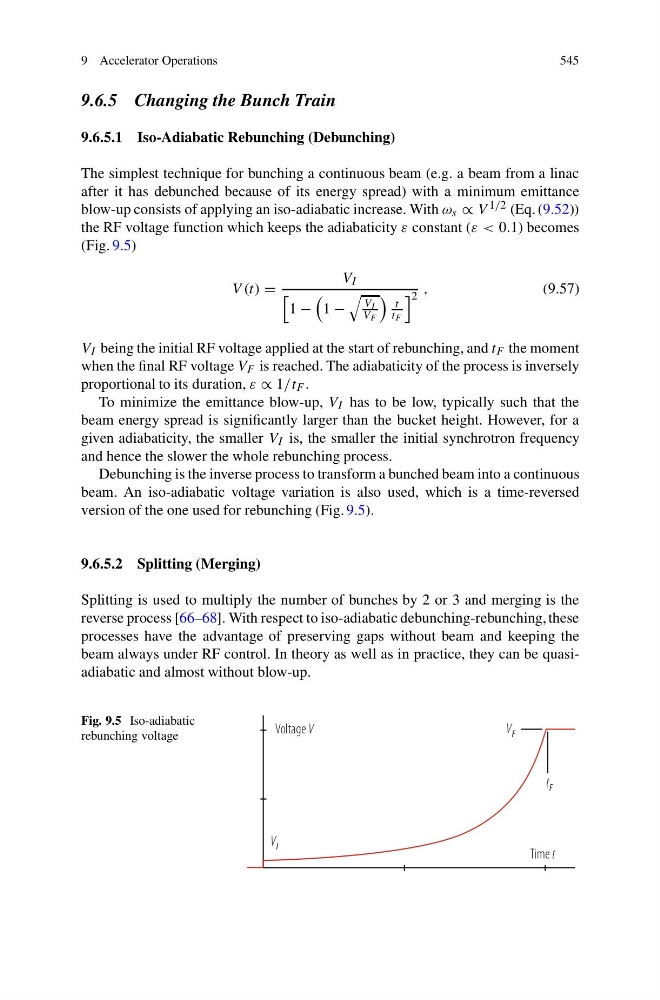
the RF voltage function which keeps the adiabaticity ε constant (ε < 0.1) becomes
(Fig. 9.5)
V (t) =
V I
1 −
1 −
V I
V F
t
t F
2 ,
(9.57)
V I being the initial RF voltage applied at the start of rebunching, and t F the moment
when the final RF voltage V F is reached. The adiabaticity of the process is inversely
proportional to its duration, ε ∝ 1/t F .
To minimize the emittance blow-up, V I has to be low, typically such that the
beam energy spread is significantly larger than the bucket height. However, for a
given adiabaticity, the smaller V I is, the smaller the initial synchrotron frequency
and hence the slower the whole rebunching process.
Debunching is the inverse process to transform a bunched beam into a continuous
beam. An iso-adiabatic voltage variation is also used, which is a time-reversed
version of the one used for rebunching (Fig. 9.5).
9.6.5.2 Splitting (Merging)
Splitting is used to multiply the number of bunches by 2 or 3 and merging is the
reverse process [66–68]. With respect to iso-adiabatic debunching-rebunching, these
processes have the advantage of preserving gaps without beam and keeping the
beam always under RF control. In theory as well as in practice, they can be quasiadiabatic and almost without blow-up.
Fig. 9.5 Iso-adiabatic
rebunching voltage
Voltage V
Time t
t F
V F
V I
545
9.6.5 Changing the Bunch Train
9.6.5.1 Iso-Adiabatic Rebunching (Debunching)
The simplest technique for bunching a continuous beam (e.g. a beam from a linac
after it has debunched because of its energy spread) with a minimum emittance
blow-up consists of applying an iso-adiabatic increase. With ω s ∝ V 1/2 (Eq. (9.52))
the RF voltage function which keeps the adiabaticity ε constant (ε < 0.1) becomes
(Fig. 9.5)
V (t) =
V I
1 −
1 −
V I
V F
t
t F
2 ,
(9.57)
V I being the initial RF voltage applied at the start of rebunching, and t F the moment
when the final RF voltage V F is reached. The adiabaticity of the process is inversely
proportional to its duration, ε ∝ 1/t F .
To minimize the emittance blow-up, V I has to be low, typically such that the
beam energy spread is significantly larger than the bucket height. However, for a
given adiabaticity, the smaller V I is, the smaller the initial synchrotron frequency
and hence the slower the whole rebunching process.
Debunching is the inverse process to transform a bunched beam into a continuous
beam. An iso-adiabatic voltage variation is also used, which is a time-reversed
version of the one used for rebunching (Fig. 9.5).
9.6.5.2 Splitting (Merging)
Splitting is used to multiply the number of bunches by 2 or 3 and merging is the
reverse process [66–68]. With respect to iso-adiabatic debunching-rebunching, these
processes have the advantage of preserving gaps without beam and keeping the
beam always under RF control. In theory as well as in practice, they can be quasiadiabatic and almost without blow-up.
Fig. 9.5 Iso-adiabatic
rebunching voltage
Voltage V
Time t
t F
V F
V I