

544
M. Lamont et al.
Because the focusing voltage is sinusoidal, the rotated bunch has a marked Sshape if, at any moment during the process, its length has exceeded 1/3 of
an RF period. If very short bunches have to be obtained, the maximum tolerable
length is even smaller [53]. More sophisticated techniques making use of multiple
RF harmonics have been developed to improve the results [58].
To avoid the step increase in RF voltage, a phase jump by π of the RF voltage
can be applied instead [59]. The bunch is stretched at the unstable point between
two buckets (Fig. 9.4b). Switching the RF voltage back to its initial phase triggers
the rotation in the longitudinal phase plane.
9.6.4 Longitudinal Controlled Blow-Up
Increasing the longitudinal emittance is a convenient mitigation means against
instabilities by keeping the beam below threshold. Such a blow-up should not
generate tails in the distribution of particles. The most efficient and fast technique
makes use of a phase-modulated high frequency (V H , h H ) superimposed to the RF
holding the beam (h rf h H ) [60, 61]:
V H = ˆ
V H sin(h H ω R t + α sin ω M t + ϑ H ) ,
(9.56)
α being the peak phase modulation, ω R the modulation frequency and ϑ H a phase
constant. This high frequency phase-modulated voltage perturbs motion in the
longitudinal phase plane. Resonances can be induced which create a re-distribution
of density in the bunch. Parameters are in practice determined with computer
simulations and finely adjusted on the real accelerator. Typical ranges of values are
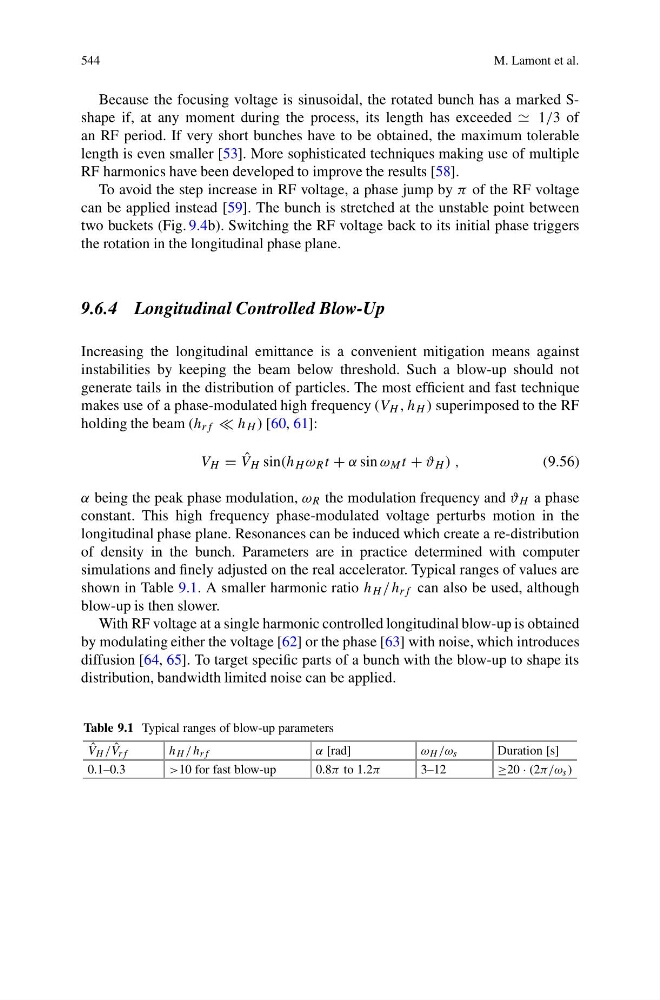
shown in Table 9.1. A smaller harmonic ratio h H /h rf can also be used, although
blow-up is then slower.
With RF voltage at a single harmonic controlled longitudinal blow-up is obtained
by modulating either the voltage [62] or the phase [63] with noise, which introduces
diffusion [64, 65]. To target specific parts of a bunch with the blow-up to shape its
distribution, bandwidth limited noise can be applied.
Table 9.1 Typical ranges of blow-up parameters
ˆ
V H / ˆ
V rf
h H /h rf
α [rad]
ω H /ω s
Duration [s]
0.1–0.3
>10 for fast blow-up
0.8π to 1.2π
3–12
≥20 · (2π/ω s )
M. Lamont et al.
Because the focusing voltage is sinusoidal, the rotated bunch has a marked Sshape if, at any moment during the process, its length has exceeded 1/3 of
an RF period. If very short bunches have to be obtained, the maximum tolerable
length is even smaller [53]. More sophisticated techniques making use of multiple
RF harmonics have been developed to improve the results [58].
To avoid the step increase in RF voltage, a phase jump by π of the RF voltage
can be applied instead [59]. The bunch is stretched at the unstable point between
two buckets (Fig. 9.4b). Switching the RF voltage back to its initial phase triggers
the rotation in the longitudinal phase plane.
9.6.4 Longitudinal Controlled Blow-Up
Increasing the longitudinal emittance is a convenient mitigation means against
instabilities by keeping the beam below threshold. Such a blow-up should not
generate tails in the distribution of particles. The most efficient and fast technique
makes use of a phase-modulated high frequency (V H , h H ) superimposed to the RF
holding the beam (h rf h H ) [60, 61]:
V H = ˆ
V H sin(h H ω R t + α sin ω M t + ϑ H ) ,
(9.56)
α being the peak phase modulation, ω R the modulation frequency and ϑ H a phase
constant. This high frequency phase-modulated voltage perturbs motion in the
longitudinal phase plane. Resonances can be induced which create a re-distribution
of density in the bunch. Parameters are in practice determined with computer
simulations and finely adjusted on the real accelerator. Typical ranges of values are
shown in Table 9.1. A smaller harmonic ratio h H /h rf can also be used, although
blow-up is then slower.
With RF voltage at a single harmonic controlled longitudinal blow-up is obtained
by modulating either the voltage [62] or the phase [63] with noise, which introduces
diffusion [64, 65]. To target specific parts of a bunch with the blow-up to shape its
distribution, bandwidth limited noise can be applied.
Table 9.1 Typical ranges of blow-up parameters
ˆ
V H / ˆ
V rf
h H /h rf
α [rad]
ω H /ω s
Duration [s]
0.1–0.3
>10 for fast blow-up
0.8π to 1.2π
3–12
≥20 · (2π/ω s )