

9 Accelerator Operations
547
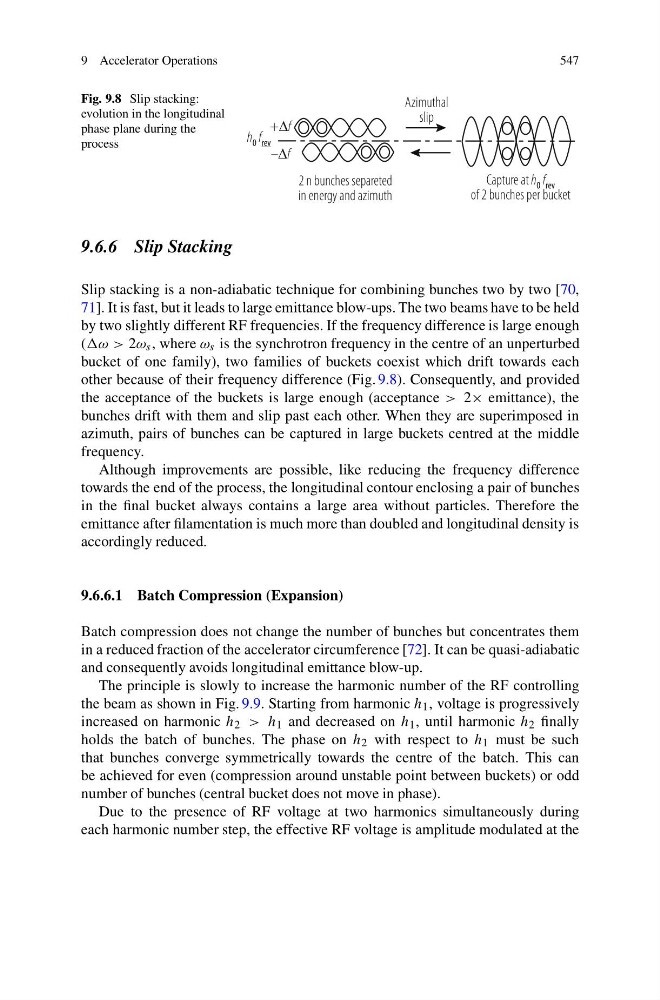
Fig. 9.8 Slip stacking:
evolution in the longitudinal
phase plane during the
process
Azimuthal
slip
2 n bunches separeted
in energy and azimuth
Capture at h 0 f rev
of 2 bunches per bucket
h 0 f rev
+'f
–'f
9.6.6 Slip Stacking
Slip stacking is a non-adiabatic technique for combining bunches two by two [70,
71]. It is fast, but it leads to large emittance blow-ups. The two beams have to be held
by two slightly different RF frequencies. If the frequency difference is large enough
( > 2ω s , where ω s is the synchrotron frequency in the centre of an unperturbed
bucket of one family), two families of buckets coexist which drift towards each
other because of their frequency difference (Fig. 9.8). Consequently, and provided
the acceptance of the buckets is large enough (acceptance > 2× emittance), the
bunches drift with them and slip past each other. When they are superimposed in
azimuth, pairs of bunches can be captured in large buckets centred at the middle
frequency.
Although improvements are possible, like reducing the frequency difference
towards the end of the process, the longitudinal contour enclosing a pair of bunches
in the final bucket always contains a large area without particles. Therefore the
emittance after filamentation is much more than doubled and longitudinal density is
accordingly reduced.
9.6.6.1 Batch Compression (Expansion)
Batch compression does not change the number of bunches but concentrates them
in a reduced fraction of the accelerator circumference [72]. It can be quasi-adiabatic
and consequently avoids longitudinal emittance blow-up.
The principle is slowly to increase the harmonic number of the RF controlling
the beam as shown in Fig. 9.9. Starting from harmonic h 1 , voltage is progressively
increased on harmonic h 2 > h 1 and decreased on h 1 , until harmonic h 2 finally
holds the batch of bunches. The phase on h 2 with respect to h 1 must be such
that bunches converge symmetrically towards the centre of the batch. This can
be achieved for even (compression around unstable point between buckets) or odd
number of bunches (central bucket does not move in phase).
Due to the presence of RF voltage at two harmonics simultaneously during
each harmonic number step, the effective RF voltage is amplitude modulated at the
547
Fig. 9.8 Slip stacking:
evolution in the longitudinal
phase plane during the
process
Azimuthal
slip
2 n bunches separeted
in energy and azimuth
Capture at h 0 f rev
of 2 bunches per bucket
h 0 f rev
+'f
–'f
9.6.6 Slip Stacking
Slip stacking is a non-adiabatic technique for combining bunches two by two [70,
71]. It is fast, but it leads to large emittance blow-ups. The two beams have to be held
by two slightly different RF frequencies. If the frequency difference is large enough
( > 2ω s , where ω s is the synchrotron frequency in the centre of an unperturbed
bucket of one family), two families of buckets coexist which drift towards each
other because of their frequency difference (Fig. 9.8). Consequently, and provided
the acceptance of the buckets is large enough (acceptance > 2× emittance), the
bunches drift with them and slip past each other. When they are superimposed in
azimuth, pairs of bunches can be captured in large buckets centred at the middle
frequency.
Although improvements are possible, like reducing the frequency difference
towards the end of the process, the longitudinal contour enclosing a pair of bunches
in the final bucket always contains a large area without particles. Therefore the
emittance after filamentation is much more than doubled and longitudinal density is
accordingly reduced.
9.6.6.1 Batch Compression (Expansion)
Batch compression does not change the number of bunches but concentrates them
in a reduced fraction of the accelerator circumference [72]. It can be quasi-adiabatic
and consequently avoids longitudinal emittance blow-up.
The principle is slowly to increase the harmonic number of the RF controlling
the beam as shown in Fig. 9.9. Starting from harmonic h 1 , voltage is progressively
increased on harmonic h 2 > h 1 and decreased on h 1 , until harmonic h 2 finally
holds the batch of bunches. The phase on h 2 with respect to h 1 must be such
that bunches converge symmetrically towards the centre of the batch. This can
be achieved for even (compression around unstable point between buckets) or odd
number of bunches (central bucket does not move in phase).
Due to the presence of RF voltage at two harmonics simultaneously during
each harmonic number step, the effective RF voltage is amplitude modulated at the