

542
M. Lamont et al.
9.6 Longitudinal Control and Manipulations
H. Damerau and R. Garoby
RF systems in synchrotrons are primarily installed for beam acceleration.
However, they provide also the possibility to manipulate the longitudinal beam
characteristics like bunch length, energy spread, distance between bunches, number
of bunches, etc. [53]. The following section deals with the typical longitudinal beam
manipulations in synchrotrons, when synchrotron radiation is negligible.
9.6.1 Adiabaticity
The longitudinal motion that we consider is conservative (i.e. there is no energy
dissipation effect like synchrotron radiation, as well as no coupling of longitudinal
and transverse motion). Liouville’s theorem is then applicable, which states that the
local density of particles in the longitudinal phase plane is always constant [54].
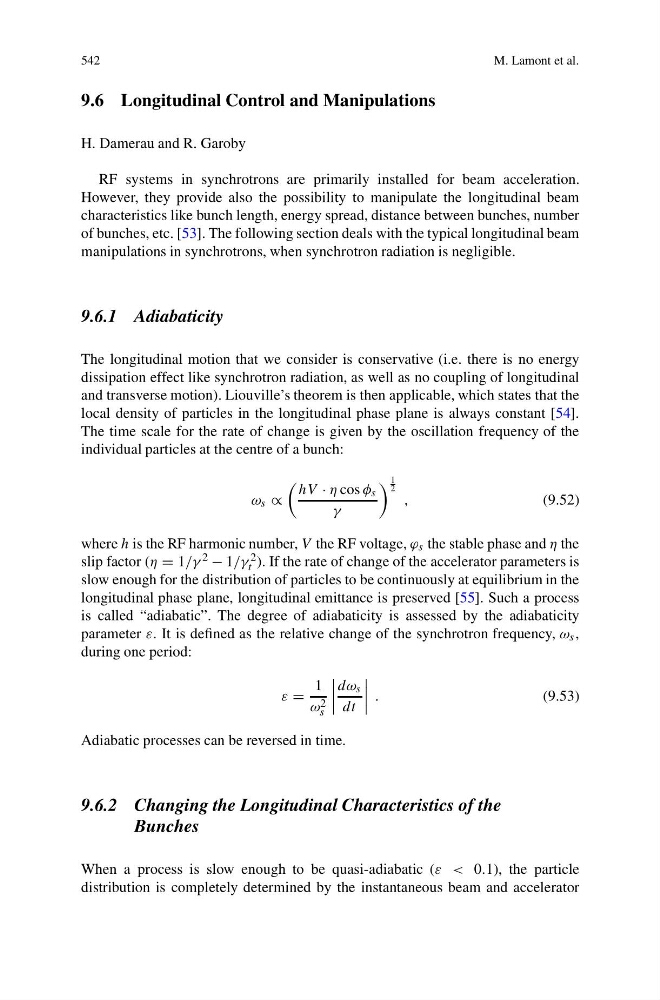
The time scale for the rate of change is given by the oscillation frequency of the
individual particles at the centre of a bunch:
ω s ∝
hV · η cos φ s
γ
1
2
,
(9.52)
where h is the RF harmonic number, V the RF voltage, ϕ s the stable phase and η the
slip factor (η = 1/γ 2 − 1/γ 2
t ). If the rate of change of the accelerator parameters is
slow enough for the distribution of particles to be continuously at equilibrium in the
longitudinal phase plane, longitudinal emittance is preserved [55]. Such a process
is called “adiabatic”. The degree of adiabaticity is assessed by the adiabaticity
parameter ε. It is defined as the relative change of the synchrotron frequency, ω s ,
during one period:
ε =
1
ω 2
s
dω s
dt
.
(9.53)
Adiabatic processes can be reversed in time.
9.6.2 Changing the Longitudinal Characteristics of the
Bunches
When a process is slow enough to be quasi-adiabatic (ε < 0.1), the particle
distribution is completely determined by the instantaneous beam and accelerator
M. Lamont et al.
9.6 Longitudinal Control and Manipulations
H. Damerau and R. Garoby
RF systems in synchrotrons are primarily installed for beam acceleration.
However, they provide also the possibility to manipulate the longitudinal beam
characteristics like bunch length, energy spread, distance between bunches, number
of bunches, etc. [53]. The following section deals with the typical longitudinal beam
manipulations in synchrotrons, when synchrotron radiation is negligible.
9.6.1 Adiabaticity
The longitudinal motion that we consider is conservative (i.e. there is no energy
dissipation effect like synchrotron radiation, as well as no coupling of longitudinal
and transverse motion). Liouville’s theorem is then applicable, which states that the
local density of particles in the longitudinal phase plane is always constant [54].
The time scale for the rate of change is given by the oscillation frequency of the
individual particles at the centre of a bunch:
ω s ∝
hV · η cos φ s
γ
1
2
,
(9.52)
where h is the RF harmonic number, V the RF voltage, ϕ s the stable phase and η the
slip factor (η = 1/γ 2 − 1/γ 2
t ). If the rate of change of the accelerator parameters is
slow enough for the distribution of particles to be continuously at equilibrium in the
longitudinal phase plane, longitudinal emittance is preserved [55]. Such a process
is called “adiabatic”. The degree of adiabaticity is assessed by the adiabaticity
parameter ε. It is defined as the relative change of the synchrotron frequency, ω s ,
during one period:
ε =
1
ω 2
s
dω s
dt
.
(9.53)
Adiabatic processes can be reversed in time.
9.6.2 Changing the Longitudinal Characteristics of the
Bunches
When a process is slow enough to be quasi-adiabatic (ε < 0.1), the particle
distribution is completely determined by the instantaneous beam and accelerator