

538
M. Lamont et al.
9.5.2.1 Quadrupole Strength Modulation
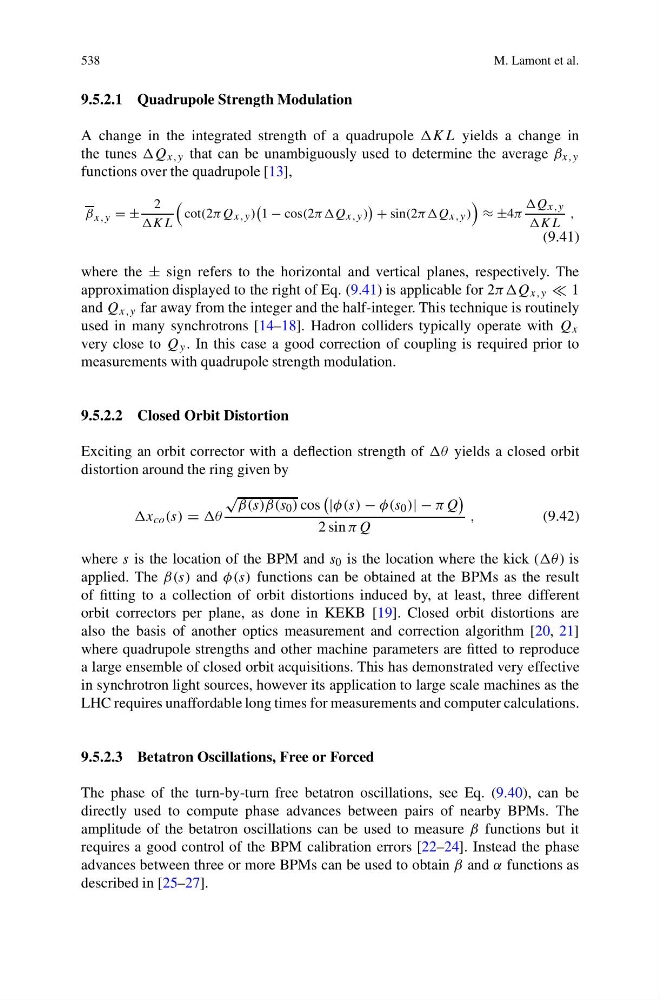
A change in the integrated strength of a quadrupole KL yields a change in
the tunes Q x,y that can be unambiguously used to determine the average β x,y
functions over the quadrupole [13],
β x,y = ±
2
KL
cot(2πQ x,y )
1 − cos(2ππQ x,y )
+ sin(2ππQ x,y )
≈ ±4π
Q x,y
KL
,
(9.41)
where the ± sign refers to the horizontal and vertical planes, respectively. The
approximation displayed to the right of Eq. (9.41) is applicable for 2ππQ x,y 1
and Q x,y far away from the integer and the half-integer. This technique is routinely
used in many synchrotrons [14–18]. Hadron colliders typically operate with Q x
very close to Q y . In this case a good correction of coupling is required prior to
measurements with quadrupole strength modulation.
9.5.2.2 Closed Orbit Distortion
Exciting an orbit corrector with a deflection strength of θ yields a closed orbit
distortion around the ring given by
x co (s) =
√
β(s)β(s 0 ) cos
|φ(s) − φ(s 0 )| − πQ
2 sin πQ
,
(9.42)
where s is the location of the BPM and s 0 is the location where the kick (θ ) is
applied. The β(s) and φ(s) functions can be obtained at the BPMs as the result
of fitting to a collection of orbit distortions induced by, at least, three different
orbit correctors per plane, as done in KEKB [19]. Closed orbit distortions are
also the basis of another optics measurement and correction algorithm [20, 21]
where quadrupole strengths and other machine parameters are fitted to reproduce
a large ensemble of closed orbit acquisitions. This has demonstrated very effective
in synchrotron light sources, however its application to large scale machines as the
LHC requires unaffordable long times for measurements and computer calculations.
9.5.2.3 Betatron Oscillations, Free or Forced
The phase of the turn-by-turn free betatron oscillations, see Eq. (9.40), can be
directly used to compute phase advances between pairs of nearby BPMs. The
amplitude of the betatron oscillations can be used to measure β functions but it
requires a good control of the BPM calibration errors [22–24]. Instead the phase
advances between three or more BPMs can be used to obtain β and α functions as
described in [25–27].
M. Lamont et al.
9.5.2.1 Quadrupole Strength Modulation
A change in the integrated strength of a quadrupole KL yields a change in
the tunes Q x,y that can be unambiguously used to determine the average β x,y
functions over the quadrupole [13],
β x,y = ±
2
KL
cot(2πQ x,y )
1 − cos(2ππQ x,y )
+ sin(2ππQ x,y )
≈ ±4π
Q x,y
KL
,
(9.41)
where the ± sign refers to the horizontal and vertical planes, respectively. The
approximation displayed to the right of Eq. (9.41) is applicable for 2ππQ x,y 1
and Q x,y far away from the integer and the half-integer. This technique is routinely
used in many synchrotrons [14–18]. Hadron colliders typically operate with Q x
very close to Q y . In this case a good correction of coupling is required prior to
measurements with quadrupole strength modulation.
9.5.2.2 Closed Orbit Distortion
Exciting an orbit corrector with a deflection strength of θ yields a closed orbit
distortion around the ring given by
x co (s) =
√
β(s)β(s 0 ) cos
|φ(s) − φ(s 0 )| − πQ
2 sin πQ
,
(9.42)
where s is the location of the BPM and s 0 is the location where the kick (θ ) is
applied. The β(s) and φ(s) functions can be obtained at the BPMs as the result
of fitting to a collection of orbit distortions induced by, at least, three different
orbit correctors per plane, as done in KEKB [19]. Closed orbit distortions are
also the basis of another optics measurement and correction algorithm [20, 21]
where quadrupole strengths and other machine parameters are fitted to reproduce
a large ensemble of closed orbit acquisitions. This has demonstrated very effective
in synchrotron light sources, however its application to large scale machines as the
LHC requires unaffordable long times for measurements and computer calculations.
9.5.2.3 Betatron Oscillations, Free or Forced
The phase of the turn-by-turn free betatron oscillations, see Eq. (9.40), can be
directly used to compute phase advances between pairs of nearby BPMs. The
amplitude of the betatron oscillations can be used to measure β functions but it
requires a good control of the BPM calibration errors [22–24]. Instead the phase
advances between three or more BPMs can be used to obtain β and α functions as
described in [25–27].