

9 Accelerator Operations
537
corresponding momentum mismatch need to be addressed differently. This is
done by subtracting them dynamically from the orbit and radial-loop feedback
reference targets. In machines running with transverse feedback systems, the tune
can similarly be derived from its actuator signal while keeping beam oscillations and
potential instabilities under control. Because of the various inter-loop dependencies,
it is beneficial to implement the tune, chromaticity, coupling, orbit and radial-loop
feedbacks in one global controller to minimise data exchange and synchronisation
requirements.
9.5 Optics Measurement and Correction
R. Tomás García
9.5.1 Introduction
The unavoidable misalignments and field errors of the different components of
an accelerator cause distortions of the machine optics with respect to the design.
Optics errors deteriorate the accelerator performance and can even challenge the
machine safety when operating with beam. Optics measurement and correction
techniques are therefore fundamental to keep optics errors as low as possible or
within specified tolerances [11]. The following sections review procedures and
techniques to measure and correct various optics parameters, focusing on circular
accelerators.
9.5.2 Optics Measurement Techniques
The tune is probably the most fundamental optics parameter as resonances need to
be avoided for efficient accelerator operation. One- and two-dimensional resonance
lines in the tune space have correspondances to Farey sequences [12]. The fractional
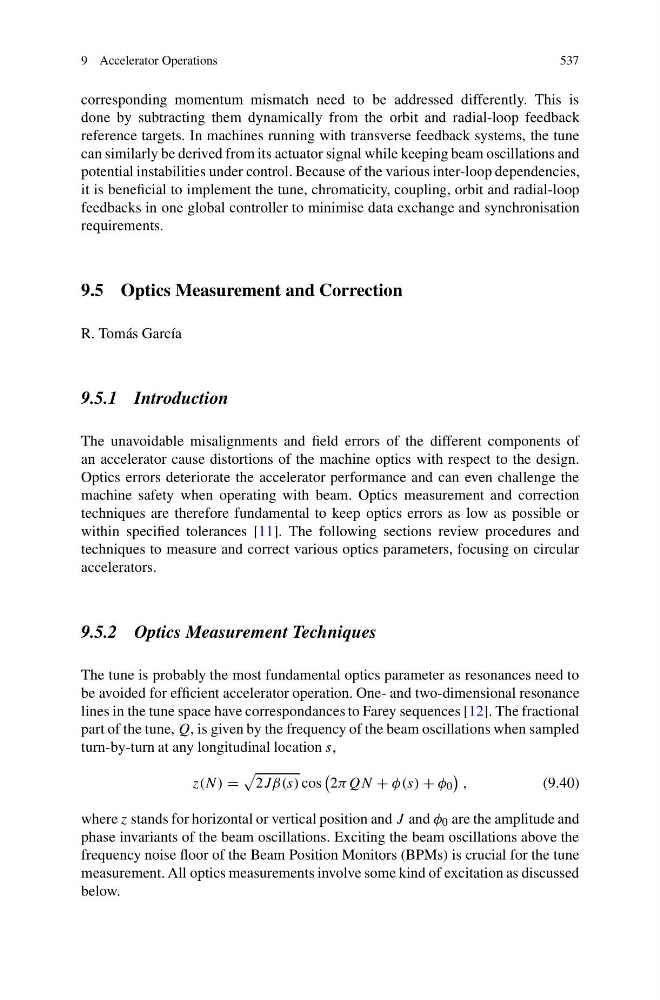
part of the tune, Q, is given by the frequency of the beam oscillations when sampled
turn-by-turn at any longitudinal location s,
z(N) =
2Jβ(s) cos
2πQN + φ(s) + φ 0
,
(9.40)
where z stands for horizontal or vertical position and J and φ 0 are the amplitude and
phase invariants of the beam oscillations. Exciting the beam oscillations above the
frequency noise floor of the Beam Position Monitors (BPMs) is crucial for the tune
measurement. All optics measurements involve some kind of excitation as discussed
below.
537
corresponding momentum mismatch need to be addressed differently. This is
done by subtracting them dynamically from the orbit and radial-loop feedback
reference targets. In machines running with transverse feedback systems, the tune
can similarly be derived from its actuator signal while keeping beam oscillations and
potential instabilities under control. Because of the various inter-loop dependencies,
it is beneficial to implement the tune, chromaticity, coupling, orbit and radial-loop
feedbacks in one global controller to minimise data exchange and synchronisation
requirements.
9.5 Optics Measurement and Correction
R. Tomás García
9.5.1 Introduction
The unavoidable misalignments and field errors of the different components of
an accelerator cause distortions of the machine optics with respect to the design.
Optics errors deteriorate the accelerator performance and can even challenge the
machine safety when operating with beam. Optics measurement and correction
techniques are therefore fundamental to keep optics errors as low as possible or
within specified tolerances [11]. The following sections review procedures and
techniques to measure and correct various optics parameters, focusing on circular
accelerators.
9.5.2 Optics Measurement Techniques
The tune is probably the most fundamental optics parameter as resonances need to
be avoided for efficient accelerator operation. One- and two-dimensional resonance
lines in the tune space have correspondances to Farey sequences [12]. The fractional
part of the tune, Q, is given by the frequency of the beam oscillations when sampled
turn-by-turn at any longitudinal location s,
z(N) =
2Jβ(s) cos
2πQN + φ(s) + φ 0
,
(9.40)
where z stands for horizontal or vertical position and J and φ 0 are the amplitude and
phase invariants of the beam oscillations. Exciting the beam oscillations above the
frequency noise floor of the Beam Position Monitors (BPMs) is crucial for the tune
measurement. All optics measurements involve some kind of excitation as discussed
below.