

9 Accelerator Operations
527
The SVD algorithm is ideally suited for feedback application since the correction
can be cast in the simple form of a matrix multiplication once the SVD decomposition has been performed. This provides a fast and reliable correction procedure for
realtime orbit feedback.
9.3.3 MICADO Algorithm
MICADO [5] is a least square correction algorithm based on Householder transformations. MICADO performs an iterative search for the most effective corrector
and is, together with SVD, one of the most common orbit correction algorithms.
For a non-singular matrix, a MICADO correction with all N correctors and an SVD
correction with all N eigenvectors yield identical solutions. For corrections with
a limited number of correctors or eigenvectors, and for singular matrices, the two
algorithms converge differently.
A major difference between SVD and MICADO is the corrector strength
distribution, MICADO using fewer but also much stronger kicks. The corrector
strength r.m.s. can be easily controlled with SVD over the number of eigenvalues
that are included in a correction. A correction of a small number of localized kicks
is very effectively handled by MICADO, particularly when the response matrix
is accurate, in which case MICADO can be used to identify the sources of the
kicks. On the other hand, corrections based on few eigenvectors with the largest
eigenvalues are similar to corrections of the main harmonics. Such a scheme spreads
out the correction of a few kicks over the whole machine which can be an asset
when the strength of correctors is limited. To compensate an isolated kick locally, a
large number of eigenvectors must be included in the correction such that the linear
combination forming
θ c converges to a single nonzero corrector.
Singularities of the response matrix, associated to very small eigenvalues, are
handled more easily with SVD, since it is sufficient to avoid using the corresponding
eigenvectors in the corrections procedure. For the MICADO algorithm, it is
necessary to regularize matrix A by removing redundant correctors.
9.3.4 Local Orbit Bumps
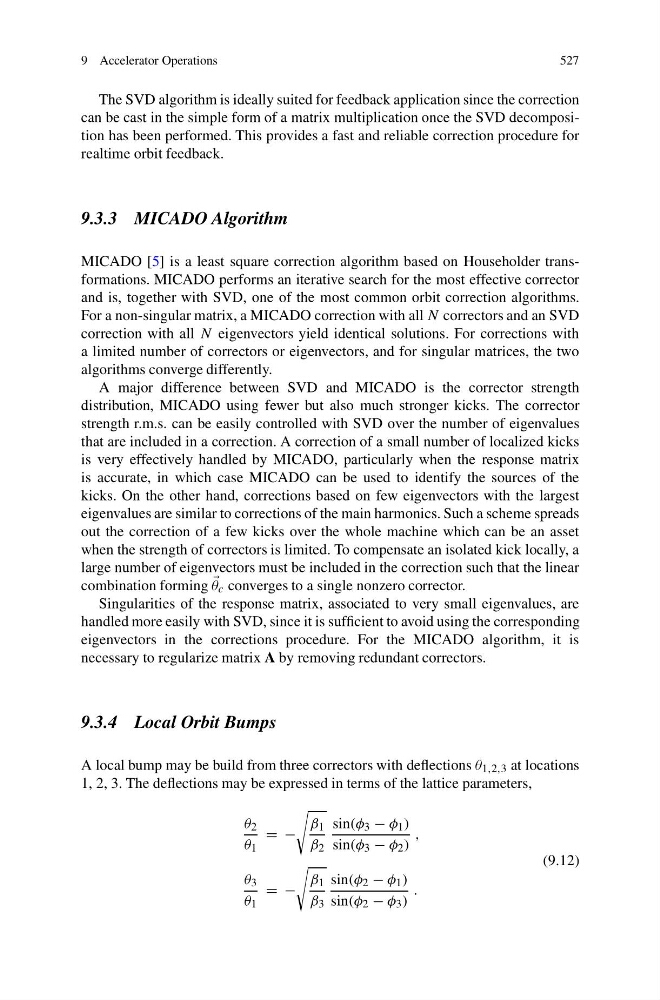
A local bump may be build from three correctors with deflections θ 1,2,3 at locations
1, 2, 3. The deflections may be expressed in terms of the lattice parameters,
θ 2
θ 1
= −
β 1
β 2
sin(φ 3 − φ 1 )
sin(φ 3 − φ 2 )
,
θ 3
θ 1
= −
β 1
β 3
sin(φ 2 − φ 1 )
sin(φ 2 − φ 3 )
.
(9.12)
527
The SVD algorithm is ideally suited for feedback application since the correction
can be cast in the simple form of a matrix multiplication once the SVD decomposition has been performed. This provides a fast and reliable correction procedure for
realtime orbit feedback.
9.3.3 MICADO Algorithm
MICADO [5] is a least square correction algorithm based on Householder transformations. MICADO performs an iterative search for the most effective corrector
and is, together with SVD, one of the most common orbit correction algorithms.
For a non-singular matrix, a MICADO correction with all N correctors and an SVD
correction with all N eigenvectors yield identical solutions. For corrections with
a limited number of correctors or eigenvectors, and for singular matrices, the two
algorithms converge differently.
A major difference between SVD and MICADO is the corrector strength
distribution, MICADO using fewer but also much stronger kicks. The corrector
strength r.m.s. can be easily controlled with SVD over the number of eigenvalues
that are included in a correction. A correction of a small number of localized kicks
is very effectively handled by MICADO, particularly when the response matrix
is accurate, in which case MICADO can be used to identify the sources of the
kicks. On the other hand, corrections based on few eigenvectors with the largest
eigenvalues are similar to corrections of the main harmonics. Such a scheme spreads
out the correction of a few kicks over the whole machine which can be an asset
when the strength of correctors is limited. To compensate an isolated kick locally, a
large number of eigenvectors must be included in the correction such that the linear
combination forming
θ c converges to a single nonzero corrector.
Singularities of the response matrix, associated to very small eigenvalues, are
handled more easily with SVD, since it is sufficient to avoid using the corresponding
eigenvectors in the corrections procedure. For the MICADO algorithm, it is
necessary to regularize matrix A by removing redundant correctors.
9.3.4 Local Orbit Bumps
A local bump may be build from three correctors with deflections θ 1,2,3 at locations
1, 2, 3. The deflections may be expressed in terms of the lattice parameters,
θ 2
θ 1
= −
β 1
β 2
sin(φ 3 − φ 1 )
sin(φ 3 − φ 2 )
,
θ 3
θ 1
= −
β 1
β 3
sin(φ 2 − φ 1 )
sin(φ 2 − φ 3 )
.
(9.12)