

8 Accelerator Engineering and Technology: Accelerator Technology
471
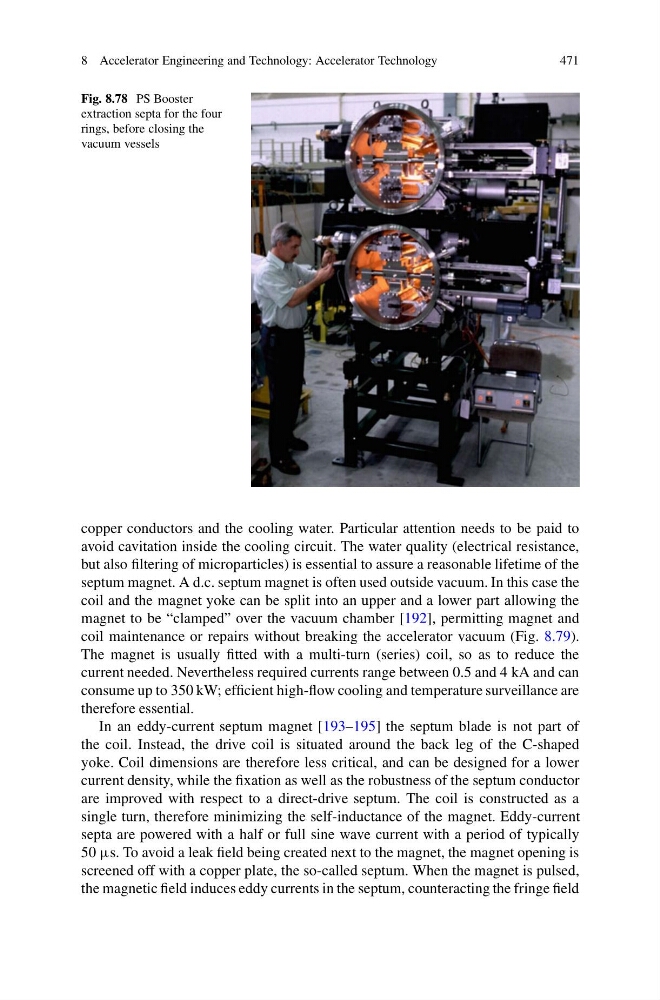
Fig. 8.78 PS Booster
extraction septa for the four
rings, before closing the
vacuum vessels
copper conductors and the cooling water. Particular attention needs to be paid to
avoid cavitation inside the cooling circuit. The water quality (electrical resistance,
but also filtering of microparticles) is essential to assure a reasonable lifetime of the
septum magnet. A d.c. septum magnet is often used outside vacuum. In this case the
coil and the magnet yoke can be split into an upper and a lower part allowing the
magnet to be “clamped” over the vacuum chamber [192], permitting magnet and
coil maintenance or repairs without breaking the accelerator vacuum (Fig. 8.79).
The magnet is usually fitted with a multi-turn (series) coil, so as to reduce the
current needed. Nevertheless required currents range between 0.5 and 4 kA and can
consume up to 350 kW; efficient high-flow cooling and temperature surveillance are
therefore essential.
In an eddy-current septum magnet [193–195] the septum blade is not part of
the coil. Instead, the drive coil is situated around the back leg of the C-shaped
yoke. Coil dimensions are therefore less critical, and can be designed for a lower
current density, while the fixation as well as the robustness of the septum conductor
are improved with respect to a direct-drive septum. The coil is constructed as a
single turn, therefore minimizing the self-inductance of the magnet. Eddy-current
septa are powered with a half or full sine wave current with a period of typically
50 μs. To avoid a leak field being created next to the magnet, the magnet opening is
screened off with a copper plate, the so-called septum. When the magnet is pulsed,
the magnetic field induces eddy currents in the septum, counteracting the fringe field
471
Fig. 8.78 PS Booster
extraction septa for the four
rings, before closing the
vacuum vessels
copper conductors and the cooling water. Particular attention needs to be paid to
avoid cavitation inside the cooling circuit. The water quality (electrical resistance,
but also filtering of microparticles) is essential to assure a reasonable lifetime of the
septum magnet. A d.c. septum magnet is often used outside vacuum. In this case the
coil and the magnet yoke can be split into an upper and a lower part allowing the
magnet to be “clamped” over the vacuum chamber [192], permitting magnet and
coil maintenance or repairs without breaking the accelerator vacuum (Fig. 8.79).
The magnet is usually fitted with a multi-turn (series) coil, so as to reduce the
current needed. Nevertheless required currents range between 0.5 and 4 kA and can
consume up to 350 kW; efficient high-flow cooling and temperature surveillance are
therefore essential.
In an eddy-current septum magnet [193–195] the septum blade is not part of
the coil. Instead, the drive coil is situated around the back leg of the C-shaped
yoke. Coil dimensions are therefore less critical, and can be designed for a lower
current density, while the fixation as well as the robustness of the septum conductor
are improved with respect to a direct-drive septum. The coil is constructed as a
single turn, therefore minimizing the self-inductance of the magnet. Eddy-current
septa are powered with a half or full sine wave current with a period of typically
50 μs. To avoid a leak field being created next to the magnet, the magnet opening is
screened off with a copper plate, the so-called septum. When the magnet is pulsed,
the magnetic field induces eddy currents in the septum, counteracting the fringe field