

8 Accelerator Engineering and Technology: Accelerator Technology
431
and atomically cleaned Cu has 1.5. Water condensation on atomically cleaned Cu
resets δ max to 2 which correspond to the as received state. Coating such as baked
TiN, activated TiZrV or amorphous carbons are used to reduce δ max close to 1.
Due to graphitization of the carbon oxides, an accumulated electron dose of a few
mC/mm 2 is also effective by beam scrubbing to reduce δ max of a metallic surface
(except Al) close to 1 [107]. These methods are used in recent machines to control
the multipacting process. Thanks to their morphology, laser engineered structured
surfaces can reduce δ max below 1. However, their exploitation in future accelerator
is still under study.
8.5.3.3 Vacuum Stability
In storage rings, the circulating particle beam ionise the residual gas. The produced
ions are then repelled toward the vacuum chamber wall desorbing neutral gasses.
As a consequence, the amount of beam-ionisation is increased leading to a higher
gas load. Ultimately, this mechanism, which was first observed in the Intersecting
Storage Rings (ISR), can conduct to a particle loss and a pressure run-away [108].
Modern accelerators operated with high beam intensities are designed to maintain
vacuum stability (SNS, LHC).
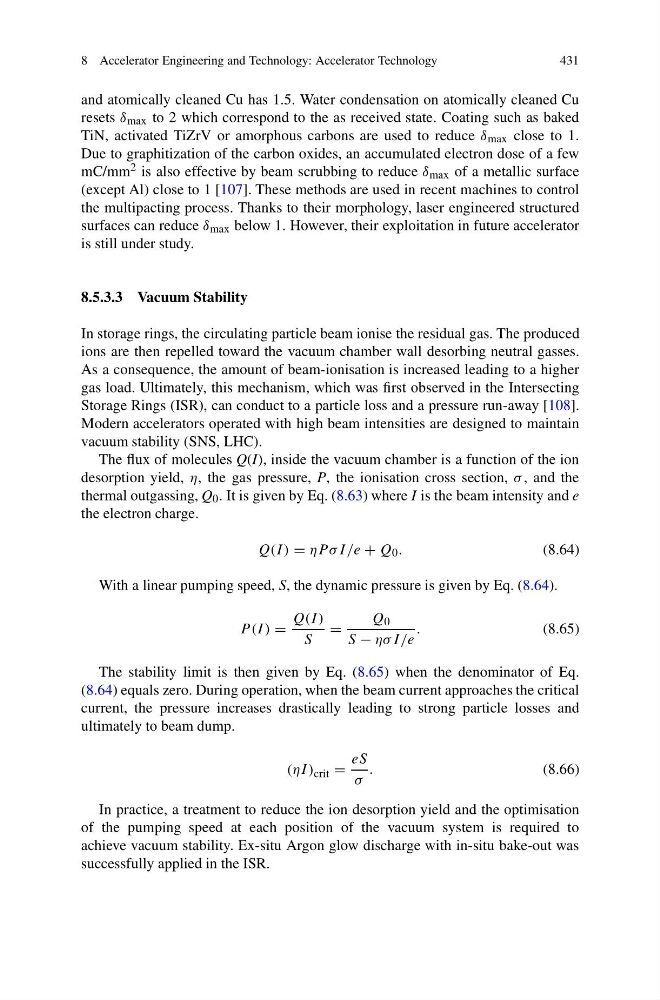
The flux of molecules Q(I), inside the vacuum chamber is a function of the ion
desorption yield, η, the gas pressure, P, the ionisation cross section, σ , and the
thermal outgassing, Q 0 . It is given by Eq. (8.63) where I is the beam intensity and e
the electron charge.
Q(I ) = ηP σ I /e + Q 0 .
(8.64)
With a linear pumping speed, S, the dynamic pressure is given by Eq. (8.64).
P (I ) =
Q(I )
S
=
Q 0
S − ησ I /e
.
(8.65)
The stability limit is then given by Eq. (8.65) when the denominator of Eq.
(8.64) equals zero. During operation, when the beam current approaches the critical
current, the pressure increases drastically leading to strong particle losses and
ultimately to beam dump.
(ηI ) crit =
eS
σ
.
(8.66)
In practice, a treatment to reduce the ion desorption yield and the optimisation
of the pumping speed at each position of the vacuum system is required to
achieve vacuum stability. Ex-situ Argon glow discharge with in-situ bake-out was
successfully applied in the ISR.
431
and atomically cleaned Cu has 1.5. Water condensation on atomically cleaned Cu
resets δ max to 2 which correspond to the as received state. Coating such as baked
TiN, activated TiZrV or amorphous carbons are used to reduce δ max close to 1.
Due to graphitization of the carbon oxides, an accumulated electron dose of a few
mC/mm 2 is also effective by beam scrubbing to reduce δ max of a metallic surface
(except Al) close to 1 [107]. These methods are used in recent machines to control
the multipacting process. Thanks to their morphology, laser engineered structured
surfaces can reduce δ max below 1. However, their exploitation in future accelerator
is still under study.
8.5.3.3 Vacuum Stability
In storage rings, the circulating particle beam ionise the residual gas. The produced
ions are then repelled toward the vacuum chamber wall desorbing neutral gasses.
As a consequence, the amount of beam-ionisation is increased leading to a higher
gas load. Ultimately, this mechanism, which was first observed in the Intersecting
Storage Rings (ISR), can conduct to a particle loss and a pressure run-away [108].
Modern accelerators operated with high beam intensities are designed to maintain
vacuum stability (SNS, LHC).
The flux of molecules Q(I), inside the vacuum chamber is a function of the ion
desorption yield, η, the gas pressure, P, the ionisation cross section, σ , and the
thermal outgassing, Q 0 . It is given by Eq. (8.63) where I is the beam intensity and e
the electron charge.
Q(I ) = ηP σ I /e + Q 0 .
(8.64)
With a linear pumping speed, S, the dynamic pressure is given by Eq. (8.64).
P (I ) =
Q(I )
S
=
Q 0
S − ησ I /e
.
(8.65)
The stability limit is then given by Eq. (8.65) when the denominator of Eq.
(8.64) equals zero. During operation, when the beam current approaches the critical
current, the pressure increases drastically leading to strong particle losses and
ultimately to beam dump.
(ηI ) crit =
eS
σ
.
(8.66)
In practice, a treatment to reduce the ion desorption yield and the optimisation
of the pumping speed at each position of the vacuum system is required to
achieve vacuum stability. Ex-situ Argon glow discharge with in-situ bake-out was
successfully applied in the ISR.