

430
F. Bordry et al.
bombardment stimulate gas desorption from the vacuum chamber wall. Clearly, the
highest gas load is observed in the multipacting regime. For instance, in the LHC,
the proton bunch intensity is large enough to give a kick of ~100 eV to the stray
electrons. At the wall, these electrons stimulate gas desorption but also produce
secondary electrons. The secondary electrons are further accelerated to ~100 eV
by the following bunch, 25 ns apart, leading to a multiplication of electrons in the
vacuum system.
Similarly to photon stimulated molecular desorption, electron simulated molecular desorption is characterised by the electron desorption yield. The electron
desorption yield is also decreased under electron bombardment according to Eq.
(8.61). The electron desorption yield increases almost linearly with the electron
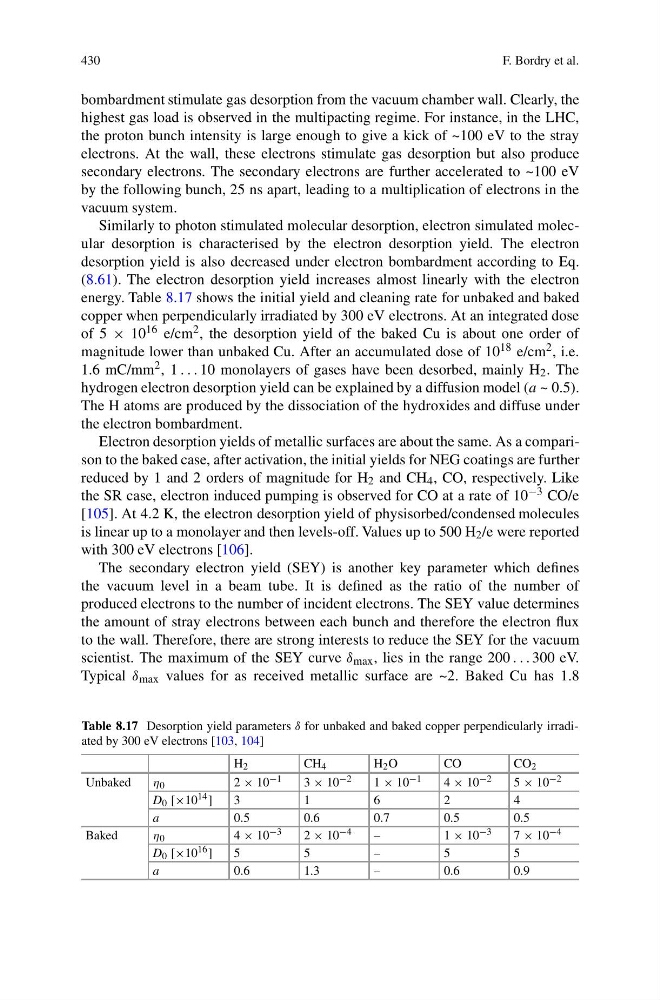
energy. Table 8.17 shows the initial yield and cleaning rate for unbaked and baked
copper when perpendicularly irradiated by 300 eV electrons. At an integrated dose
of 5 × 10 16 e/cm 2 , the desorption yield of the baked Cu is about one order of
magnitude lower than unbaked Cu. After an accumulated dose of 10 18 e/cm 2 , i.e.
1.6 mC/mm 2 , 1 . . . 10 monolayers of gases have been desorbed, mainly H 2 . The
hydrogen electron desorption yield can be explained by a diffusion model (a ~ 0.5).
The H atoms are produced by the dissociation of the hydroxides and diffuse under
the electron bombardment.
Electron desorption yields of metallic surfaces are about the same. As a comparison to the baked case, after activation, the initial yields for NEG coatings are further
reduced by 1 and 2 orders of magnitude for H 2 and CH 4 , CO, respectively. Like
the SR case, electron induced pumping is observed for CO at a rate of 10 −3 CO/e
[105]. At 4.2 K, the electron desorption yield of physisorbed/condensed molecules
is linear up to a monolayer and then levels-off. Values up to 500 H 2 /e were reported
with 300 eV electrons [106].
The secondary electron yield (SEY) is another key parameter which defines
the vacuum level in a beam tube. It is defined as the ratio of the number of
produced electrons to the number of incident electrons. The SEY value determines
the amount of stray electrons between each bunch and therefore the electron flux
to the wall. Therefore, there are strong interests to reduce the SEY for the vacuum
scientist. The maximum of the SEY curve δ max , lies in the range 200 . . . 300 eV.
Typical δ max values for as received metallic surface are ~2. Baked Cu has 1.8
Table 8.17 Desorption yield parameters δ for unbaked and baked copper perpendicularly irradiated by 300 eV electrons [103, 104]
H 2
CH 4
H 2 O
CO
CO 2
Unbaked
η 0
2 × 10 −1
3 × 10 −2
1 × 10 −1
4 × 10 −2
5 × 10 −2
D 0 [×10 14 ]
3
1
6
2
4
a
0.5
0.6
0.7
0.5
0.5
Baked
η 0
4 × 10 −3
2 × 10 −4
–
1 × 10 −3
7 × 10 −4
D 0 [×10 16 ]
5
5
–
5
5
a
0.6
1.3
–
0.6
0.9
F. Bordry et al.
bombardment stimulate gas desorption from the vacuum chamber wall. Clearly, the
highest gas load is observed in the multipacting regime. For instance, in the LHC,
the proton bunch intensity is large enough to give a kick of ~100 eV to the stray
electrons. At the wall, these electrons stimulate gas desorption but also produce
secondary electrons. The secondary electrons are further accelerated to ~100 eV
by the following bunch, 25 ns apart, leading to a multiplication of electrons in the
vacuum system.
Similarly to photon stimulated molecular desorption, electron simulated molecular desorption is characterised by the electron desorption yield. The electron
desorption yield is also decreased under electron bombardment according to Eq.
(8.61). The electron desorption yield increases almost linearly with the electron
energy. Table 8.17 shows the initial yield and cleaning rate for unbaked and baked
copper when perpendicularly irradiated by 300 eV electrons. At an integrated dose
of 5 × 10 16 e/cm 2 , the desorption yield of the baked Cu is about one order of
magnitude lower than unbaked Cu. After an accumulated dose of 10 18 e/cm 2 , i.e.
1.6 mC/mm 2 , 1 . . . 10 monolayers of gases have been desorbed, mainly H 2 . The
hydrogen electron desorption yield can be explained by a diffusion model (a ~ 0.5).
The H atoms are produced by the dissociation of the hydroxides and diffuse under
the electron bombardment.
Electron desorption yields of metallic surfaces are about the same. As a comparison to the baked case, after activation, the initial yields for NEG coatings are further
reduced by 1 and 2 orders of magnitude for H 2 and CH 4 , CO, respectively. Like
the SR case, electron induced pumping is observed for CO at a rate of 10 −3 CO/e
[105]. At 4.2 K, the electron desorption yield of physisorbed/condensed molecules
is linear up to a monolayer and then levels-off. Values up to 500 H 2 /e were reported
with 300 eV electrons [106].
The secondary electron yield (SEY) is another key parameter which defines
the vacuum level in a beam tube. It is defined as the ratio of the number of
produced electrons to the number of incident electrons. The SEY value determines
the amount of stray electrons between each bunch and therefore the electron flux
to the wall. Therefore, there are strong interests to reduce the SEY for the vacuum
scientist. The maximum of the SEY curve δ max , lies in the range 200 . . . 300 eV.
Typical δ max values for as received metallic surface are ~2. Baked Cu has 1.8
Table 8.17 Desorption yield parameters δ for unbaked and baked copper perpendicularly irradiated by 300 eV electrons [103, 104]
H 2
CH 4
H 2 O
CO
CO 2
Unbaked
η 0
2 × 10 −1
3 × 10 −2
1 × 10 −1
4 × 10 −2
5 × 10 −2
D 0 [×10 14 ]
3
1
6
2
4
a
0.5
0.6
0.7
0.5
0.5
Baked
η 0
4 × 10 −3
2 × 10 −4
–
1 × 10 −3
7 × 10 −4
D 0 [×10 16 ]
5
5
–
5
5
a
0.6
1.3
–
0.6
0.9