

8 Accelerator Engineering and Technology: Accelerator Technology
429
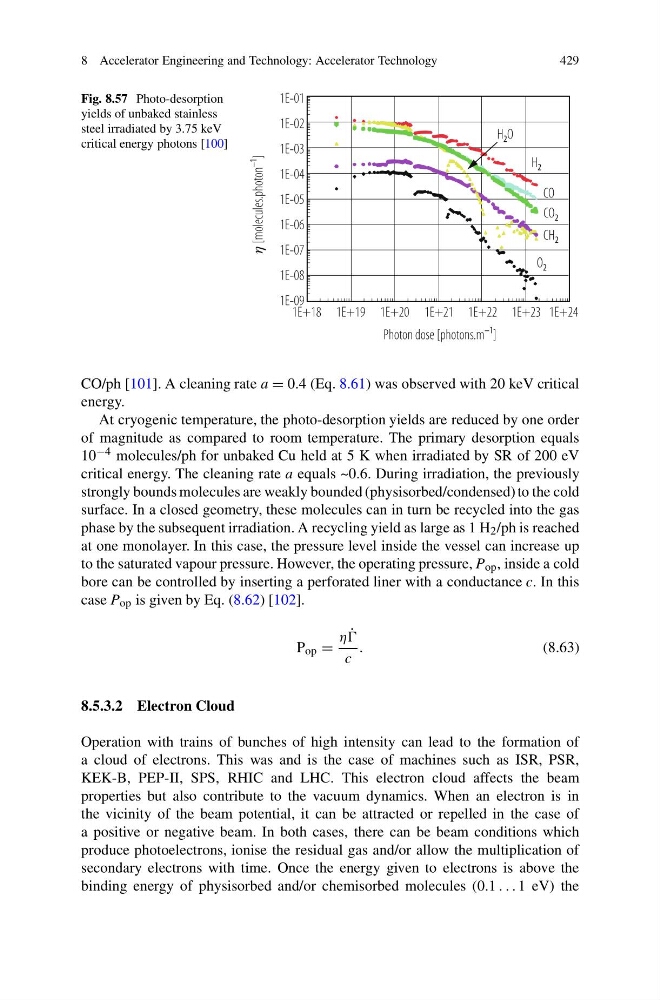
Fig. 8.57 Photo-desorption
yields of unbaked stainless
steel irradiated by 3.75 keV
critical energy photons [100]
CO/ph [101]. A cleaning rate a = 0.4 (Eq. 8.61) was observed with 20 keV critical
energy.
At cryogenic temperature, the photo-desorption yields are reduced by one order
of magnitude as compared to room temperature. The primary desorption equals
10 −4 molecules/ph for unbaked Cu held at 5 K when irradiated by SR of 200 eV
critical energy. The cleaning rate a equals ~0.6. During irradiation, the previously
strongly bounds molecules are weakly bounded (physisorbed/condensed) to the cold
surface. In a closed geometry, these molecules can in turn be recycled into the gas
phase by the subsequent irradiation. A recycling yield as large as 1 H 2 /ph is reached
at one monolayer. In this case, the pressure level inside the vessel can increase up
to the saturated vapour pressure. However, the operating pressure, P op , inside a cold
bore can be controlled by inserting a perforated liner with a conductance c. In this
case P op is given by Eq. (8.62) [102].
P op =
η ˙
c
.
(8.63)
8.5.3.2 Electron Cloud
Operation with trains of bunches of high intensity can lead to the formation of
a cloud of electrons. This was and is the case of machines such as ISR, PSR,
KEK-B, PEP-II, SPS, RHIC and LHC. This electron cloud affects the beam
properties but also contribute to the vacuum dynamics. When an electron is in
the vicinity of the beam potential, it can be attracted or repelled in the case of
a positive or negative beam. In both cases, there can be beam conditions which
produce photoelectrons, ionise the residual gas and/or allow the multiplication of
secondary electrons with time. Once the energy given to electrons is above the
binding energy of physisorbed and/or chemisorbed molecules (0.1 . . . 1 eV) the
429
Fig. 8.57 Photo-desorption
yields of unbaked stainless
steel irradiated by 3.75 keV
critical energy photons [100]
CO/ph [101]. A cleaning rate a = 0.4 (Eq. 8.61) was observed with 20 keV critical
energy.
At cryogenic temperature, the photo-desorption yields are reduced by one order
of magnitude as compared to room temperature. The primary desorption equals
10 −4 molecules/ph for unbaked Cu held at 5 K when irradiated by SR of 200 eV
critical energy. The cleaning rate a equals ~0.6. During irradiation, the previously
strongly bounds molecules are weakly bounded (physisorbed/condensed) to the cold
surface. In a closed geometry, these molecules can in turn be recycled into the gas
phase by the subsequent irradiation. A recycling yield as large as 1 H 2 /ph is reached
at one monolayer. In this case, the pressure level inside the vessel can increase up
to the saturated vapour pressure. However, the operating pressure, P op , inside a cold
bore can be controlled by inserting a perforated liner with a conductance c. In this
case P op is given by Eq. (8.62) [102].
P op =
η ˙
c
.
(8.63)
8.5.3.2 Electron Cloud
Operation with trains of bunches of high intensity can lead to the formation of
a cloud of electrons. This was and is the case of machines such as ISR, PSR,
KEK-B, PEP-II, SPS, RHIC and LHC. This electron cloud affects the beam
properties but also contribute to the vacuum dynamics. When an electron is in
the vicinity of the beam potential, it can be attracted or repelled in the case of
a positive or negative beam. In both cases, there can be beam conditions which
produce photoelectrons, ionise the residual gas and/or allow the multiplication of
secondary electrons with time. Once the energy given to electrons is above the
binding energy of physisorbed and/or chemisorbed molecules (0.1 . . . 1 eV) the