

428
F. Bordry et al.
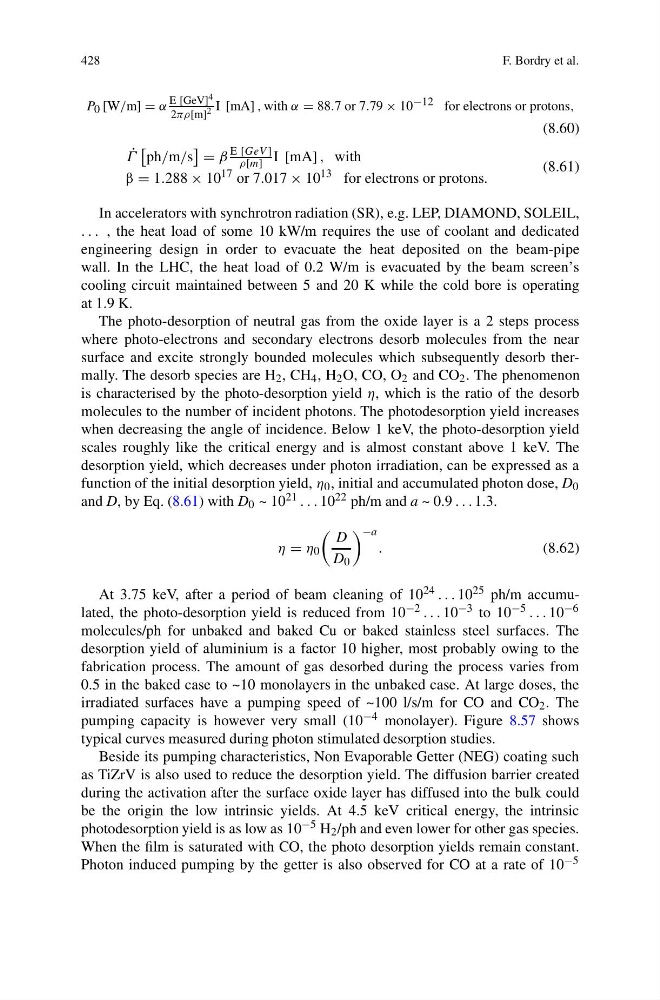
P 0 [W/m] = α
E [GeV] 4
2πρ[m] 2 I [mA] , with α = 88.7 or 7.79 × 10 −12 for electrons or protons,
(8.60)
˙
Γ
ph/m/s
= β
E [GeV ]
ρ[m] I [mA] , with
β = 1.288 × 10
17 or 7.017 × 10
13 for electrons or protons.
(8.61)
In accelerators with synchrotron radiation (SR), e.g. LEP, DIAMOND, SOLEIL,
. . . , the heat load of some 10 kW/m requires the use of coolant and dedicated
engineering design in order to evacuate the heat deposited on the beam-pipe
wall. In the LHC, the heat load of 0.2 W/m is evacuated by the beam screen’s
cooling circuit maintained between 5 and 20 K while the cold bore is operating
at 1.9 K.
The photo-desorption of neutral gas from the oxide layer is a 2 steps process
where photo-electrons and secondary electrons desorb molecules from the near
surface and excite strongly bounded molecules which subsequently desorb thermally. The desorb species are H 2 , CH 4 , H 2 O, CO, O 2 and CO 2 . The phenomenon
is characterised by the photo-desorption yield η, which is the ratio of the desorb
molecules to the number of incident photons. The photodesorption yield increases
when decreasing the angle of incidence. Below 1 keV, the photo-desorption yield
scales roughly like the critical energy and is almost constant above 1 keV. The
desorption yield, which decreases under photon irradiation, can be expressed as a
function of the initial desorption yield, η 0 , initial and accumulated photon dose, D 0
and D, by Eq. (8.61) with D 0 ~ 10 21 . . . 10 22 ph/m and a ~ 0.9 . . . 1.3.
η = η 0
D
D 0
−a
.
(8.62)
At 3.75 keV, after a period of beam cleaning of 10 24 . . . 10 25 ph/m accumulated, the photo-desorption yield is reduced from 10 −2 . . . 10 −3 to 10 −5 . . . 10 −6
molecules/ph for unbaked and baked Cu or baked stainless steel surfaces. The
desorption yield of aluminium is a factor 10 higher, most probably owing to the
fabrication process. The amount of gas desorbed during the process varies from
0.5 in the baked case to ~10 monolayers in the unbaked case. At large doses, the
irradiated surfaces have a pumping speed of ~100 l/s/m for CO and CO 2 . The
pumping capacity is however very small (10 −4 monolayer). Figure 8.57 shows
typical curves measured during photon stimulated desorption studies.
Beside its pumping characteristics, Non Evaporable Getter (NEG) coating such
as TiZrV is also used to reduce the desorption yield. The diffusion barrier created
during the activation after the surface oxide layer has diffused into the bulk could
be the origin the low intrinsic yields. At 4.5 keV critical energy, the intrinsic
photodesorption yield is as low as 10 −5 H 2 /ph and even lower for other gas species.
When the film is saturated with CO, the photo desorption yields remain constant.
Photon induced pumping by the getter is also observed for CO at a rate of 10 −5
F. Bordry et al.
P 0 [W/m] = α
E [GeV] 4
2πρ[m] 2 I [mA] , with α = 88.7 or 7.79 × 10 −12 for electrons or protons,
(8.60)
˙
Γ
ph/m/s
= β
E [GeV ]
ρ[m] I [mA] , with
β = 1.288 × 10
17 or 7.017 × 10
13 for electrons or protons.
(8.61)
In accelerators with synchrotron radiation (SR), e.g. LEP, DIAMOND, SOLEIL,
. . . , the heat load of some 10 kW/m requires the use of coolant and dedicated
engineering design in order to evacuate the heat deposited on the beam-pipe
wall. In the LHC, the heat load of 0.2 W/m is evacuated by the beam screen’s
cooling circuit maintained between 5 and 20 K while the cold bore is operating
at 1.9 K.
The photo-desorption of neutral gas from the oxide layer is a 2 steps process
where photo-electrons and secondary electrons desorb molecules from the near
surface and excite strongly bounded molecules which subsequently desorb thermally. The desorb species are H 2 , CH 4 , H 2 O, CO, O 2 and CO 2 . The phenomenon
is characterised by the photo-desorption yield η, which is the ratio of the desorb
molecules to the number of incident photons. The photodesorption yield increases
when decreasing the angle of incidence. Below 1 keV, the photo-desorption yield
scales roughly like the critical energy and is almost constant above 1 keV. The
desorption yield, which decreases under photon irradiation, can be expressed as a
function of the initial desorption yield, η 0 , initial and accumulated photon dose, D 0
and D, by Eq. (8.61) with D 0 ~ 10 21 . . . 10 22 ph/m and a ~ 0.9 . . . 1.3.
η = η 0
D
D 0
−a
.
(8.62)
At 3.75 keV, after a period of beam cleaning of 10 24 . . . 10 25 ph/m accumulated, the photo-desorption yield is reduced from 10 −2 . . . 10 −3 to 10 −5 . . . 10 −6
molecules/ph for unbaked and baked Cu or baked stainless steel surfaces. The
desorption yield of aluminium is a factor 10 higher, most probably owing to the
fabrication process. The amount of gas desorbed during the process varies from
0.5 in the baked case to ~10 monolayers in the unbaked case. At large doses, the
irradiated surfaces have a pumping speed of ~100 l/s/m for CO and CO 2 . The
pumping capacity is however very small (10 −4 monolayer). Figure 8.57 shows
typical curves measured during photon stimulated desorption studies.
Beside its pumping characteristics, Non Evaporable Getter (NEG) coating such
as TiZrV is also used to reduce the desorption yield. The diffusion barrier created
during the activation after the surface oxide layer has diffused into the bulk could
be the origin the low intrinsic yields. At 4.5 keV critical energy, the intrinsic
photodesorption yield is as low as 10 −5 H 2 /ph and even lower for other gas species.
When the film is saturated with CO, the photo desorption yields remain constant.
Photon induced pumping by the getter is also observed for CO at a rate of 10 −5