

8 Accelerator Engineering and Technology: Accelerator Technology
427
8.5.3 Vacuum Dynamics
8.5.3.1 Synchrotron Radiation
When a particle beam circulates in a bending magnet or circulates off-axis in
a quadrupole magnet, it might radiates photons and lose energy by synchrotron
radiation (SR). The interaction of the synchrotron radiation with the vacuum
chamber wall stimulates molecular gas desorption and dissipates heat load.
Therefore, the vacuum chamber design must take into account these effects [98,
99].
The synchrotron radiation is due to the acceleration (centripetal or longitudinal)
of the charged particles. Therefore, these charged particles loose energy which
must be compensated by the RF system in order to keep the particles on
the closed orbit. The dissipated power due to the centripetal acceleration
is much larger than the longitudinal acceleration. The proportional factor is
equal to the relativistic factor γ to the square. Due to the relativistic effects,
the radiation is strongly emitted in the forward direction. The opening angle
is roughly 1/γ. The energy of the emitted photons varies from meV to
MeV.
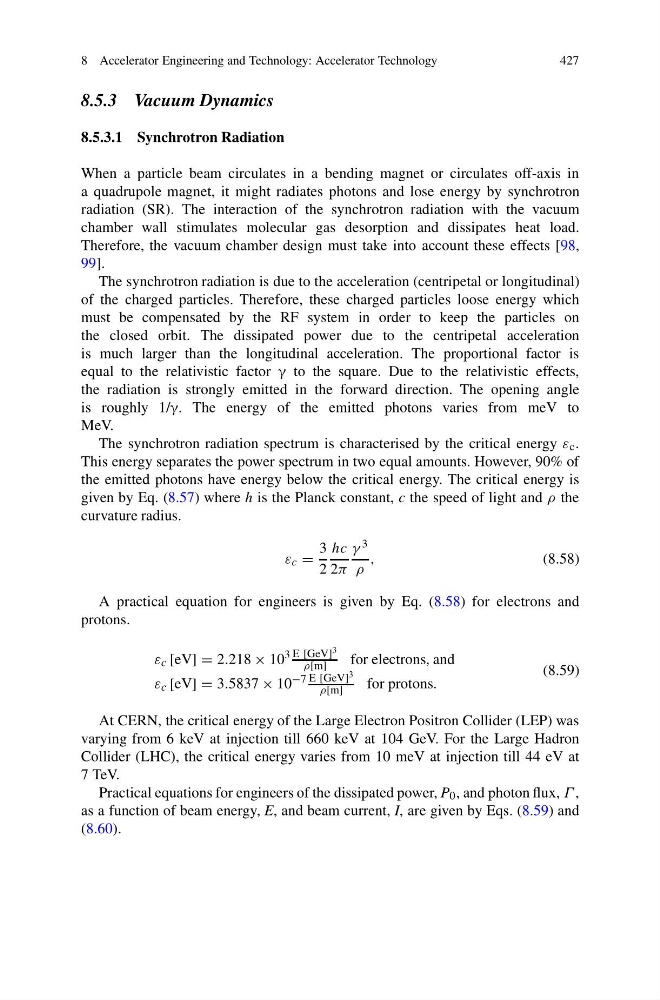
The synchrotron radiation spectrum is characterised by the critical energy ε c .
This energy separates the power spectrum in two equal amounts. However, 90% of
the emitted photons have energy below the critical energy. The critical energy is
given by Eq. (8.57) where h is the Planck constant, c the speed of light and ρ the
curvature radius.
ε c =
3
2
hc
2π
γ 3
ρ
,
(8.58)
A practical equation for engineers is given by Eq. (8.58) for electrons and
protons.
ε c [eV] = 2.218 × 10
3 E [GeV] 3
ρ[m]
for electrons, and
ε c [eV] = 3.5837 × 10
−7 E [GeV] 3
ρ[m]
for protons.
(8.59)
At CERN, the critical energy of the Large Electron Positron Collider (LEP) was
varying from 6 keV at injection till 660 keV at 104 GeV. For the Large Hadron
Collider (LHC), the critical energy varies from 10 meV at injection till 44 eV at
7 TeV.
Practical equations for engineers of the dissipated power, P 0 , and photon flux, Γ ,
as a function of beam energy, E, and beam current, I, are given by Eqs. (8.59) and
(8.60).
427
8.5.3 Vacuum Dynamics
8.5.3.1 Synchrotron Radiation
When a particle beam circulates in a bending magnet or circulates off-axis in
a quadrupole magnet, it might radiates photons and lose energy by synchrotron
radiation (SR). The interaction of the synchrotron radiation with the vacuum
chamber wall stimulates molecular gas desorption and dissipates heat load.
Therefore, the vacuum chamber design must take into account these effects [98,
99].
The synchrotron radiation is due to the acceleration (centripetal or longitudinal)
of the charged particles. Therefore, these charged particles loose energy which
must be compensated by the RF system in order to keep the particles on
the closed orbit. The dissipated power due to the centripetal acceleration
is much larger than the longitudinal acceleration. The proportional factor is
equal to the relativistic factor γ to the square. Due to the relativistic effects,
the radiation is strongly emitted in the forward direction. The opening angle
is roughly 1/γ. The energy of the emitted photons varies from meV to
MeV.
The synchrotron radiation spectrum is characterised by the critical energy ε c .
This energy separates the power spectrum in two equal amounts. However, 90% of
the emitted photons have energy below the critical energy. The critical energy is
given by Eq. (8.57) where h is the Planck constant, c the speed of light and ρ the
curvature radius.
ε c =
3
2
hc
2π
γ 3
ρ
,
(8.58)
A practical equation for engineers is given by Eq. (8.58) for electrons and
protons.
ε c [eV] = 2.218 × 10
3 E [GeV] 3
ρ[m]
for electrons, and
ε c [eV] = 3.5837 × 10
−7 E [GeV] 3
ρ[m]
for protons.
(8.59)
At CERN, the critical energy of the Large Electron Positron Collider (LEP) was
varying from 6 keV at injection till 660 keV at 104 GeV. For the Large Hadron
Collider (LHC), the critical energy varies from 10 meV at injection till 44 eV at
7 TeV.
Practical equations for engineers of the dissipated power, P 0 , and photon flux, Γ ,
as a function of beam energy, E, and beam current, I, are given by Eqs. (8.59) and
(8.60).