

426
F. Bordry et al.
dn
dν
= 2n
m 3
2πk 3 T 3 e
−
mν 2
2kT ν 2 .
(8.52)
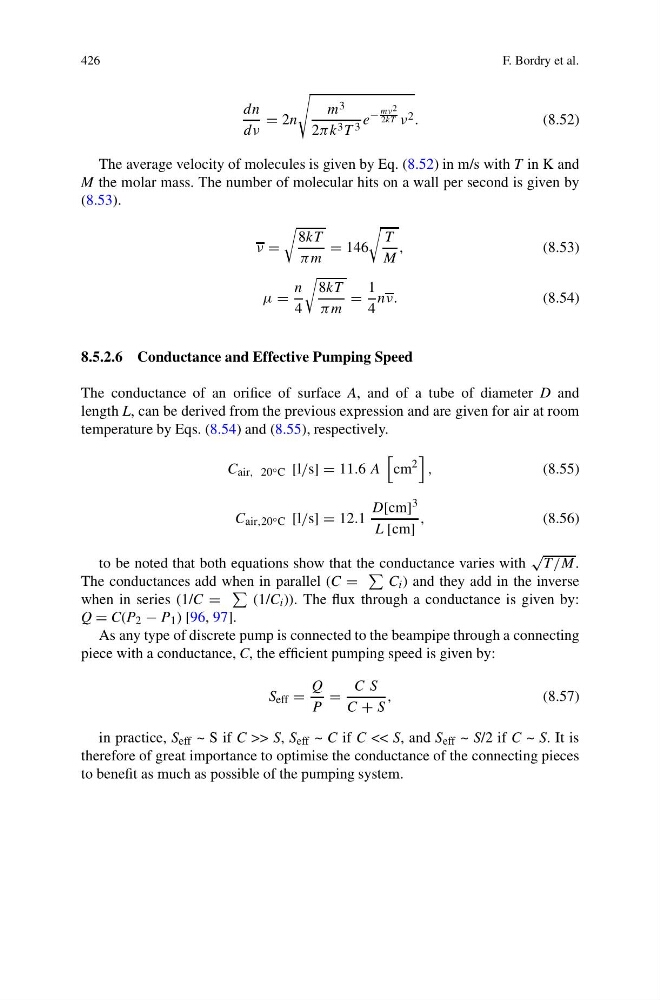
The average velocity of molecules is given by Eq. (8.52) in m/s with T in K and
M the molar mass. The number of molecular hits on a wall per second is given by
(8.53).
ν =
8kT
πm
= 146
T
M
,
(8.53)
μ =
n
4
8kT
πm
=
1
4
nν.
(8.54)
8.5.2.6 Conductance and Effective Pumping Speed
The conductance of an orifice of surface A, and of a tube of diameter D and
length L, can be derived from the previous expression and are given for air at room
temperature by Eqs. (8.54) and (8.55), respectively.
C air, 20 ◦ C [l/s] = 11.6 A
cm
2
,
(8.55)
C air,20 ◦ C [l/s] = 12.1
D[cm] 3
L [cm]
,
(8.56)
to be noted that both equations show that the conductance varies with
√
T /M.
The conductances add when in parallel (C =
C i ) and they add in the inverse
when in series (1/C =
(1/C i )). The flux through a conductance is given by:
Q = C(P 2 − P 1 ) [96, 97].
As any type of discrete pump is connected to the beampipe through a connecting
piece with a conductance, C, the efficient pumping speed is given by:
S eff =
Q
P
=
C S
C + S
,
(8.57)
in practice, S eff ~ S if C >> S, S eff ~ C if C << S, and S eff ~ S/2 if C ~ S. It is
therefore of great importance to optimise the conductance of the connecting pieces
to benefit as much as possible of the pumping system.
F. Bordry et al.
dn
dν
= 2n
m 3
2πk 3 T 3 e
−
mν 2
2kT ν 2 .
(8.52)
The average velocity of molecules is given by Eq. (8.52) in m/s with T in K and
M the molar mass. The number of molecular hits on a wall per second is given by
(8.53).
ν =
8kT
πm
= 146
T
M
,
(8.53)
μ =
n
4
8kT
πm
=
1
4
nν.
(8.54)
8.5.2.6 Conductance and Effective Pumping Speed
The conductance of an orifice of surface A, and of a tube of diameter D and
length L, can be derived from the previous expression and are given for air at room
temperature by Eqs. (8.54) and (8.55), respectively.
C air, 20 ◦ C [l/s] = 11.6 A
cm
2
,
(8.55)
C air,20 ◦ C [l/s] = 12.1
D[cm] 3
L [cm]
,
(8.56)
to be noted that both equations show that the conductance varies with
√
T /M.
The conductances add when in parallel (C =
C i ) and they add in the inverse
when in series (1/C =
(1/C i )). The flux through a conductance is given by:
Q = C(P 2 − P 1 ) [96, 97].
As any type of discrete pump is connected to the beampipe through a connecting
piece with a conductance, C, the efficient pumping speed is given by:
S eff =
Q
P
=
C S
C + S
,
(8.57)
in practice, S eff ~ S if C >> S, S eff ~ C if C << S, and S eff ~ S/2 if C ~ S. It is
therefore of great importance to optimise the conductance of the connecting pieces
to benefit as much as possible of the pumping system.