

432
F. Bordry et al.
In the LHC, the ion impact energy is ~500 eV. For baked materials, ion desorption
yields are a few 0.1 molecules/ion while minor beam conditioning is expected
during operation. When using NEG coatings, the vacuum stability is ensured by
lumped pumping to constraint CH 4 . This allows to achieve a critical current larger
than 4 A in the LHC experiments and in the long straight sections [109]. At 4.2 K
and 5 keV, the ion desorption at a monolayer for a condensed gas is as large as 2000
and 2 for H 2 and CO 2 respectively. Due to the closed geometry of the beam tube
and the possibility to physisorbed/condensed gas, the critical current of Eq. (8.65)
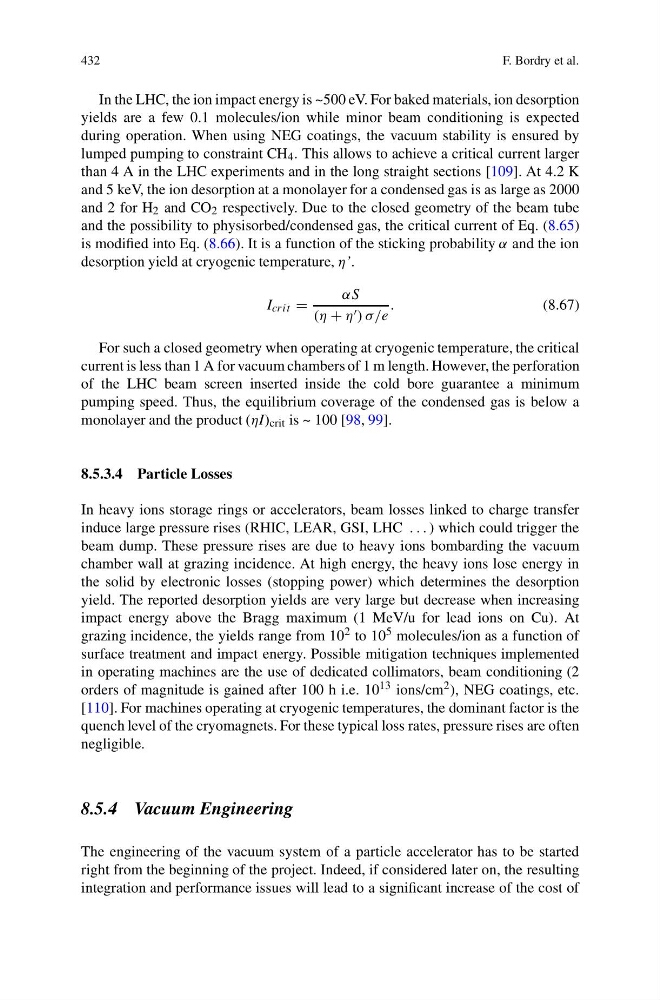
is modified into Eq. (8.66). It is a function of the sticking probability α and the ion
desorption yield at cryogenic temperature, η’.
I crit =
αS
(η + η ) σ/e
.
(8.67)
For such a closed geometry when operating at cryogenic temperature, the critical
current is less than 1 A for vacuum chambers of 1 m length. However, the perforation
of the LHC beam screen inserted inside the cold bore guarantee a minimum
pumping speed. Thus, the equilibrium coverage of the condensed gas is below a
monolayer and the product (ηI) crit is ~ 100 [98, 99].
8.5.3.4 Particle Losses
In heavy ions storage rings or accelerators, beam losses linked to charge transfer
induce large pressure rises (RHIC, LEAR, GSI, LHC . . . ) which could trigger the
beam dump. These pressure rises are due to heavy ions bombarding the vacuum
chamber wall at grazing incidence. At high energy, the heavy ions lose energy in
the solid by electronic losses (stopping power) which determines the desorption
yield. The reported desorption yields are very large but decrease when increasing
impact energy above the Bragg maximum (1 MeV/u for lead ions on Cu). At
grazing incidence, the yields range from 10 2 to 10 5 molecules/ion as a function of
surface treatment and impact energy. Possible mitigation techniques implemented
in operating machines are the use of dedicated collimators, beam conditioning (2
orders of magnitude is gained after 100 h i.e. 10 13 ions/cm 2 ), NEG coatings, etc.
[110]. For machines operating at cryogenic temperatures, the dominant factor is the
quench level of the cryomagnets. For these typical loss rates, pressure rises are often
negligible.
8.5.4 Vacuum Engineering
The engineering of the vacuum system of a particle accelerator has to be started
right from the beginning of the project. Indeed, if considered later on, the resulting
integration and performance issues will lead to a significant increase of the cost of
F. Bordry et al.
In the LHC, the ion impact energy is ~500 eV. For baked materials, ion desorption
yields are a few 0.1 molecules/ion while minor beam conditioning is expected
during operation. When using NEG coatings, the vacuum stability is ensured by
lumped pumping to constraint CH 4 . This allows to achieve a critical current larger
than 4 A in the LHC experiments and in the long straight sections [109]. At 4.2 K
and 5 keV, the ion desorption at a monolayer for a condensed gas is as large as 2000
and 2 for H 2 and CO 2 respectively. Due to the closed geometry of the beam tube
and the possibility to physisorbed/condensed gas, the critical current of Eq. (8.65)
is modified into Eq. (8.66). It is a function of the sticking probability α and the ion
desorption yield at cryogenic temperature, η’.
I crit =
αS
(η + η ) σ/e
.
(8.67)
For such a closed geometry when operating at cryogenic temperature, the critical
current is less than 1 A for vacuum chambers of 1 m length. However, the perforation
of the LHC beam screen inserted inside the cold bore guarantee a minimum
pumping speed. Thus, the equilibrium coverage of the condensed gas is below a
monolayer and the product (ηI) crit is ~ 100 [98, 99].
8.5.3.4 Particle Losses
In heavy ions storage rings or accelerators, beam losses linked to charge transfer
induce large pressure rises (RHIC, LEAR, GSI, LHC . . . ) which could trigger the
beam dump. These pressure rises are due to heavy ions bombarding the vacuum
chamber wall at grazing incidence. At high energy, the heavy ions lose energy in
the solid by electronic losses (stopping power) which determines the desorption
yield. The reported desorption yields are very large but decrease when increasing
impact energy above the Bragg maximum (1 MeV/u for lead ions on Cu). At
grazing incidence, the yields range from 10 2 to 10 5 molecules/ion as a function of
surface treatment and impact energy. Possible mitigation techniques implemented
in operating machines are the use of dedicated collimators, beam conditioning (2
orders of magnitude is gained after 100 h i.e. 10 13 ions/cm 2 ), NEG coatings, etc.
[110]. For machines operating at cryogenic temperatures, the dominant factor is the
quench level of the cryomagnets. For these typical loss rates, pressure rises are often
negligible.
8.5.4 Vacuum Engineering
The engineering of the vacuum system of a particle accelerator has to be started
right from the beginning of the project. Indeed, if considered later on, the resulting
integration and performance issues will lead to a significant increase of the cost of