

416
F. Bordry et al.
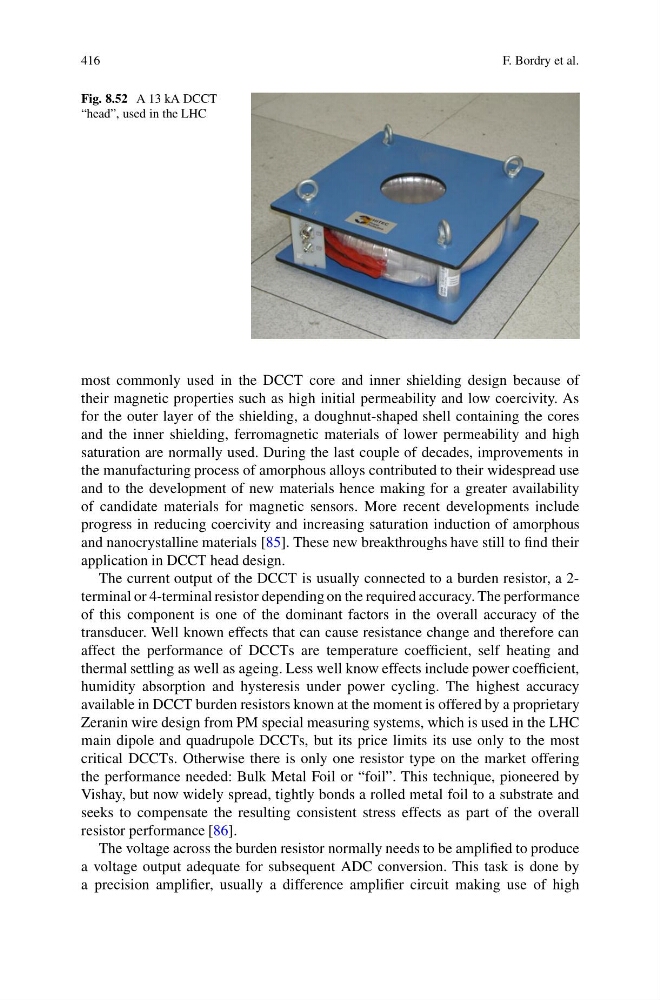
Fig. 8.52 A 13 kA DCCT
“head”, used in the LHC
most commonly used in the DCCT core and inner shielding design because of
their magnetic properties such as high initial permeability and low coercivity. As
for the outer layer of the shielding, a doughnut-shaped shell containing the cores
and the inner shielding, ferromagnetic materials of lower permeability and high
saturation are normally used. During the last couple of decades, improvements in
the manufacturing process of amorphous alloys contributed to their widespread use
and to the development of new materials hence making for a greater availability
of candidate materials for magnetic sensors. More recent developments include
progress in reducing coercivity and increasing saturation induction of amorphous
and nanocrystalline materials [85]. These new breakthroughs have still to find their
application in DCCT head design.
The current output of the DCCT is usually connected to a burden resistor, a 2terminal or 4-terminal resistor depending on the required accuracy. The performance
of this component is one of the dominant factors in the overall accuracy of the
transducer. Well known effects that can cause resistance change and therefore can
affect the performance of DCCTs are temperature coefficient, self heating and
thermal settling as well as ageing. Less well know effects include power coefficient,
humidity absorption and hysteresis under power cycling. The highest accuracy
available in DCCT burden resistors known at the moment is offered by a proprietary
Zeranin wire design from PM special measuring systems, which is used in the LHC
main dipole and quadrupole DCCTs, but its price limits its use only to the most
critical DCCTs. Otherwise there is only one resistor type on the market offering
the performance needed: Bulk Metal Foil or “foil”. This technique, pioneered by
Vishay, but now widely spread, tightly bonds a rolled metal foil to a substrate and
seeks to compensate the resulting consistent stress effects as part of the overall
resistor performance [86].
The voltage across the burden resistor normally needs to be amplified to produce
a voltage output adequate for subsequent ADC conversion. This task is done by
a precision amplifier, usually a difference amplifier circuit making use of high
F. Bordry et al.
Fig. 8.52 A 13 kA DCCT
“head”, used in the LHC
most commonly used in the DCCT core and inner shielding design because of
their magnetic properties such as high initial permeability and low coercivity. As
for the outer layer of the shielding, a doughnut-shaped shell containing the cores
and the inner shielding, ferromagnetic materials of lower permeability and high
saturation are normally used. During the last couple of decades, improvements in
the manufacturing process of amorphous alloys contributed to their widespread use
and to the development of new materials hence making for a greater availability
of candidate materials for magnetic sensors. More recent developments include
progress in reducing coercivity and increasing saturation induction of amorphous
and nanocrystalline materials [85]. These new breakthroughs have still to find their
application in DCCT head design.
The current output of the DCCT is usually connected to a burden resistor, a 2terminal or 4-terminal resistor depending on the required accuracy. The performance
of this component is one of the dominant factors in the overall accuracy of the
transducer. Well known effects that can cause resistance change and therefore can
affect the performance of DCCTs are temperature coefficient, self heating and
thermal settling as well as ageing. Less well know effects include power coefficient,
humidity absorption and hysteresis under power cycling. The highest accuracy
available in DCCT burden resistors known at the moment is offered by a proprietary
Zeranin wire design from PM special measuring systems, which is used in the LHC
main dipole and quadrupole DCCTs, but its price limits its use only to the most
critical DCCTs. Otherwise there is only one resistor type on the market offering
the performance needed: Bulk Metal Foil or “foil”. This technique, pioneered by
Vishay, but now widely spread, tightly bonds a rolled metal foil to a substrate and
seeks to compensate the resulting consistent stress effects as part of the overall
resistor performance [86].
The voltage across the burden resistor normally needs to be amplified to produce
a voltage output adequate for subsequent ADC conversion. This task is done by
a precision amplifier, usually a difference amplifier circuit making use of high