

8 Accelerator Engineering and Technology: Accelerator Technology
415
8.4.4.2.2 DCCTs (Direct-Current Current Transformers)
A DCCT is a magnetic current transducer of the zero-flux type where a second
harmonic or a peak detector is used in a feedback loop to generate a compensation
current which is a fractional image of the current being measured, keeping zero
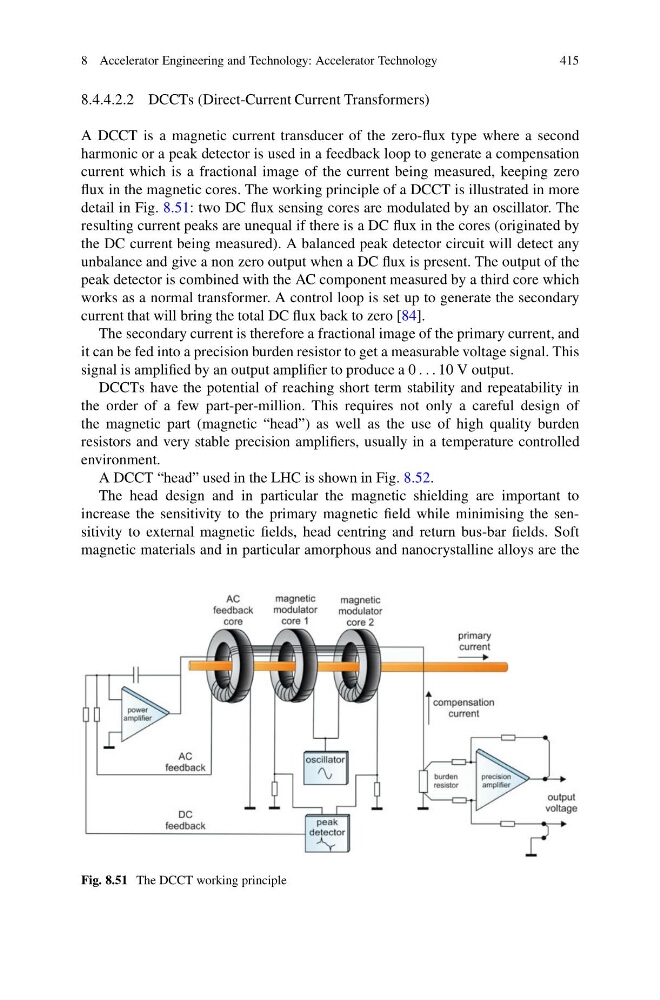
flux in the magnetic cores. The working principle of a DCCT is illustrated in more
detail in Fig. 8.51: two DC flux sensing cores are modulated by an oscillator. The
resulting current peaks are unequal if there is a DC flux in the cores (originated by
the DC current being measured). A balanced peak detector circuit will detect any
unbalance and give a non zero output when a DC flux is present. The output of the
peak detector is combined with the AC component measured by a third core which
works as a normal transformer. A control loop is set up to generate the secondary
current that will bring the total DC flux back to zero [84].
The secondary current is therefore a fractional image of the primary current, and
it can be fed into a precision burden resistor to get a measurable voltage signal. This
signal is amplified by an output amplifier to produce a 0 . . . 10 V output.
DCCTs have the potential of reaching short term stability and repeatability in
the order of a few part-per-million. This requires not only a careful design of
the magnetic part (magnetic “head”) as well as the use of high quality burden
resistors and very stable precision amplifiers, usually in a temperature controlled
environment.
A DCCT “head” used in the LHC is shown in Fig. 8.52.
The head design and in particular the magnetic shielding are important to
increase the sensitivity to the primary magnetic field while minimising the sensitivity to external magnetic fields, head centring and return bus-bar fields. Soft
magnetic materials and in particular amorphous and nanocrystalline alloys are the
Fig. 8.51 The DCCT working principle
415
8.4.4.2.2 DCCTs (Direct-Current Current Transformers)
A DCCT is a magnetic current transducer of the zero-flux type where a second
harmonic or a peak detector is used in a feedback loop to generate a compensation
current which is a fractional image of the current being measured, keeping zero
flux in the magnetic cores. The working principle of a DCCT is illustrated in more
detail in Fig. 8.51: two DC flux sensing cores are modulated by an oscillator. The
resulting current peaks are unequal if there is a DC flux in the cores (originated by
the DC current being measured). A balanced peak detector circuit will detect any
unbalance and give a non zero output when a DC flux is present. The output of the
peak detector is combined with the AC component measured by a third core which
works as a normal transformer. A control loop is set up to generate the secondary
current that will bring the total DC flux back to zero [84].
The secondary current is therefore a fractional image of the primary current, and
it can be fed into a precision burden resistor to get a measurable voltage signal. This
signal is amplified by an output amplifier to produce a 0 . . . 10 V output.
DCCTs have the potential of reaching short term stability and repeatability in
the order of a few part-per-million. This requires not only a careful design of
the magnetic part (magnetic “head”) as well as the use of high quality burden
resistors and very stable precision amplifiers, usually in a temperature controlled
environment.
A DCCT “head” used in the LHC is shown in Fig. 8.52.
The head design and in particular the magnetic shielding are important to
increase the sensitivity to the primary magnetic field while minimising the sensitivity to external magnetic fields, head centring and return bus-bar fields. Soft
magnetic materials and in particular amorphous and nanocrystalline alloys are the
Fig. 8.51 The DCCT working principle