

410
F. Bordry et al.
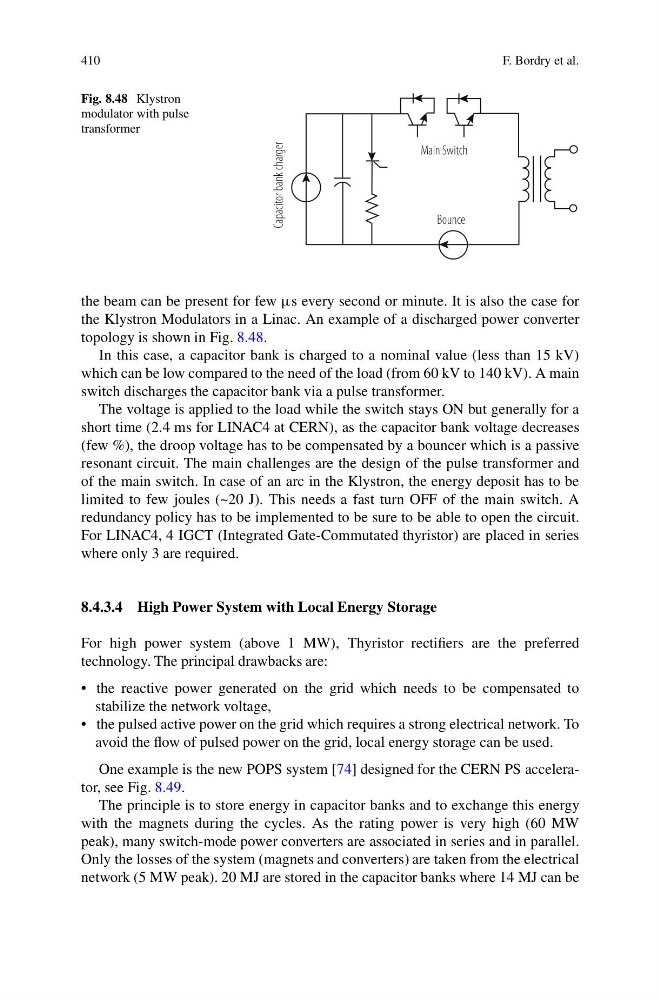
Fig. 8.48 Klystron
modulator with pulse
transformer
Main Switch
Bounce
Capacitor bank charger
the beam can be present for few μs every second or minute. It is also the case for
the Klystron Modulators in a Linac. An example of a discharged power converter
topology is shown in Fig. 8.48.
In this case, a capacitor bank is charged to a nominal value (less than 15 kV)
which can be low compared to the need of the load (from 60 kV to 140 kV). A main
switch discharges the capacitor bank via a pulse transformer.
The voltage is applied to the load while the switch stays ON but generally for a
short time (2.4 ms for LINAC4 at CERN), as the capacitor bank voltage decreases
(few %), the droop voltage has to be compensated by a bouncer which is a passive
resonant circuit. The main challenges are the design of the pulse transformer and
of the main switch. In case of an arc in the Klystron, the energy deposit has to be
limited to few joules (~20 J). This needs a fast turn OFF of the main switch. A
redundancy policy has to be implemented to be sure to be able to open the circuit.
For LINAC4, 4 IGCT (Integrated Gate-Commutated thyristor) are placed in series
where only 3 are required.
8.4.3.4 High Power System with Local Energy Storage
For high power system (above 1 MW), Thyristor rectifiers are the preferred
technology. The principal drawbacks are:
• the reactive power generated on the grid which needs to be compensated to
stabilize the network voltage,
• the pulsed active power on the grid which requires a strong electrical network. To
avoid the flow of pulsed power on the grid, local energy storage can be used.
One example is the new POPS system [74] designed for the CERN PS accelerator, see Fig. 8.49.
The principle is to store energy in capacitor banks and to exchange this energy
with the magnets during the cycles. As the rating power is very high (60 MW
peak), many switch-mode power converters are associated in series and in parallel.
Only the losses of the system (magnets and converters) are taken from the electrical
network (5 MW peak). 20 MJ are stored in the capacitor banks where 14 MJ can be
F. Bordry et al.
Fig. 8.48 Klystron
modulator with pulse
transformer
Main Switch
Bounce
Capacitor bank charger
the beam can be present for few μs every second or minute. It is also the case for
the Klystron Modulators in a Linac. An example of a discharged power converter
topology is shown in Fig. 8.48.
In this case, a capacitor bank is charged to a nominal value (less than 15 kV)
which can be low compared to the need of the load (from 60 kV to 140 kV). A main
switch discharges the capacitor bank via a pulse transformer.
The voltage is applied to the load while the switch stays ON but generally for a
short time (2.4 ms for LINAC4 at CERN), as the capacitor bank voltage decreases
(few %), the droop voltage has to be compensated by a bouncer which is a passive
resonant circuit. The main challenges are the design of the pulse transformer and
of the main switch. In case of an arc in the Klystron, the energy deposit has to be
limited to few joules (~20 J). This needs a fast turn OFF of the main switch. A
redundancy policy has to be implemented to be sure to be able to open the circuit.
For LINAC4, 4 IGCT (Integrated Gate-Commutated thyristor) are placed in series
where only 3 are required.
8.4.3.4 High Power System with Local Energy Storage
For high power system (above 1 MW), Thyristor rectifiers are the preferred
technology. The principal drawbacks are:
• the reactive power generated on the grid which needs to be compensated to
stabilize the network voltage,
• the pulsed active power on the grid which requires a strong electrical network. To
avoid the flow of pulsed power on the grid, local energy storage can be used.
One example is the new POPS system [74] designed for the CERN PS accelerator, see Fig. 8.49.
The principle is to store energy in capacitor banks and to exchange this energy
with the magnets during the cycles. As the rating power is very high (60 MW
peak), many switch-mode power converters are associated in series and in parallel.
Only the losses of the system (magnets and converters) are taken from the electrical
network (5 MW peak). 20 MJ are stored in the capacitor banks where 14 MJ can be