

402
F. Bordry et al.
However, superimposing this cycle on the temperature-entropy diagram of
helium shows that one should operate at a high pressure of about 613 kbar (!),
with a first isentropic compression from 1.3 bar to 82 kbar (!), followed by an
isothermal compression. This is clearly impractical, and real helium cycles are
elongated along isobar (or isochoric) lines, thus involving transforms which require
heat exchange between the high- and low-pressure streams. This heat exchange
can be performed in recuperative or regenerative heat exchangers, respectively for
continuous or alternating flows. In the following, we focus on the continuous-flow
cycles using recuperative heat exchangers which constitute the operating principles
of large-capacity helium refrigerators and liquefiers.
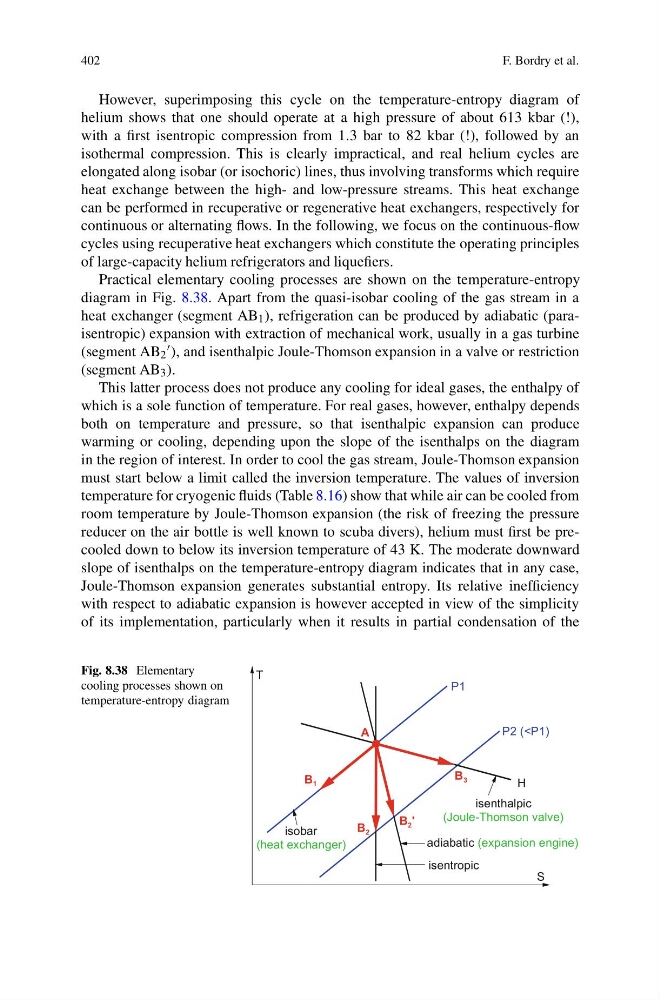
Practical elementary cooling processes are shown on the temperature-entropy
diagram in Fig. 8.38. Apart from the quasi-isobar cooling of the gas stream in a
heat exchanger (segment AB 1 ), refrigeration can be produced by adiabatic (paraisentropic) expansion with extraction of mechanical work, usually in a gas turbine
(segment AB 2
), and isenthalpic Joule-Thomson expansion in a valve or restriction
(segment AB 3 ).
This latter process does not produce any cooling for ideal gases, the enthalpy of
which is a sole function of temperature. For real gases, however, enthalpy depends
both on temperature and pressure, so that isenthalpic expansion can produce
warming or cooling, depending upon the slope of the isenthalps on the diagram
in the region of interest. In order to cool the gas stream, Joule-Thomson expansion
must start below a limit called the inversion temperature. The values of inversion
temperature for cryogenic fluids (Table 8.16) show that while air can be cooled from
room temperature by Joule-Thomson expansion (the risk of freezing the pressure
reducer on the air bottle is well known to scuba divers), helium must first be precooled down to below its inversion temperature of 43 K. The moderate downward
slope of isenthalps on the temperature-entropy diagram indicates that in any case,
Joule-Thomson expansion generates substantial entropy. Its relative inefficiency
with respect to adiabatic expansion is however accepted in view of the simplicity
of its implementation, particularly when it results in partial condensation of the
Fig. 8.38 Elementary
cooling processes shown on
temperature-entropy diagram
P1
P2 (
(Joule-Thomson valve)
adiabatic (expansion engine)
isentropic
isobar
(heat exchanger)
T
S
H
A
B 1
B 2
B 2 '
B 3
F. Bordry et al.
However, superimposing this cycle on the temperature-entropy diagram of
helium shows that one should operate at a high pressure of about 613 kbar (!),
with a first isentropic compression from 1.3 bar to 82 kbar (!), followed by an
isothermal compression. This is clearly impractical, and real helium cycles are
elongated along isobar (or isochoric) lines, thus involving transforms which require
heat exchange between the high- and low-pressure streams. This heat exchange
can be performed in recuperative or regenerative heat exchangers, respectively for
continuous or alternating flows. In the following, we focus on the continuous-flow
cycles using recuperative heat exchangers which constitute the operating principles
of large-capacity helium refrigerators and liquefiers.
Practical elementary cooling processes are shown on the temperature-entropy
diagram in Fig. 8.38. Apart from the quasi-isobar cooling of the gas stream in a
heat exchanger (segment AB 1 ), refrigeration can be produced by adiabatic (paraisentropic) expansion with extraction of mechanical work, usually in a gas turbine
(segment AB 2
), and isenthalpic Joule-Thomson expansion in a valve or restriction
(segment AB 3 ).
This latter process does not produce any cooling for ideal gases, the enthalpy of
which is a sole function of temperature. For real gases, however, enthalpy depends
both on temperature and pressure, so that isenthalpic expansion can produce
warming or cooling, depending upon the slope of the isenthalps on the diagram
in the region of interest. In order to cool the gas stream, Joule-Thomson expansion
must start below a limit called the inversion temperature. The values of inversion
temperature for cryogenic fluids (Table 8.16) show that while air can be cooled from
room temperature by Joule-Thomson expansion (the risk of freezing the pressure
reducer on the air bottle is well known to scuba divers), helium must first be precooled down to below its inversion temperature of 43 K. The moderate downward
slope of isenthalps on the temperature-entropy diagram indicates that in any case,
Joule-Thomson expansion generates substantial entropy. Its relative inefficiency
with respect to adiabatic expansion is however accepted in view of the simplicity
of its implementation, particularly when it results in partial condensation of the
Fig. 8.38 Elementary
cooling processes shown on
temperature-entropy diagram
P1
P2 (
(Joule-Thomson valve)
adiabatic (expansion engine)
isentropic
isobar
(heat exchanger)
T
S
H
A
B 1
B 2
B 2 '
B 3