

8 Accelerator Engineering and Technology: Accelerator Technology
401
Eq. (8.38), the minimum mechanical power W liq for helium liquefaction is:
W liq = W condens + W precool ,
(8.42)
W liq = T 0 ΔS condens − Q condens + T 0 ΔS precool − Q precool .
(8.43)
The heat quantities Q condens and Q precool exchanged at constant pressure are—
by definition—equal to the enthalpy variations H condens and H precool . With
T 0 = 300 K and the entropy and enthalpy differences taken from thermodynamic
tables, one finds W liq = 6628 W per g/s of helium liquefied. Given the minimum
specific mechanical work of 65.7 at 4.5 K, this yields an approximate equivalence
of about 100 W at 4.5 K for 1 g/s liquefaction. More precisely, a liquefier producing
1 g/s liquid helium at 4.5 K will absorb the same power (and thus have similar size)
as a refrigerator extracting about 100 W at 4.5 K, provided they both have the same
efficiency with respect to the Carnot cycle. For machines with mixed refrigeration
and liquefaction duties, this equivalence can be approximately verified by trading
some liquefaction against refrigeration around the design point and vice versa. An
example is given in reference [70].
8.3.5.3 Real Cycles and Refrigeration Equipment
So far we have only addressed cryogenic refrigeration and liquefaction through thermodynamics, i.e. through the exchanges of mass, heat and work at the boundaries
of machines seen as “black boxes”. We will now consider cycles, cooling methods
and equipment of real refrigerators.
In order to minimize the specific mechanical work requirement (and hence the
size and power consumption), an efficient refrigerator should try to approximate
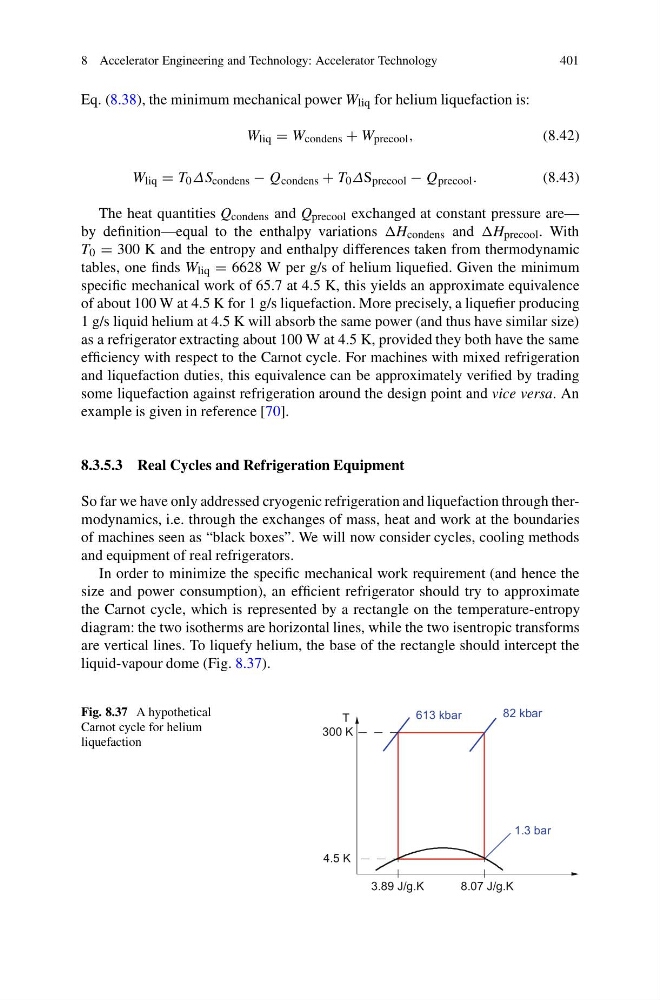
the Carnot cycle, which is represented by a rectangle on the temperature-entropy
diagram: the two isotherms are horizontal lines, while the two isentropic transforms
are vertical lines. To liquefy helium, the base of the rectangle should intercept the
liquid-vapour dome (Fig. 8.37).
Fig. 8.37 A hypothetical
Carnot cycle for helium
liquefaction
T
300 K
4.5 K
3.89 J/g.K
8.07 J/g.K
613 kbar
82 kbar
1.3 bar
401
Eq. (8.38), the minimum mechanical power W liq for helium liquefaction is:
W liq = W condens + W precool ,
(8.42)
W liq = T 0 ΔS condens − Q condens + T 0 ΔS precool − Q precool .
(8.43)
The heat quantities Q condens and Q precool exchanged at constant pressure are—
by definition—equal to the enthalpy variations H condens and H precool . With
T 0 = 300 K and the entropy and enthalpy differences taken from thermodynamic
tables, one finds W liq = 6628 W per g/s of helium liquefied. Given the minimum
specific mechanical work of 65.7 at 4.5 K, this yields an approximate equivalence
of about 100 W at 4.5 K for 1 g/s liquefaction. More precisely, a liquefier producing
1 g/s liquid helium at 4.5 K will absorb the same power (and thus have similar size)
as a refrigerator extracting about 100 W at 4.5 K, provided they both have the same
efficiency with respect to the Carnot cycle. For machines with mixed refrigeration
and liquefaction duties, this equivalence can be approximately verified by trading
some liquefaction against refrigeration around the design point and vice versa. An
example is given in reference [70].
8.3.5.3 Real Cycles and Refrigeration Equipment
So far we have only addressed cryogenic refrigeration and liquefaction through thermodynamics, i.e. through the exchanges of mass, heat and work at the boundaries
of machines seen as “black boxes”. We will now consider cycles, cooling methods
and equipment of real refrigerators.
In order to minimize the specific mechanical work requirement (and hence the
size and power consumption), an efficient refrigerator should try to approximate
the Carnot cycle, which is represented by a rectangle on the temperature-entropy
diagram: the two isotherms are horizontal lines, while the two isentropic transforms
are vertical lines. To liquefy helium, the base of the rectangle should intercept the
liquid-vapour dome (Fig. 8.37).
Fig. 8.37 A hypothetical
Carnot cycle for helium
liquefaction
T
300 K
4.5 K
3.89 J/g.K
8.07 J/g.K
613 kbar
82 kbar
1.3 bar