

400
F. Bordry et al.
Cryogenic refrigerators are often required to provide cooling duties at several
temperatures or in several temperature ranges, e.g. for thermal shields or continuous
heat interception. Equation (8.39) can then be applied to the cooling duty at every
temperature and every elementary mechanical power W i summed or integrated in
the case of continuous cooling. This also allows comparison of different cooling
duties in terms of required mechanical work.
8.3.5.2 Helium Refrigerators vs. Liquefiers
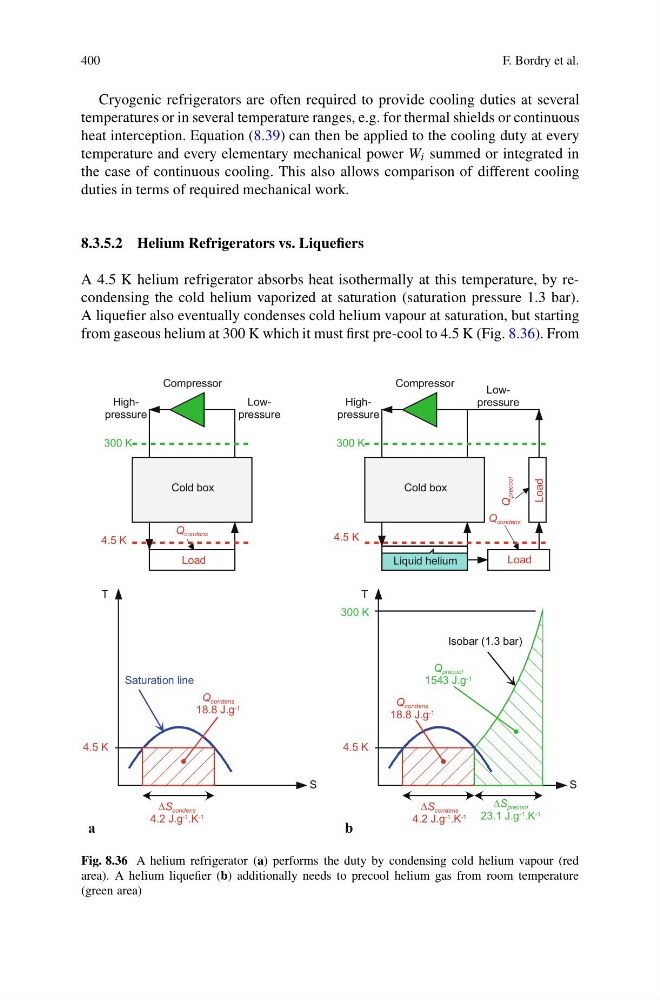
A 4.5 K helium refrigerator absorbs heat isothermally at this temperature, by recondensing the cold helium vaporized at saturation (saturation pressure 1.3 bar).
A liquefier also eventually condenses cold helium vapour at saturation, but starting
from gaseous helium at 300 K which it must first pre-cool to 4.5 K (Fig. 8.36). From
a
b
Compressor
Highpressure
Lowpressure
Load
Cold box
4.5 K
300 K
Q condens
Compressor
Highpressure
Lowpressure
Load
Cold box
4.5 K
300 K
Liquid helium
Load
Q condens
Q
precool
T
S
ΔS condens
4.2 J.g -1 .K -1
4.5 K
Saturation line
T
S
4.5 K
Q condens
18.8 J.g -1
300 K
Isobar (1.3 bar)
Q precool
1543 J.g -1
Q condens
18.8 J.g -1
ΔS condens
4.2 J.g -1 .K -1
ΔS precool
23.1 J.g -1 .K -1
Fig. 8.36 A helium refrigerator (a) performs the duty by condensing cold helium vapour (red
area). A helium liquefier (b) additionally needs to precool helium gas from room temperature
(green area)
F. Bordry et al.
Cryogenic refrigerators are often required to provide cooling duties at several
temperatures or in several temperature ranges, e.g. for thermal shields or continuous
heat interception. Equation (8.39) can then be applied to the cooling duty at every
temperature and every elementary mechanical power W i summed or integrated in
the case of continuous cooling. This also allows comparison of different cooling
duties in terms of required mechanical work.
8.3.5.2 Helium Refrigerators vs. Liquefiers
A 4.5 K helium refrigerator absorbs heat isothermally at this temperature, by recondensing the cold helium vaporized at saturation (saturation pressure 1.3 bar).
A liquefier also eventually condenses cold helium vapour at saturation, but starting
from gaseous helium at 300 K which it must first pre-cool to 4.5 K (Fig. 8.36). From
a
b
Compressor
Highpressure
Lowpressure
Load
Cold box
4.5 K
300 K
Q condens
Compressor
Highpressure
Lowpressure
Load
Cold box
4.5 K
300 K
Liquid helium
Load
Q condens
Q
precool
T
S
ΔS condens
4.2 J.g -1 .K -1
4.5 K
Saturation line
T
S
4.5 K
Q condens
18.8 J.g -1
300 K
Isobar (1.3 bar)
Q precool
1543 J.g -1
Q condens
18.8 J.g -1
ΔS condens
4.2 J.g -1 .K -1
ΔS precool
23.1 J.g -1 .K -1
Fig. 8.36 A helium refrigerator (a) performs the duty by condensing cold helium vapour (red
area). A helium liquefier (b) additionally needs to precool helium gas from room temperature
(green area)