

8 Accelerator Engineering and Technology: Accelerator Technology
399
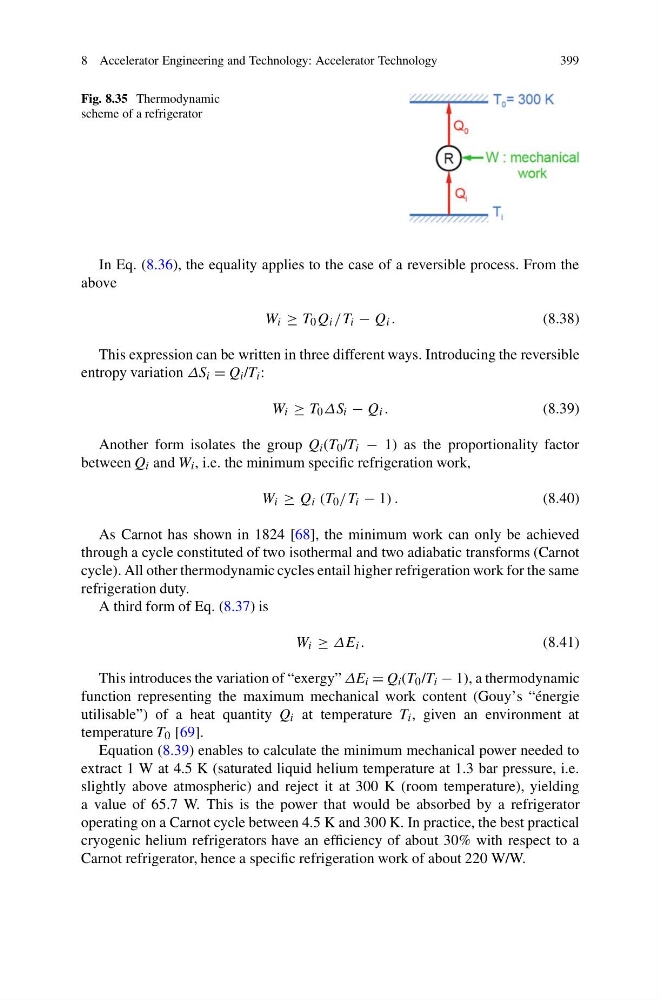
Fig. 8.35 Thermodynamic
scheme of a refrigerator
In Eq. (8.36), the equality applies to the case of a reversible process. From the
above
W i ≥ T 0 Q i /T i − Q i .
(8.38)
This expression can be written in three different ways. Introducing the reversible
entropy variation ΔS i = Q i /T i :
W i ≥ T 0 ΔS i − Q i .
(8.39)
Another form isolates the group Q i (T 0 /T i − 1) as the proportionality factor
between Q i and W i , i.e. the minimum specific refrigeration work,
W i ≥ Q i (T 0 /T i − 1) .
(8.40)
As Carnot has shown in 1824 [68], the minimum work can only be achieved
through a cycle constituted of two isothermal and two adiabatic transforms (Carnot
cycle). All other thermodynamic cycles entail higher refrigeration work for the same
refrigeration duty.
A third form of Eq. (8.37) is
W i ≥ ΔE i .
(8.41)
This introduces the variation of “exergy” ΔE i = Q i (T 0 /T i − 1), a thermodynamic
function representing the maximum mechanical work content (Gouy’s “énergie
utilisable”) of a heat quantity Q i at temperature T i , given an environment at
temperature T 0 [69].
Equation (8.39) enables to calculate the minimum mechanical power needed to
extract 1 W at 4.5 K (saturated liquid helium temperature at 1.3 bar pressure, i.e.
slightly above atmospheric) and reject it at 300 K (room temperature), yielding
a value of 65.7 W. This is the power that would be absorbed by a refrigerator
operating on a Carnot cycle between 4.5 K and 300 K. In practice, the best practical
cryogenic helium refrigerators have an efficiency of about 30% with respect to a
Carnot refrigerator, hence a specific refrigeration work of about 220 W/W.
399
Fig. 8.35 Thermodynamic
scheme of a refrigerator
In Eq. (8.36), the equality applies to the case of a reversible process. From the
above
W i ≥ T 0 Q i /T i − Q i .
(8.38)
This expression can be written in three different ways. Introducing the reversible
entropy variation ΔS i = Q i /T i :
W i ≥ T 0 ΔS i − Q i .
(8.39)
Another form isolates the group Q i (T 0 /T i − 1) as the proportionality factor
between Q i and W i , i.e. the minimum specific refrigeration work,
W i ≥ Q i (T 0 /T i − 1) .
(8.40)
As Carnot has shown in 1824 [68], the minimum work can only be achieved
through a cycle constituted of two isothermal and two adiabatic transforms (Carnot
cycle). All other thermodynamic cycles entail higher refrigeration work for the same
refrigeration duty.
A third form of Eq. (8.37) is
W i ≥ ΔE i .
(8.41)
This introduces the variation of “exergy” ΔE i = Q i (T 0 /T i − 1), a thermodynamic
function representing the maximum mechanical work content (Gouy’s “énergie
utilisable”) of a heat quantity Q i at temperature T i , given an environment at
temperature T 0 [69].
Equation (8.39) enables to calculate the minimum mechanical power needed to
extract 1 W at 4.5 K (saturated liquid helium temperature at 1.3 bar pressure, i.e.
slightly above atmospheric) and reject it at 300 K (room temperature), yielding
a value of 65.7 W. This is the power that would be absorbed by a refrigerator
operating on a Carnot cycle between 4.5 K and 300 K. In practice, the best practical
cryogenic helium refrigerators have an efficiency of about 30% with respect to a
Carnot refrigerator, hence a specific refrigeration work of about 220 W/W.