

398
F. Bordry et al.
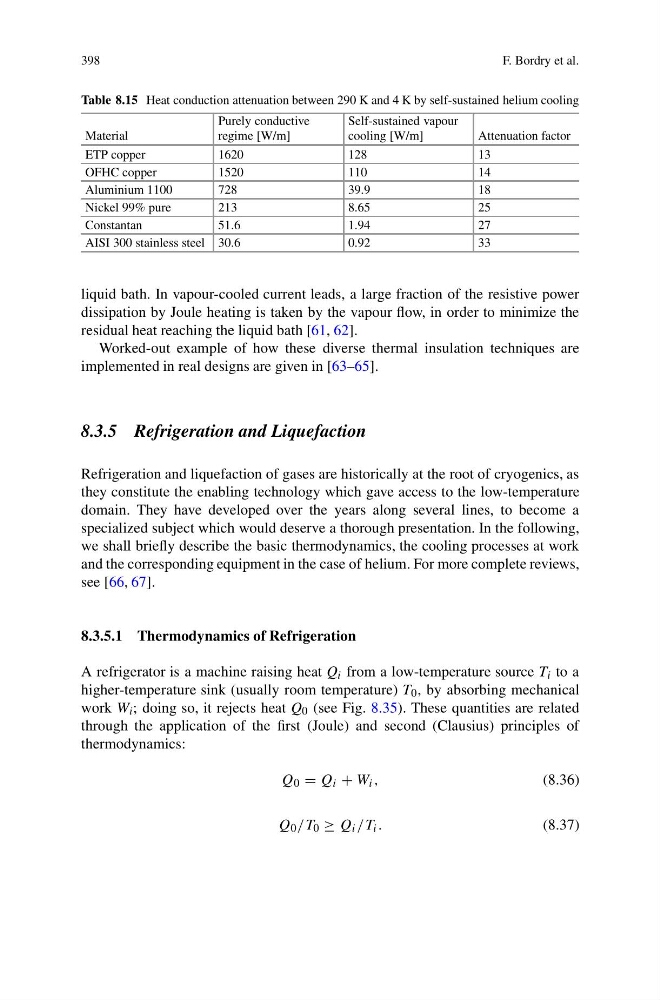
Table 8.15 Heat conduction attenuation between 290 K and 4 K by self-sustained helium cooling
Material
Purely conductive
regime [W/m]
Self-sustained vapour
cooling [W/m]
Attenuation factor
ETP copper
1620
128
13
OFHC copper
1520
110
14
Aluminium 1100
728
39.9
18
Nickel 99% pure
213
8.65
25
Constantan
51.6
1.94
27
AISI 300 stainless steel 30.6
0.92
33
liquid bath. In vapour-cooled current leads, a large fraction of the resistive power
dissipation by Joule heating is taken by the vapour flow, in order to minimize the
residual heat reaching the liquid bath [61, 62].
Worked-out example of how these diverse thermal insulation techniques are
implemented in real designs are given in [63–65].
8.3.5 Refrigeration and Liquefaction
Refrigeration and liquefaction of gases are historically at the root of cryogenics, as
they constitute the enabling technology which gave access to the low-temperature
domain. They have developed over the years along several lines, to become a
specialized subject which would deserve a thorough presentation. In the following,
we shall briefly describe the basic thermodynamics, the cooling processes at work
and the corresponding equipment in the case of helium. For more complete reviews,
see [66, 67].
8.3.5.1 Thermodynamics of Refrigeration
A refrigerator is a machine raising heat Q i from a low-temperature source T i to a
higher-temperature sink (usually room temperature) T 0 , by absorbing mechanical
work W i ; doing so, it rejects heat Q 0 (see Fig. 8.35). These quantities are related
through the application of the first (Joule) and second (Clausius) principles of
thermodynamics:
Q 0 = Q i + W i ,
(8.36)
Q 0 /T 0 ≥ Q i /T i .
(8.37)
F. Bordry et al.
Table 8.15 Heat conduction attenuation between 290 K and 4 K by self-sustained helium cooling
Material
Purely conductive
regime [W/m]
Self-sustained vapour
cooling [W/m]
Attenuation factor
ETP copper
1620
128
13
OFHC copper
1520
110
14
Aluminium 1100
728
39.9
18
Nickel 99% pure
213
8.65
25
Constantan
51.6
1.94
27
AISI 300 stainless steel 30.6
0.92
33
liquid bath. In vapour-cooled current leads, a large fraction of the resistive power
dissipation by Joule heating is taken by the vapour flow, in order to minimize the
residual heat reaching the liquid bath [61, 62].
Worked-out example of how these diverse thermal insulation techniques are
implemented in real designs are given in [63–65].
8.3.5 Refrigeration and Liquefaction
Refrigeration and liquefaction of gases are historically at the root of cryogenics, as
they constitute the enabling technology which gave access to the low-temperature
domain. They have developed over the years along several lines, to become a
specialized subject which would deserve a thorough presentation. In the following,
we shall briefly describe the basic thermodynamics, the cooling processes at work
and the corresponding equipment in the case of helium. For more complete reviews,
see [66, 67].
8.3.5.1 Thermodynamics of Refrigeration
A refrigerator is a machine raising heat Q i from a low-temperature source T i to a
higher-temperature sink (usually room temperature) T 0 , by absorbing mechanical
work W i ; doing so, it rejects heat Q 0 (see Fig. 8.35). These quantities are related
through the application of the first (Joule) and second (Clausius) principles of
thermodynamics:
Q 0 = Q i + W i ,
(8.36)
Q 0 /T 0 ≥ Q i /T i .
(8.37)