

8 Accelerator Engineering and Technology: Accelerator Technology
397
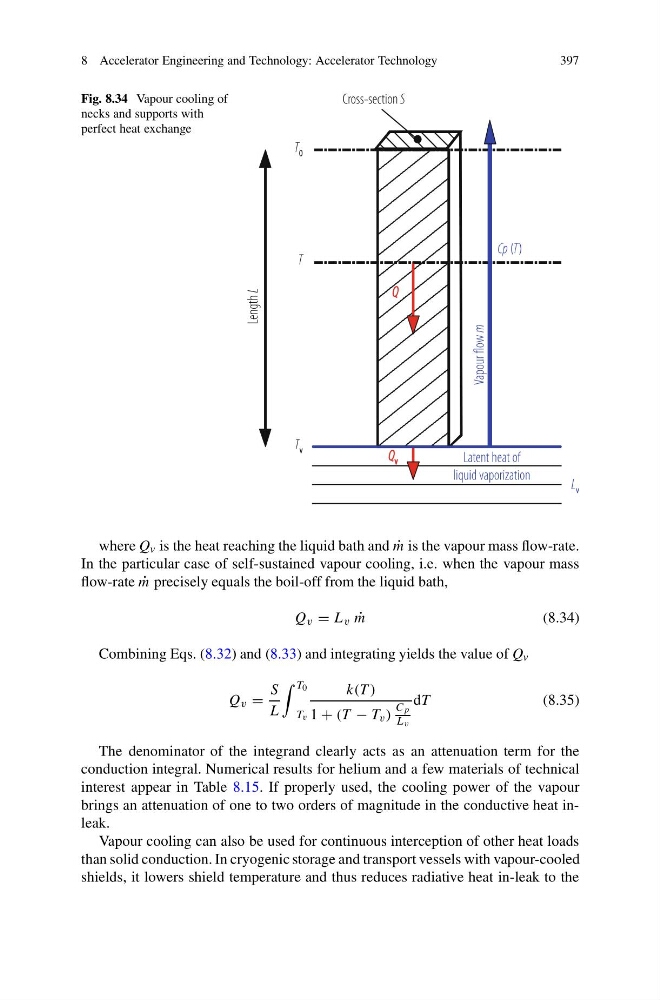
Fig. 8.34 Vapour cooling of
necks and supports with
perfect heat exchange
where Q v is the heat reaching the liquid bath and ˙
m is the vapour mass flow-rate.
In the particular case of self-sustained vapour cooling, i.e. when the vapour mass
flow-rate ˙
m precisely equals the boil-off from the liquid bath,
Q v = L v ˙
m
(8.34)
Combining Eqs. (8.32) and (8.33) and integrating yields the value of Q v
Q v =
S
L
T 0
T v
k(T )
1 + (T − T v )
C p
L v
dT
(8.35)
The denominator of the integrand clearly acts as an attenuation term for the
conduction integral. Numerical results for helium and a few materials of technical
interest appear in Table 8.15. If properly used, the cooling power of the vapour
brings an attenuation of one to two orders of magnitude in the conductive heat inleak.
Vapour cooling can also be used for continuous interception of other heat loads
than solid conduction. In cryogenic storage and transport vessels with vapour-cooled
shields, it lowers shield temperature and thus reduces radiative heat in-leak to the
397
Fig. 8.34 Vapour cooling of
necks and supports with
perfect heat exchange
where Q v is the heat reaching the liquid bath and ˙
m is the vapour mass flow-rate.
In the particular case of self-sustained vapour cooling, i.e. when the vapour mass
flow-rate ˙
m precisely equals the boil-off from the liquid bath,
Q v = L v ˙
m
(8.34)
Combining Eqs. (8.32) and (8.33) and integrating yields the value of Q v
Q v =
S
L
T 0
T v
k(T )
1 + (T − T v )
C p
L v
dT
(8.35)
The denominator of the integrand clearly acts as an attenuation term for the
conduction integral. Numerical results for helium and a few materials of technical
interest appear in Table 8.15. If properly used, the cooling power of the vapour
brings an attenuation of one to two orders of magnitude in the conductive heat inleak.
Vapour cooling can also be used for continuous interception of other heat loads
than solid conduction. In cryogenic storage and transport vessels with vapour-cooled
shields, it lowers shield temperature and thus reduces radiative heat in-leak to the