

396
F. Bordry et al.
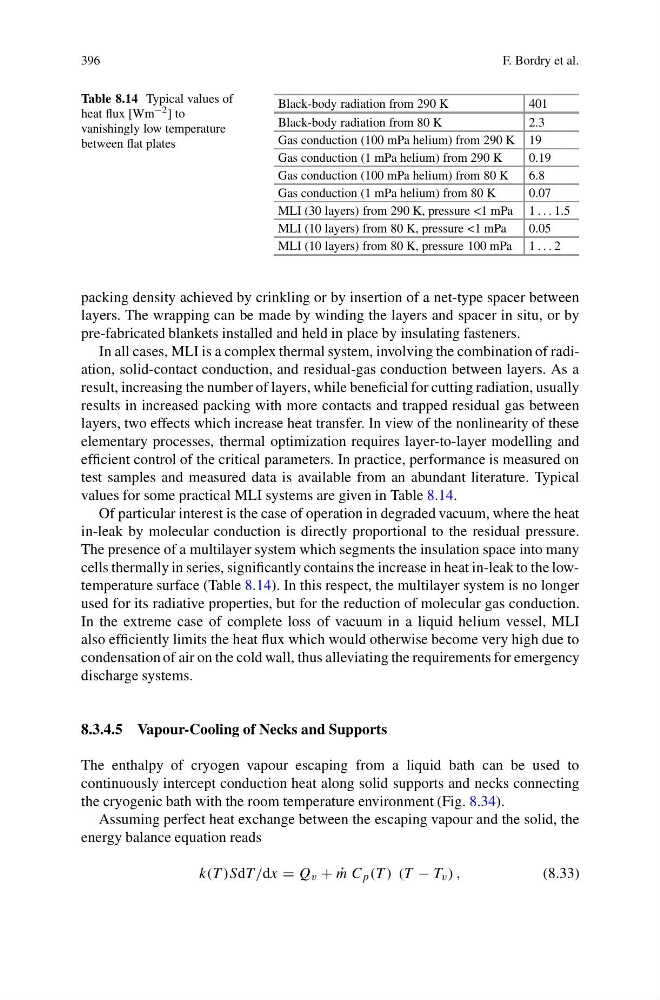
Table 8.14 Typical values of
heat flux [Wm −2 ] to
vanishingly low temperature
between flat plates
Black-body radiation from 290 K
401
Black-body radiation from 80 K
2.3
Gas conduction (100 mPa helium) from 290 K 19
Gas conduction (1 mPa helium) from 290 K
0.19
Gas conduction (100 mPa helium) from 80 K
6.8
Gas conduction (1 mPa helium) from 80 K
0.07
MLI (30 layers) from 290 K, pressure <1 mPa 1 . . . 1.5
MLI (10 layers) from 80 K, pressure <1 mPa
0.05
MLI (10 layers) from 80 K, pressure 100 mPa 1 . . . 2
packing density achieved by crinkling or by insertion of a net-type spacer between
layers. The wrapping can be made by winding the layers and spacer in situ, or by
pre-fabricated blankets installed and held in place by insulating fasteners.
In all cases, MLI is a complex thermal system, involving the combination of radiation, solid-contact conduction, and residual-gas conduction between layers. As a
result, increasing the number of layers, while beneficial for cutting radiation, usually
results in increased packing with more contacts and trapped residual gas between
layers, two effects which increase heat transfer. In view of the nonlinearity of these
elementary processes, thermal optimization requires layer-to-layer modelling and
efficient control of the critical parameters. In practice, performance is measured on
test samples and measured data is available from an abundant literature. Typical
values for some practical MLI systems are given in Table 8.14.
Of particular interest is the case of operation in degraded vacuum, where the heat
in-leak by molecular conduction is directly proportional to the residual pressure.
The presence of a multilayer system which segments the insulation space into many
cells thermally in series, significantly contains the increase in heat in-leak to the lowtemperature surface (Table 8.14). In this respect, the multilayer system is no longer
used for its radiative properties, but for the reduction of molecular gas conduction.
In the extreme case of complete loss of vacuum in a liquid helium vessel, MLI
also efficiently limits the heat flux which would otherwise become very high due to
condensation of air on the cold wall, thus alleviating the requirements for emergency
discharge systems.
8.3.4.5 Vapour-Cooling of Necks and Supports
The enthalpy of cryogen vapour escaping from a liquid bath can be used to
continuously intercept conduction heat along solid supports and necks connecting
the cryogenic bath with the room temperature environment (Fig. 8.34).
Assuming perfect heat exchange between the escaping vapour and the solid, the
energy balance equation reads
k(T )SdT /dx = Q v + ˙
m C p (T ) (T − T v ) ,
(8.33)
F. Bordry et al.
Table 8.14 Typical values of
heat flux [Wm −2 ] to
vanishingly low temperature
between flat plates
Black-body radiation from 290 K
401
Black-body radiation from 80 K
2.3
Gas conduction (100 mPa helium) from 290 K 19
Gas conduction (1 mPa helium) from 290 K
0.19
Gas conduction (100 mPa helium) from 80 K
6.8
Gas conduction (1 mPa helium) from 80 K
0.07
MLI (30 layers) from 290 K, pressure <1 mPa 1 . . . 1.5
MLI (10 layers) from 80 K, pressure <1 mPa
0.05
MLI (10 layers) from 80 K, pressure 100 mPa 1 . . . 2
packing density achieved by crinkling or by insertion of a net-type spacer between
layers. The wrapping can be made by winding the layers and spacer in situ, or by
pre-fabricated blankets installed and held in place by insulating fasteners.
In all cases, MLI is a complex thermal system, involving the combination of radiation, solid-contact conduction, and residual-gas conduction between layers. As a
result, increasing the number of layers, while beneficial for cutting radiation, usually
results in increased packing with more contacts and trapped residual gas between
layers, two effects which increase heat transfer. In view of the nonlinearity of these
elementary processes, thermal optimization requires layer-to-layer modelling and
efficient control of the critical parameters. In practice, performance is measured on
test samples and measured data is available from an abundant literature. Typical
values for some practical MLI systems are given in Table 8.14.
Of particular interest is the case of operation in degraded vacuum, where the heat
in-leak by molecular conduction is directly proportional to the residual pressure.
The presence of a multilayer system which segments the insulation space into many
cells thermally in series, significantly contains the increase in heat in-leak to the lowtemperature surface (Table 8.14). In this respect, the multilayer system is no longer
used for its radiative properties, but for the reduction of molecular gas conduction.
In the extreme case of complete loss of vacuum in a liquid helium vessel, MLI
also efficiently limits the heat flux which would otherwise become very high due to
condensation of air on the cold wall, thus alleviating the requirements for emergency
discharge systems.
8.3.4.5 Vapour-Cooling of Necks and Supports
The enthalpy of cryogen vapour escaping from a liquid bath can be used to
continuously intercept conduction heat along solid supports and necks connecting
the cryogenic bath with the room temperature environment (Fig. 8.34).
Assuming perfect heat exchange between the escaping vapour and the solid, the
energy balance equation reads
k(T )SdT /dx = Q v + ˙
m C p (T ) (T − T v ) ,
(8.33)