

8 Accelerator Engineering and Technology: Accelerator Technology
393
8.3.4.1 Solid Conduction
Heat conduction in solids is represented by Fourier’s law, expressing proportionality
of heat flux with thermal gradient
Q = k(T )SdT /dx.
(8.25)
This equation also defines the thermal conductivity k(T) of the material, which
varies with temperature. Conduction along a solid rod of length L, cross section S
spanning a temperature range [T 1 , T 2 ], e.g. the support strut of a cryogenic vessel,
is then given by the integral form
Q =
S
L
T 2
T 1
k(T )dT ,
(8.26)
where
T 2
T 1
k(T )dT is called the thermal conductivity integral.
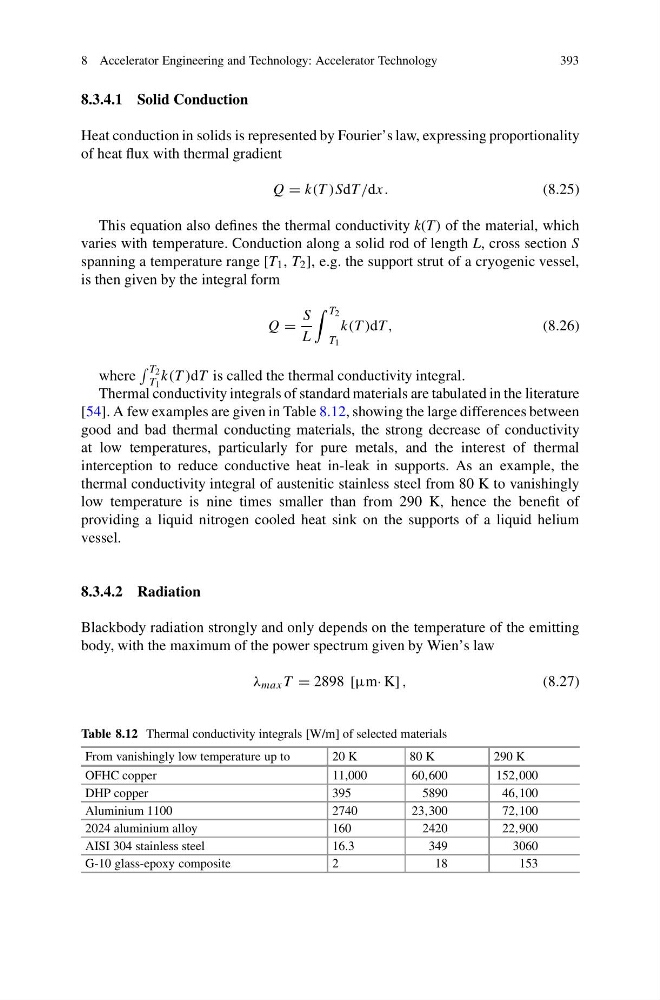
Thermal conductivity integrals of standard materials are tabulated in the literature
[54]. A few examples are given in Table 8.12, showing the large differences between
good and bad thermal conducting materials, the strong decrease of conductivity
at low temperatures, particularly for pure metals, and the interest of thermal
interception to reduce conductive heat in-leak in supports. As an example, the
thermal conductivity integral of austenitic stainless steel from 80 K to vanishingly
low temperature is nine times smaller than from 290 K, hence the benefit of
providing a liquid nitrogen cooled heat sink on the supports of a liquid helium
vessel.
8.3.4.2 Radiation
Blackbody radiation strongly and only depends on the temperature of the emitting
body, with the maximum of the power spectrum given by Wien’s law
λ max T = 2898 [μm· K] ,
(8.27)
Table 8.12 Thermal conductivity integrals [W/m] of selected materials
From vanishingly low temperature up to
20 K
80 K
290 K
OFHC copper
11,000
60,600
152,000
DHP copper
395
5890
46,100
Aluminium 1100
2740
23,300
72,100
2024 aluminium alloy
160
2420
22,900
AISI 304 stainless steel
16.3
349
3060
G-10 glass-epoxy composite
2
18
153
393
8.3.4.1 Solid Conduction
Heat conduction in solids is represented by Fourier’s law, expressing proportionality
of heat flux with thermal gradient
Q = k(T )SdT /dx.
(8.25)
This equation also defines the thermal conductivity k(T) of the material, which
varies with temperature. Conduction along a solid rod of length L, cross section S
spanning a temperature range [T 1 , T 2 ], e.g. the support strut of a cryogenic vessel,
is then given by the integral form
Q =
S
L
T 2
T 1
k(T )dT ,
(8.26)
where
T 2
T 1
k(T )dT is called the thermal conductivity integral.
Thermal conductivity integrals of standard materials are tabulated in the literature
[54]. A few examples are given in Table 8.12, showing the large differences between
good and bad thermal conducting materials, the strong decrease of conductivity
at low temperatures, particularly for pure metals, and the interest of thermal
interception to reduce conductive heat in-leak in supports. As an example, the
thermal conductivity integral of austenitic stainless steel from 80 K to vanishingly
low temperature is nine times smaller than from 290 K, hence the benefit of
providing a liquid nitrogen cooled heat sink on the supports of a liquid helium
vessel.
8.3.4.2 Radiation
Blackbody radiation strongly and only depends on the temperature of the emitting
body, with the maximum of the power spectrum given by Wien’s law
λ max T = 2898 [μm· K] ,
(8.27)
Table 8.12 Thermal conductivity integrals [W/m] of selected materials
From vanishingly low temperature up to
20 K
80 K
290 K
OFHC copper
11,000
60,600
152,000
DHP copper
395
5890
46,100
Aluminium 1100
2740
23,300
72,100
2024 aluminium alloy
160
2420
22,900
AISI 304 stainless steel
16.3
349
3060
G-10 glass-epoxy composite
2
18
153