

392
F. Bordry et al.
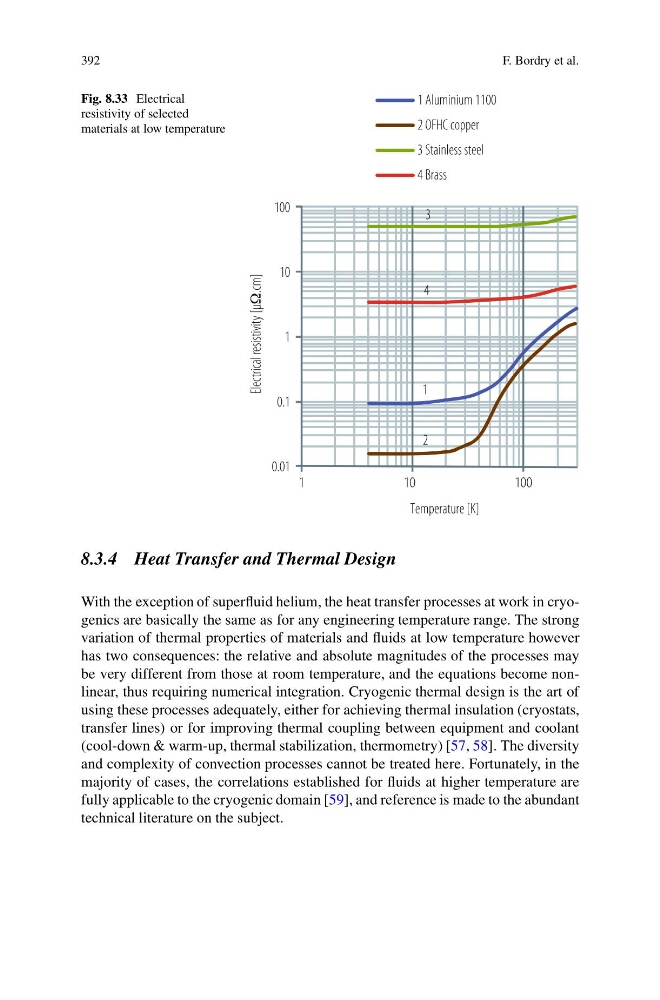
Fig. 8.33 Electrical
resistivity of selected
materials at low temperature
8.3.4 Heat Transfer and Thermal Design
With the exception of superfluid helium, the heat transfer processes at work in cryogenics are basically the same as for any engineering temperature range. The strong
variation of thermal properties of materials and fluids at low temperature however
has two consequences: the relative and absolute magnitudes of the processes may
be very different from those at room temperature, and the equations become nonlinear, thus requiring numerical integration. Cryogenic thermal design is the art of
using these processes adequately, either for achieving thermal insulation (cryostats,
transfer lines) or for improving thermal coupling between equipment and coolant
(cool-down & warm-up, thermal stabilization, thermometry) [57, 58]. The diversity
and complexity of convection processes cannot be treated here. Fortunately, in the
majority of cases, the correlations established for fluids at higher temperature are
fully applicable to the cryogenic domain [59], and reference is made to the abundant
technical literature on the subject.
F. Bordry et al.
Fig. 8.33 Electrical
resistivity of selected
materials at low temperature
8.3.4 Heat Transfer and Thermal Design
With the exception of superfluid helium, the heat transfer processes at work in cryogenics are basically the same as for any engineering temperature range. The strong
variation of thermal properties of materials and fluids at low temperature however
has two consequences: the relative and absolute magnitudes of the processes may
be very different from those at room temperature, and the equations become nonlinear, thus requiring numerical integration. Cryogenic thermal design is the art of
using these processes adequately, either for achieving thermal insulation (cryostats,
transfer lines) or for improving thermal coupling between equipment and coolant
(cool-down & warm-up, thermal stabilization, thermometry) [57, 58]. The diversity
and complexity of convection processes cannot be treated here. Fortunately, in the
majority of cases, the correlations established for fluids at higher temperature are
fully applicable to the cryogenic domain [59], and reference is made to the abundant
technical literature on the subject.