

394
F. Bordry et al.
and the total power radiated by an surface area A given by Stefan-Boltzmann’s
law
Q = σ A T
4 ,
(8.28)
with Stefan-Boltzmann’s constant σ 5.67 10 −8 W m −2 K −4 . The dependence
of the radiative heat flux on the fourth power of temperature makes a strong plea for
radiation shielding of low-temperature vessels with one or several shields cooled
by liquid nitrogen or cold helium vapour. Technical radiating surfaces are usually
described as “gray” bodies, characterized by an emissivity ε smaller than 1:
Q = ε σ A T
4 .
(8.29)
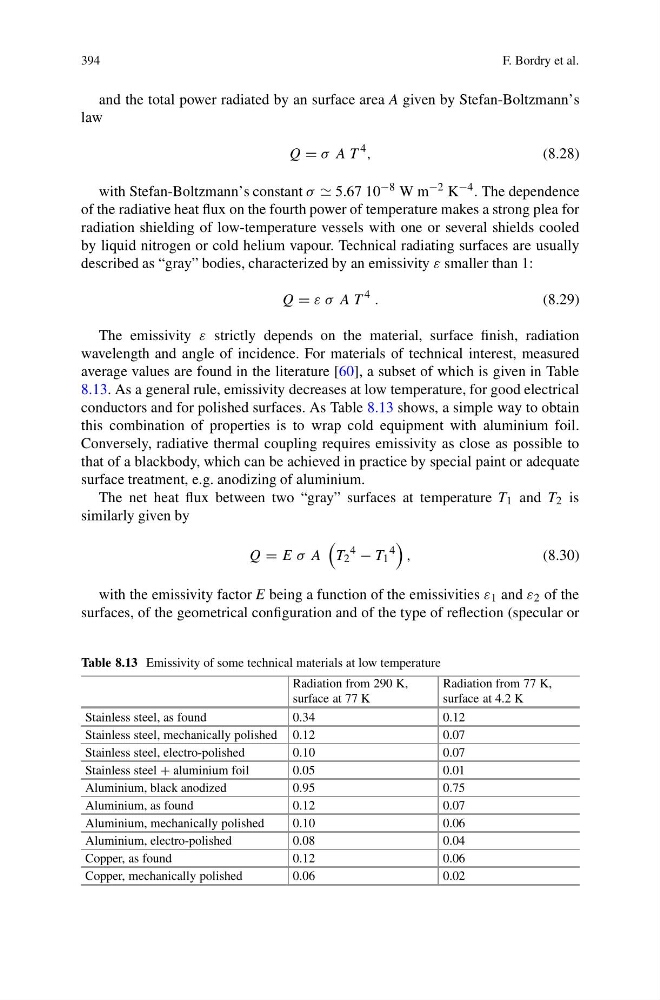
The emissivity ε strictly depends on the material, surface finish, radiation
wavelength and angle of incidence. For materials of technical interest, measured
average values are found in the literature [60], a subset of which is given in Table
8.13. As a general rule, emissivity decreases at low temperature, for good electrical
conductors and for polished surfaces. As Table 8.13 shows, a simple way to obtain
this combination of properties is to wrap cold equipment with aluminium foil.
Conversely, radiative thermal coupling requires emissivity as close as possible to
that of a blackbody, which can be achieved in practice by special paint or adequate
surface treatment, e.g. anodizing of aluminium.
The net heat flux between two “gray” surfaces at temperature T 1 and T 2 is
similarly given by
Q = E σ A
T 2
4
− T 1
4
,
(8.30)
with the emissivity factor E being a function of the emissivities ε 1 and ε 2 of the
surfaces, of the geometrical configuration and of the type of reflection (specular or
Table 8.13 Emissivity of some technical materials at low temperature
Radiation from 290 K,
surface at 77 K
Radiation from 77 K,
surface at 4.2 K
Stainless steel, as found
0.34
0.12
Stainless steel, mechanically polished 0.12
0.07
Stainless steel, electro-polished
0.10
0.07
Stainless steel + aluminium foil
0.05
0.01
Aluminium, black anodized
0.95
0.75
Aluminium, as found
0.12
0.07
Aluminium, mechanically polished
0.10
0.06
Aluminium, electro-polished
0.08
0.04
Copper, as found
0.12
0.06
Copper, mechanically polished
0.06
0.02
F. Bordry et al.
and the total power radiated by an surface area A given by Stefan-Boltzmann’s
law
Q = σ A T
4 ,
(8.28)
with Stefan-Boltzmann’s constant σ 5.67 10 −8 W m −2 K −4 . The dependence
of the radiative heat flux on the fourth power of temperature makes a strong plea for
radiation shielding of low-temperature vessels with one or several shields cooled
by liquid nitrogen or cold helium vapour. Technical radiating surfaces are usually
described as “gray” bodies, characterized by an emissivity ε smaller than 1:
Q = ε σ A T
4 .
(8.29)
The emissivity ε strictly depends on the material, surface finish, radiation
wavelength and angle of incidence. For materials of technical interest, measured
average values are found in the literature [60], a subset of which is given in Table
8.13. As a general rule, emissivity decreases at low temperature, for good electrical
conductors and for polished surfaces. As Table 8.13 shows, a simple way to obtain
this combination of properties is to wrap cold equipment with aluminium foil.
Conversely, radiative thermal coupling requires emissivity as close as possible to
that of a blackbody, which can be achieved in practice by special paint or adequate
surface treatment, e.g. anodizing of aluminium.
The net heat flux between two “gray” surfaces at temperature T 1 and T 2 is
similarly given by
Q = E σ A
T 2
4
− T 1
4
,
(8.30)
with the emissivity factor E being a function of the emissivities ε 1 and ε 2 of the
surfaces, of the geometrical configuration and of the type of reflection (specular or
Table 8.13 Emissivity of some technical materials at low temperature
Radiation from 290 K,
surface at 77 K
Radiation from 77 K,
surface at 4.2 K
Stainless steel, as found
0.34
0.12
Stainless steel, mechanically polished 0.12
0.07
Stainless steel, electro-polished
0.10
0.07
Stainless steel + aluminium foil
0.05
0.01
Aluminium, black anodized
0.95
0.75
Aluminium, as found
0.12
0.07
Aluminium, mechanically polished
0.10
0.06
Aluminium, electro-polished
0.08
0.04
Copper, as found
0.12
0.06
Copper, mechanically polished
0.06
0.02