

8 Accelerator Engineering and Technology: Accelerator Technology
389
The use of mono-phase supercritical helium in forced-flow systems avoids the
problems of two-phase flow. However, the strongly varying properties of the fluid
in the vicinity of the critical point may create other issues, such as density wave
oscillations. More fundamentally, supercritical helium exhibits no latent heat, so
that applied heat loads result in temperature increases which must be contained by
high flow-rate or periodic re-cooling in extended systems.
8.3.3 Materials at Low Temperatures
Designing and building cryogenic apparatus require good knowledge of material
properties at low temperatures [54–56], some of which may vary by orders of
magnitude between ambient and cryogenic conditions, or even exhibit discontinuous behaviour. Of particular concern is the ductile-to-brittle transition undergone
by metals and alloys of body-centered cubic and to a lesser extent, hexagonal
close-packed structures: these materials should always be used above their ductileto-brittle transition temperature.
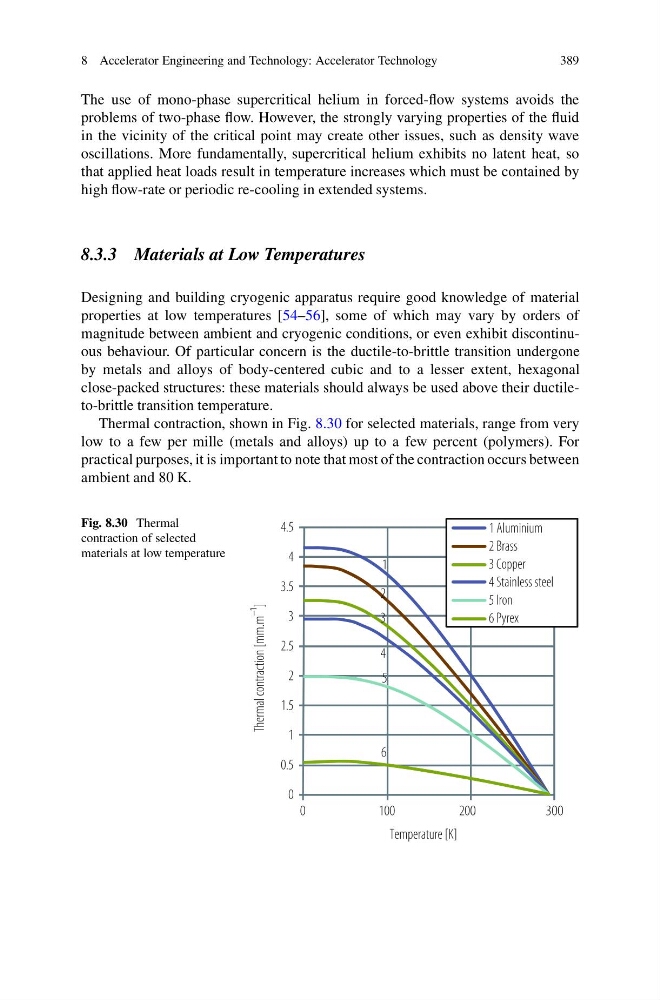
Thermal contraction, shown in Fig. 8.30 for selected materials, range from very
low to a few per mille (metals and alloys) up to a few percent (polymers). For
practical purposes, it is important to note that most of the contraction occurs between
ambient and 80 K.
Fig. 8.30 Thermal
contraction of selected
materials at low temperature
389
The use of mono-phase supercritical helium in forced-flow systems avoids the
problems of two-phase flow. However, the strongly varying properties of the fluid
in the vicinity of the critical point may create other issues, such as density wave
oscillations. More fundamentally, supercritical helium exhibits no latent heat, so
that applied heat loads result in temperature increases which must be contained by
high flow-rate or periodic re-cooling in extended systems.
8.3.3 Materials at Low Temperatures
Designing and building cryogenic apparatus require good knowledge of material
properties at low temperatures [54–56], some of which may vary by orders of
magnitude between ambient and cryogenic conditions, or even exhibit discontinuous behaviour. Of particular concern is the ductile-to-brittle transition undergone
by metals and alloys of body-centered cubic and to a lesser extent, hexagonal
close-packed structures: these materials should always be used above their ductileto-brittle transition temperature.
Thermal contraction, shown in Fig. 8.30 for selected materials, range from very
low to a few per mille (metals and alloys) up to a few percent (polymers). For
practical purposes, it is important to note that most of the contraction occurs between
ambient and 80 K.
Fig. 8.30 Thermal
contraction of selected
materials at low temperature