

390
F. Bordry et al.
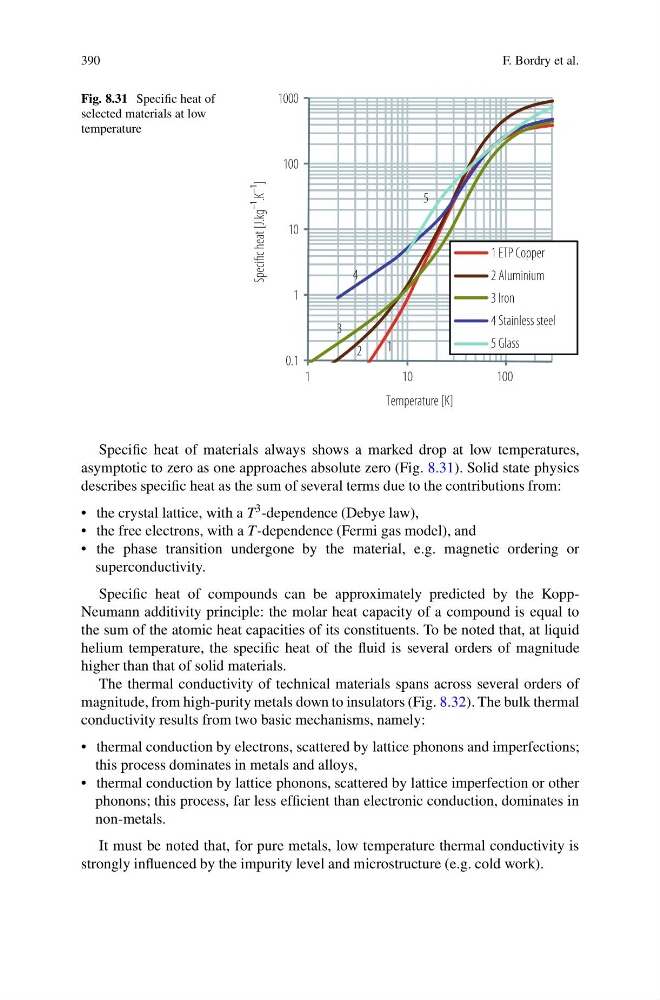
Fig. 8.31 Specific heat of
selected materials at low
temperature
Specific heat of materials always shows a marked drop at low temperatures,
asymptotic to zero as one approaches absolute zero (Fig. 8.31). Solid state physics
describes specific heat as the sum of several terms due to the contributions from:
• the crystal lattice, with a T 3 -dependence (Debye law),
• the free electrons, with a T-dependence (Fermi gas model), and
• the phase transition undergone by the material, e.g. magnetic ordering or
superconductivity.
Specific heat of compounds can be approximately predicted by the KoppNeumann additivity principle: the molar heat capacity of a compound is equal to
the sum of the atomic heat capacities of its constituents. To be noted that, at liquid
helium temperature, the specific heat of the fluid is several orders of magnitude
higher than that of solid materials.
The thermal conductivity of technical materials spans across several orders of
magnitude, from high-purity metals down to insulators (Fig. 8.32). The bulk thermal
conductivity results from two basic mechanisms, namely:
• thermal conduction by electrons, scattered by lattice phonons and imperfections;
this process dominates in metals and alloys,
• thermal conduction by lattice phonons, scattered by lattice imperfection or other
phonons; this process, far less efficient than electronic conduction, dominates in
non-metals.
It must be noted that, for pure metals, low temperature thermal conductivity is
strongly influenced by the impurity level and microstructure (e.g. cold work).
F. Bordry et al.
Fig. 8.31 Specific heat of
selected materials at low
temperature
Specific heat of materials always shows a marked drop at low temperatures,
asymptotic to zero as one approaches absolute zero (Fig. 8.31). Solid state physics
describes specific heat as the sum of several terms due to the contributions from:
• the crystal lattice, with a T 3 -dependence (Debye law),
• the free electrons, with a T-dependence (Fermi gas model), and
• the phase transition undergone by the material, e.g. magnetic ordering or
superconductivity.
Specific heat of compounds can be approximately predicted by the KoppNeumann additivity principle: the molar heat capacity of a compound is equal to
the sum of the atomic heat capacities of its constituents. To be noted that, at liquid
helium temperature, the specific heat of the fluid is several orders of magnitude
higher than that of solid materials.
The thermal conductivity of technical materials spans across several orders of
magnitude, from high-purity metals down to insulators (Fig. 8.32). The bulk thermal
conductivity results from two basic mechanisms, namely:
• thermal conduction by electrons, scattered by lattice phonons and imperfections;
this process dominates in metals and alloys,
• thermal conduction by lattice phonons, scattered by lattice imperfection or other
phonons; this process, far less efficient than electronic conduction, dominates in
non-metals.
It must be noted that, for pure metals, low temperature thermal conductivity is
strongly influenced by the impurity level and microstructure (e.g. cold work).