

388
F. Bordry et al.
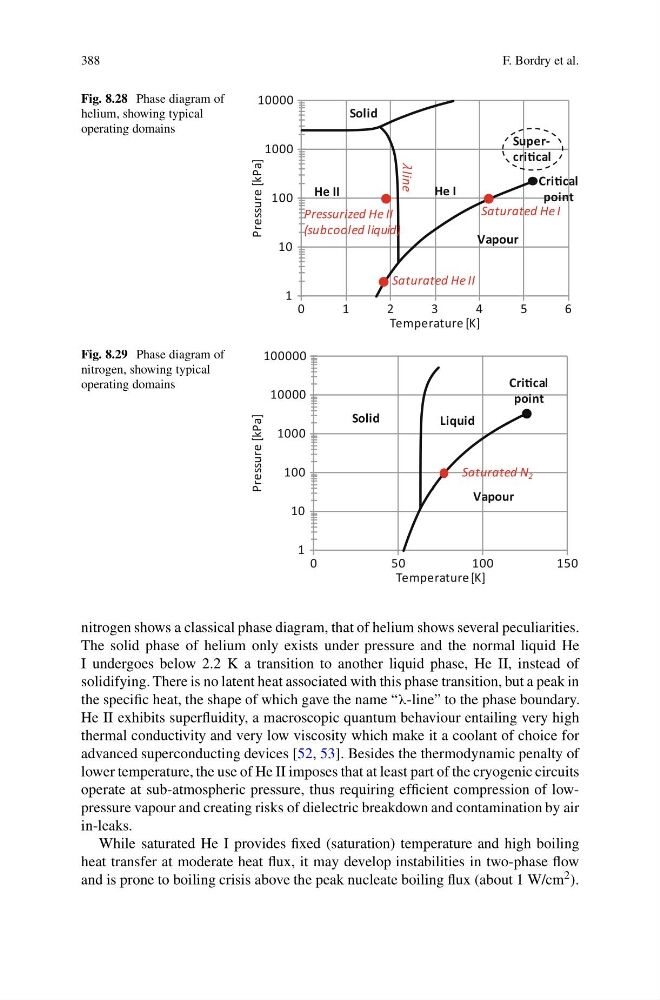
Fig. 8.28 Phase diagram of
helium, showing typical
operating domains
1
10
100
1000
10000
0
1
2
3
4
5
6
Pressure [kPa]
Temperature [K]
Pressurized He II
(subcooled liquid)
Saturated He I
Saturated He II
Vapour
He II
He I
line
Solid
CriƟcal
point
SupercriƟcal
Fig. 8.29 Phase diagram of
nitrogen, showing typical
operating domains
1
10
100
1000
10000
100000
0
50
100
150
Pressure [kPa]
Temperature [K]
Saturated N 2
Vapour
Liquid
Solid
CriƟcal
point
nitrogen shows a classical phase diagram, that of helium shows several peculiarities.
The solid phase of helium only exists under pressure and the normal liquid He
I undergoes below 2.2 K a transition to another liquid phase, He II, instead of
solidifying. There is no latent heat associated with this phase transition, but a peak in
the specific heat, the shape of which gave the name “λ-line” to the phase boundary.
He II exhibits superfluidity, a macroscopic quantum behaviour entailing very high
thermal conductivity and very low viscosity which make it a coolant of choice for
advanced superconducting devices [52, 53]. Besides the thermodynamic penalty of
lower temperature, the use of He II imposes that at least part of the cryogenic circuits
operate at sub-atmospheric pressure, thus requiring efficient compression of lowpressure vapour and creating risks of dielectric breakdown and contamination by air
in-leaks.
While saturated He I provides fixed (saturation) temperature and high boiling
heat transfer at moderate heat flux, it may develop instabilities in two-phase flow
and is prone to boiling crisis above the peak nucleate boiling flux (about 1 W/cm 2 ).
F. Bordry et al.
Fig. 8.28 Phase diagram of
helium, showing typical
operating domains
1
10
100
1000
10000
0
1
2
3
4
5
6
Pressure [kPa]
Temperature [K]
Pressurized He II
(subcooled liquid)
Saturated He I
Saturated He II
Vapour
He II
He I
line
Solid
CriƟcal
point
SupercriƟcal
Fig. 8.29 Phase diagram of
nitrogen, showing typical
operating domains
1
10
100
1000
10000
100000
0
50
100
150
Pressure [kPa]
Temperature [K]
Saturated N 2
Vapour
Liquid
Solid
CriƟcal
point
nitrogen shows a classical phase diagram, that of helium shows several peculiarities.
The solid phase of helium only exists under pressure and the normal liquid He
I undergoes below 2.2 K a transition to another liquid phase, He II, instead of
solidifying. There is no latent heat associated with this phase transition, but a peak in
the specific heat, the shape of which gave the name “λ-line” to the phase boundary.
He II exhibits superfluidity, a macroscopic quantum behaviour entailing very high
thermal conductivity and very low viscosity which make it a coolant of choice for
advanced superconducting devices [52, 53]. Besides the thermodynamic penalty of
lower temperature, the use of He II imposes that at least part of the cryogenic circuits
operate at sub-atmospheric pressure, thus requiring efficient compression of lowpressure vapour and creating risks of dielectric breakdown and contamination by air
in-leaks.
While saturated He I provides fixed (saturation) temperature and high boiling
heat transfer at moderate heat flux, it may develop instabilities in two-phase flow
and is prone to boiling crisis above the peak nucleate boiling flux (about 1 W/cm 2 ).