

8 Accelerator Engineering and Technology: Accelerator Technology
387
Table 8.10 Vaporization of
cryogen at normal boiling
point under 1 W applied heat
load
Cryogen [mg/s] [l/h liquid] [l/min gas NTP]
Helium
48
1.38
16.4
Nitrogen
5
0.02
0.24
state boil-off constitute a practical method for assessing the heat load of a cryostat
holding a saturated cryogen bath.
8.3.2.3 Cryogen Usage for Equipment Cooldown
For both fluids, the specific heat of the vapour over the temperature range from liquid
saturation to ambient is comparable to or larger than the latent heat of vaporization.
This provides a valuable cooling potential at intermediate temperature, which can be
used for thermal shielding or for pre-cooling of equipment from room temperature.
The heat balance equation for cooling a mass of, say iron m Fe of specific heat
C Fe (T) at temperature T by vaporizing a mass dm of cryogenic liquid at saturation
temperature T v , latent heat of vaporization L v and vapour specific heat C p (taken as
constant), is assuming perfect heat exchange with the liquid and the vapour:
m Fe C Fe (T )dT =
L v + C p (T − T v )
dm.
(8.21)
Hence the specific liquid cryogen requirement for cool-down from temperature
T 0 :
m
m Fe
=
T
T 0
C F e (T )dT
L v + C p (T − T v )
.
(8.22)
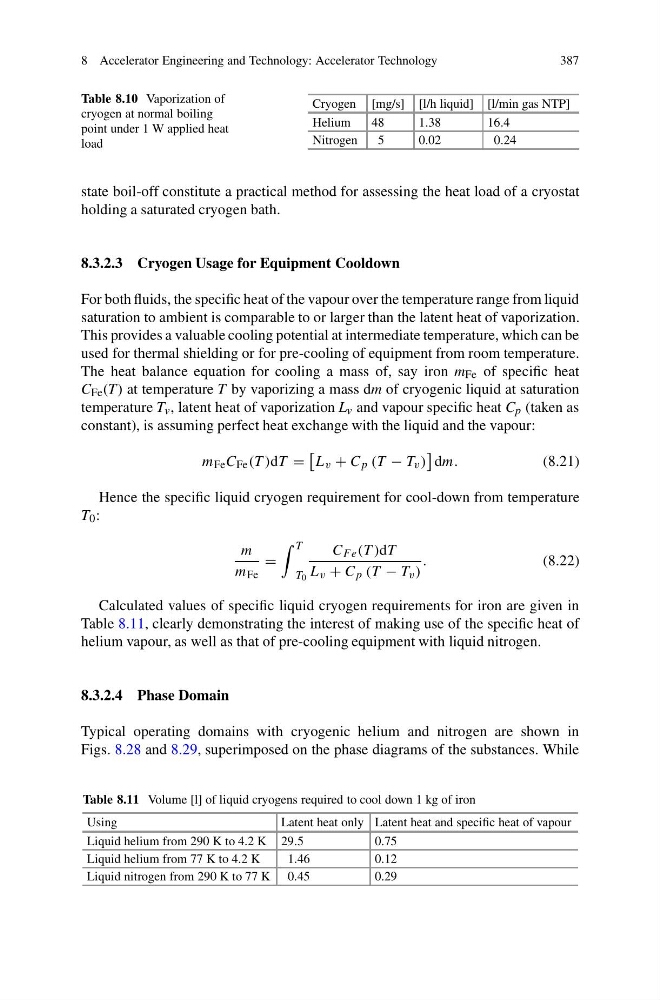
Calculated values of specific liquid cryogen requirements for iron are given in
Table 8.11, clearly demonstrating the interest of making use of the specific heat of
helium vapour, as well as that of pre-cooling equipment with liquid nitrogen.
8.3.2.4 Phase Domain
Typical operating domains with cryogenic helium and nitrogen are shown in
Figs. 8.28 and 8.29, superimposed on the phase diagrams of the substances. While
Table 8.11 Volume [l] of liquid cryogens required to cool down 1 kg of iron
Using
Latent heat only Latent heat and specific heat of vapour
Liquid helium from 290 K to 4.2 K 29.5
0.75
Liquid helium from 77 K to 4.2 K
1.46
0.12
Liquid nitrogen from 290 K to 77 K 0.45
0.29
387
Table 8.10 Vaporization of
cryogen at normal boiling
point under 1 W applied heat
load
Cryogen [mg/s] [l/h liquid] [l/min gas NTP]
Helium
48
1.38
16.4
Nitrogen
5
0.02
0.24
state boil-off constitute a practical method for assessing the heat load of a cryostat
holding a saturated cryogen bath.
8.3.2.3 Cryogen Usage for Equipment Cooldown
For both fluids, the specific heat of the vapour over the temperature range from liquid
saturation to ambient is comparable to or larger than the latent heat of vaporization.
This provides a valuable cooling potential at intermediate temperature, which can be
used for thermal shielding or for pre-cooling of equipment from room temperature.
The heat balance equation for cooling a mass of, say iron m Fe of specific heat
C Fe (T) at temperature T by vaporizing a mass dm of cryogenic liquid at saturation
temperature T v , latent heat of vaporization L v and vapour specific heat C p (taken as
constant), is assuming perfect heat exchange with the liquid and the vapour:
m Fe C Fe (T )dT =
L v + C p (T − T v )
dm.
(8.21)
Hence the specific liquid cryogen requirement for cool-down from temperature
T 0 :
m
m Fe
=
T
T 0
C F e (T )dT
L v + C p (T − T v )
.
(8.22)
Calculated values of specific liquid cryogen requirements for iron are given in
Table 8.11, clearly demonstrating the interest of making use of the specific heat of
helium vapour, as well as that of pre-cooling equipment with liquid nitrogen.
8.3.2.4 Phase Domain
Typical operating domains with cryogenic helium and nitrogen are shown in
Figs. 8.28 and 8.29, superimposed on the phase diagrams of the substances. While
Table 8.11 Volume [l] of liquid cryogens required to cool down 1 kg of iron
Using
Latent heat only Latent heat and specific heat of vapour
Liquid helium from 290 K to 4.2 K 29.5
0.75
Liquid helium from 77 K to 4.2 K
1.46
0.12
Liquid nitrogen from 290 K to 77 K 0.45
0.29