

386
F. Bordry et al.
Table 8.8 Characteristic temperature [K] of cryogenic fluids
Cryogen
Triple point
Normal boiling point
Critical point
Methane
90.7
111.6
190.5
Oxygen
54.4
90.2
154.6
Argon
83.8
87.3
150.9
Nitrogen
63.1
77.3
126.2
Neon
24.6
27.1
44.4
Hydrogen
13.8
20.4
33.2
Helium
2.2 a
4.2
5.2
a λ point
Table 8.9 Properties of
helium and nitrogen
compared to water
Property
Helium Nitrogen Water
Normal boiling point [K]
4.2
77
373
Critical temperature [K]
5.2
126
647
Critical pressure [bar]
2.3
34
221
Liquid density a [kg/m 3 ]
125
808
960
Liquid/vapour density ratio
7.4
175
1600
Heat of vaporization a [kJ/kg] 20.4
199
2260
Liquid viscosity a [μPl]
3.3
152
278
a At normal boiling point
devices [50, 51], and nitrogen for its wide availability and ease of use for pre-cooling
equipment and for thermal shielding.
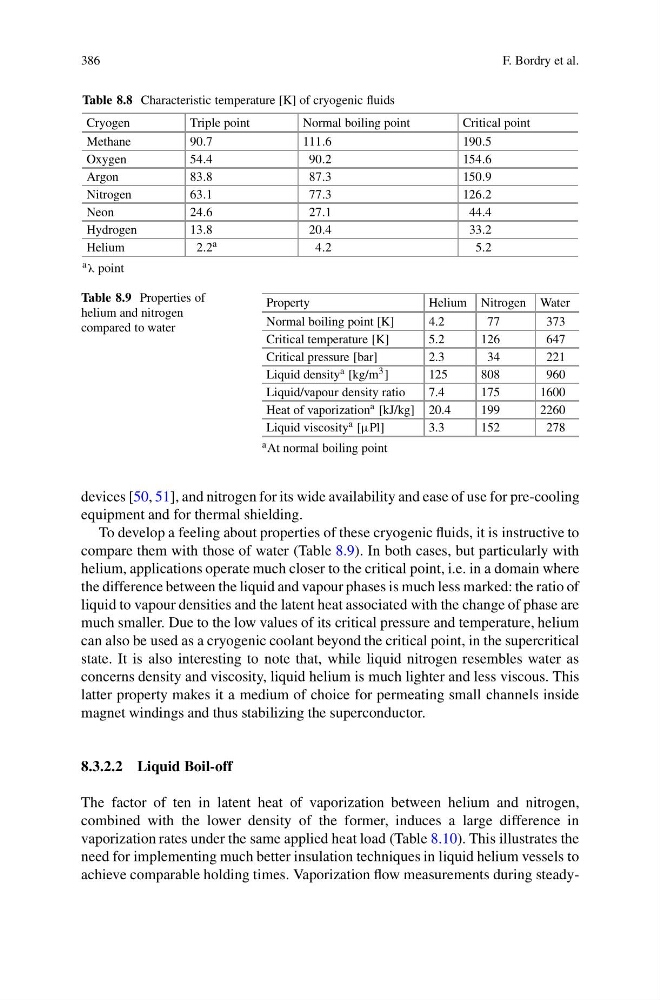
To develop a feeling about properties of these cryogenic fluids, it is instructive to
compare them with those of water (Table 8.9). In both cases, but particularly with
helium, applications operate much closer to the critical point, i.e. in a domain where
the difference between the liquid and vapour phases is much less marked: the ratio of
liquid to vapour densities and the latent heat associated with the change of phase are
much smaller. Due to the low values of its critical pressure and temperature, helium
can also be used as a cryogenic coolant beyond the critical point, in the supercritical
state. It is also interesting to note that, while liquid nitrogen resembles water as
concerns density and viscosity, liquid helium is much lighter and less viscous. This
latter property makes it a medium of choice for permeating small channels inside
magnet windings and thus stabilizing the superconductor.
8.3.2.2 Liquid Boil-off
The factor of ten in latent heat of vaporization between helium and nitrogen,
combined with the lower density of the former, induces a large difference in
vaporization rates under the same applied heat load (Table 8.10). This illustrates the
need for implementing much better insulation techniques in liquid helium vessels to
achieve comparable holding times. Vaporization flow measurements during steady-
F. Bordry et al.
Table 8.8 Characteristic temperature [K] of cryogenic fluids
Cryogen
Triple point
Normal boiling point
Critical point
Methane
90.7
111.6
190.5
Oxygen
54.4
90.2
154.6
Argon
83.8
87.3
150.9
Nitrogen
63.1
77.3
126.2
Neon
24.6
27.1
44.4
Hydrogen
13.8
20.4
33.2
Helium
2.2 a
4.2
5.2
a λ point
Table 8.9 Properties of
helium and nitrogen
compared to water
Property
Helium Nitrogen Water
Normal boiling point [K]
4.2
77
373
Critical temperature [K]
5.2
126
647
Critical pressure [bar]
2.3
34
221
Liquid density a [kg/m 3 ]
125
808
960
Liquid/vapour density ratio
7.4
175
1600
Heat of vaporization a [kJ/kg] 20.4
199
2260
Liquid viscosity a [μPl]
3.3
152
278
a At normal boiling point
devices [50, 51], and nitrogen for its wide availability and ease of use for pre-cooling
equipment and for thermal shielding.
To develop a feeling about properties of these cryogenic fluids, it is instructive to
compare them with those of water (Table 8.9). In both cases, but particularly with
helium, applications operate much closer to the critical point, i.e. in a domain where
the difference between the liquid and vapour phases is much less marked: the ratio of
liquid to vapour densities and the latent heat associated with the change of phase are
much smaller. Due to the low values of its critical pressure and temperature, helium
can also be used as a cryogenic coolant beyond the critical point, in the supercritical
state. It is also interesting to note that, while liquid nitrogen resembles water as
concerns density and viscosity, liquid helium is much lighter and less viscous. This
latter property makes it a medium of choice for permeating small channels inside
magnet windings and thus stabilizing the superconductor.
8.3.2.2 Liquid Boil-off
The factor of ten in latent heat of vaporization between helium and nitrogen,
combined with the lower density of the former, induces a large difference in
vaporization rates under the same applied heat load (Table 8.10). This illustrates the
need for implementing much better insulation techniques in liquid helium vessels to
achieve comparable holding times. Vaporization flow measurements during steady-