

8 Accelerator Engineering and Technology: Accelerator Technology
383
8.2.9 Deflecting Cavities: Crab Cavities
Another class of RF cavities employ the transverse, not the longitudinal component
of the force to kick particles sideways. If a beam bunched at a frequency f travels
through a deflecting cavity oscillating at a frequency f /2, every even bunch will
be kicked in one direction, every odd bunched in the other. This can be used to
separate the beam in two beams bunched at half the frequency. It can equally be
used to combine two beams, interleaving the bunches and thus creating one beam
with twice the current and bunched at double the frequency. This scheme is a basic
building block of the drive beam recombination scheme in CLIC (see Sect. 7.4.3
above) and has been thoroughly tested in the CTF3 facility.
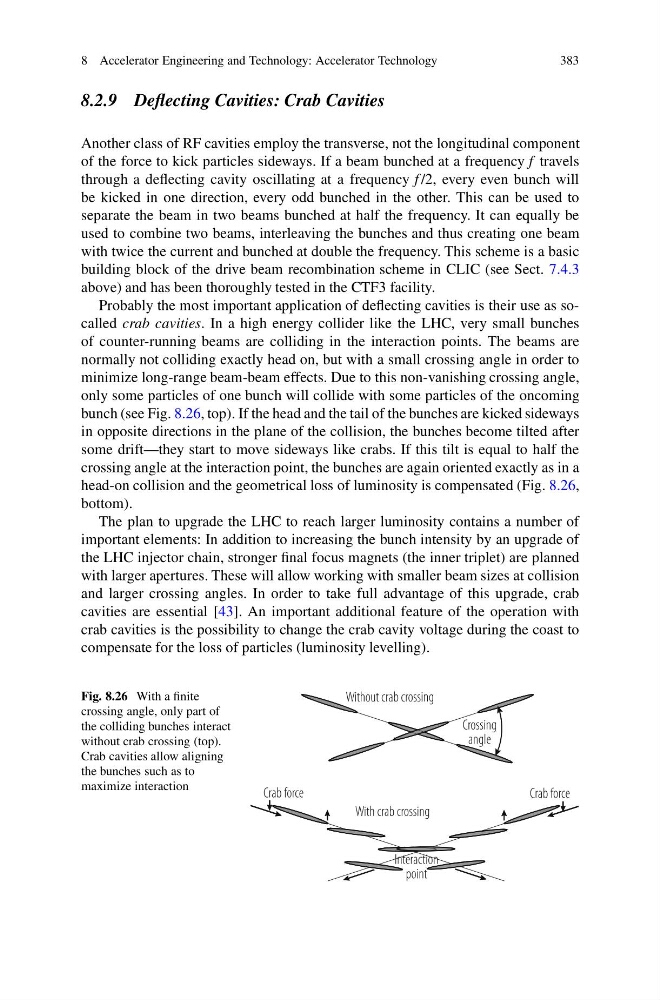
Probably the most important application of deflecting cavities is their use as socalled crab cavities. In a high energy collider like the LHC, very small bunches
of counter-running beams are colliding in the interaction points. The beams are
normally not colliding exactly head on, but with a small crossing angle in order to
minimize long-range beam-beam effects. Due to this non-vanishing crossing angle,
only some particles of one bunch will collide with some particles of the oncoming
bunch (see Fig. 8.26, top). If the head and the tail of the bunches are kicked sideways
in opposite directions in the plane of the collision, the bunches become tilted after
some drift—they start to move sideways like crabs. If this tilt is equal to half the
crossing angle at the interaction point, the bunches are again oriented exactly as in a
head-on collision and the geometrical loss of luminosity is compensated (Fig. 8.26,
bottom).
The plan to upgrade the LHC to reach larger luminosity contains a number of
important elements: In addition to increasing the bunch intensity by an upgrade of
the LHC injector chain, stronger final focus magnets (the inner triplet) are planned
with larger apertures. These will allow working with smaller beam sizes at collision
and larger crossing angles. In order to take full advantage of this upgrade, crab
cavities are essential [43]. An important additional feature of the operation with
crab cavities is the possibility to change the crab cavity voltage during the coast to
compensate for the loss of particles (luminosity levelling).
Fig. 8.26 With a finite
crossing angle, only part of
the colliding bunches interact
without crab crossing (top).
Crab cavities allow aligning
the bunches such as to
maximize interaction
383
8.2.9 Deflecting Cavities: Crab Cavities
Another class of RF cavities employ the transverse, not the longitudinal component
of the force to kick particles sideways. If a beam bunched at a frequency f travels
through a deflecting cavity oscillating at a frequency f /2, every even bunch will
be kicked in one direction, every odd bunched in the other. This can be used to
separate the beam in two beams bunched at half the frequency. It can equally be
used to combine two beams, interleaving the bunches and thus creating one beam
with twice the current and bunched at double the frequency. This scheme is a basic
building block of the drive beam recombination scheme in CLIC (see Sect. 7.4.3
above) and has been thoroughly tested in the CTF3 facility.
Probably the most important application of deflecting cavities is their use as socalled crab cavities. In a high energy collider like the LHC, very small bunches
of counter-running beams are colliding in the interaction points. The beams are
normally not colliding exactly head on, but with a small crossing angle in order to
minimize long-range beam-beam effects. Due to this non-vanishing crossing angle,
only some particles of one bunch will collide with some particles of the oncoming
bunch (see Fig. 8.26, top). If the head and the tail of the bunches are kicked sideways
in opposite directions in the plane of the collision, the bunches become tilted after
some drift—they start to move sideways like crabs. If this tilt is equal to half the
crossing angle at the interaction point, the bunches are again oriented exactly as in a
head-on collision and the geometrical loss of luminosity is compensated (Fig. 8.26,
bottom).
The plan to upgrade the LHC to reach larger luminosity contains a number of
important elements: In addition to increasing the bunch intensity by an upgrade of
the LHC injector chain, stronger final focus magnets (the inner triplet) are planned
with larger apertures. These will allow working with smaller beam sizes at collision
and larger crossing angles. In order to take full advantage of this upgrade, crab
cavities are essential [43]. An important additional feature of the operation with
crab cavities is the possibility to change the crab cavity voltage during the coast to
compensate for the loss of particles (luminosity levelling).
Fig. 8.26 With a finite
crossing angle, only part of
the colliding bunches interact
without crab crossing (top).
Crab cavities allow aligning
the bunches such as to
maximize interaction