

382
F. Bordry et al.
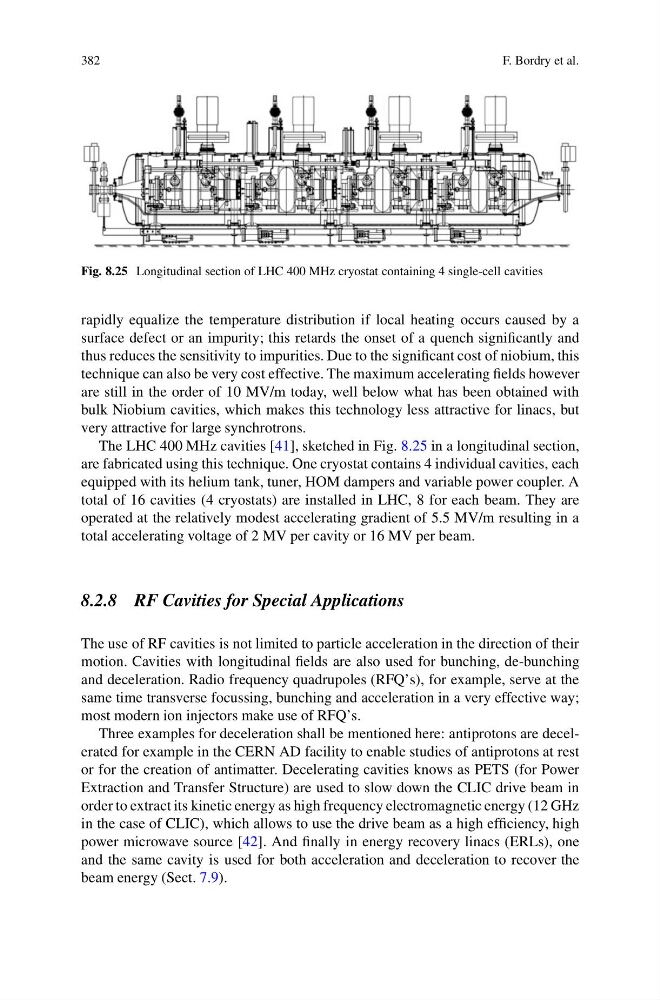
Fig. 8.25 Longitudinal section of LHC 400 MHz cryostat containing 4 single-cell cavities
rapidly equalize the temperature distribution if local heating occurs caused by a
surface defect or an impurity; this retards the onset of a quench significantly and
thus reduces the sensitivity to impurities. Due to the significant cost of niobium, this
technique can also be very cost effective. The maximum accelerating fields however
are still in the order of 10 MV/m today, well below what has been obtained with
bulk Niobium cavities, which makes this technology less attractive for linacs, but
very attractive for large synchrotrons.
The LHC 400 MHz cavities [41], sketched in Fig. 8.25 in a longitudinal section,
are fabricated using this technique. One cryostat contains 4 individual cavities, each
equipped with its helium tank, tuner, HOM dampers and variable power coupler. A
total of 16 cavities (4 cryostats) are installed in LHC, 8 for each beam. They are
operated at the relatively modest accelerating gradient of 5.5 MV/m resulting in a
total accelerating voltage of 2 MV per cavity or 16 MV per beam.
8.2.8 RF Cavities for Special Applications
The use of RF cavities is not limited to particle acceleration in the direction of their
motion. Cavities with longitudinal fields are also used for bunching, de-bunching
and deceleration. Radio frequency quadrupoles (RFQ’s), for example, serve at the
same time transverse focussing, bunching and acceleration in a very effective way;
most modern ion injectors make use of RFQ’s.
Three examples for deceleration shall be mentioned here: antiprotons are decelerated for example in the CERN AD facility to enable studies of antiprotons at rest
or for the creation of antimatter. Decelerating cavities knows as PETS (for Power
Extraction and Transfer Structure) are used to slow down the CLIC drive beam in
order to extract its kinetic energy as high frequency electromagnetic energy (12 GHz
in the case of CLIC), which allows to use the drive beam as a high efficiency, high
power microwave source [42]. And finally in energy recovery linacs (ERLs), one
and the same cavity is used for both acceleration and deceleration to recover the
beam energy (Sect. 7.9).
F. Bordry et al.
Fig. 8.25 Longitudinal section of LHC 400 MHz cryostat containing 4 single-cell cavities
rapidly equalize the temperature distribution if local heating occurs caused by a
surface defect or an impurity; this retards the onset of a quench significantly and
thus reduces the sensitivity to impurities. Due to the significant cost of niobium, this
technique can also be very cost effective. The maximum accelerating fields however
are still in the order of 10 MV/m today, well below what has been obtained with
bulk Niobium cavities, which makes this technology less attractive for linacs, but
very attractive for large synchrotrons.
The LHC 400 MHz cavities [41], sketched in Fig. 8.25 in a longitudinal section,
are fabricated using this technique. One cryostat contains 4 individual cavities, each
equipped with its helium tank, tuner, HOM dampers and variable power coupler. A
total of 16 cavities (4 cryostats) are installed in LHC, 8 for each beam. They are
operated at the relatively modest accelerating gradient of 5.5 MV/m resulting in a
total accelerating voltage of 2 MV per cavity or 16 MV per beam.
8.2.8 RF Cavities for Special Applications
The use of RF cavities is not limited to particle acceleration in the direction of their
motion. Cavities with longitudinal fields are also used for bunching, de-bunching
and deceleration. Radio frequency quadrupoles (RFQ’s), for example, serve at the
same time transverse focussing, bunching and acceleration in a very effective way;
most modern ion injectors make use of RFQ’s.
Three examples for deceleration shall be mentioned here: antiprotons are decelerated for example in the CERN AD facility to enable studies of antiprotons at rest
or for the creation of antimatter. Decelerating cavities knows as PETS (for Power
Extraction and Transfer Structure) are used to slow down the CLIC drive beam in
order to extract its kinetic energy as high frequency electromagnetic energy (12 GHz
in the case of CLIC), which allows to use the drive beam as a high efficiency, high
power microwave source [42]. And finally in energy recovery linacs (ERLs), one
and the same cavity is used for both acceleration and deceleration to recover the
beam energy (Sect. 7.9).