

8 Accelerator Engineering and Technology: Accelerator Technology
377
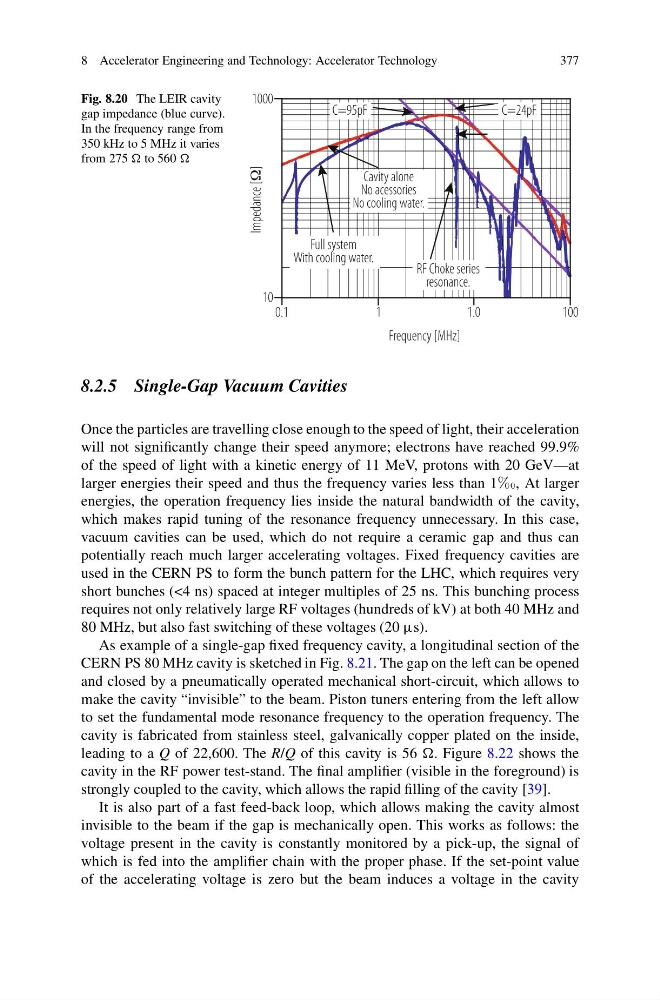
Fig. 8.20 The LEIR cavity
gap impedance (blue curve).
In the frequency range from
350 kHz to 5 MHz it varies
from 275 to 560
8.2.5 Single-Gap Vacuum Cavities
Once the particles are travelling close enough to the speed of light, their acceleration
will not significantly change their speed anymore; electrons have reached 99.9%
of the speed of light with a kinetic energy of 11 MeV, protons with 20 GeV—at
larger energies their speed and thus the frequency varies less than 1%%, At larger
energies, the operation frequency lies inside the natural bandwidth of the cavity,
which makes rapid tuning of the resonance frequency unnecessary. In this case,
vacuum cavities can be used, which do not require a ceramic gap and thus can
potentially reach much larger accelerating voltages. Fixed frequency cavities are
used in the CERN PS to form the bunch pattern for the LHC, which requires very
short bunches (<4 ns) spaced at integer multiples of 25 ns. This bunching process
requires not only relatively large RF voltages (hundreds of kV) at both 40 MHz and
80 MHz, but also fast switching of these voltages (20 μs).
As example of a single-gap fixed frequency cavity, a longitudinal section of the
CERN PS 80 MHz cavity is sketched in Fig. 8.21. The gap on the left can be opened
and closed by a pneumatically operated mechanical short-circuit, which allows to
make the cavity “invisible” to the beam. Piston tuners entering from the left allow
to set the fundamental mode resonance frequency to the operation frequency. The
cavity is fabricated from stainless steel, galvanically copper plated on the inside,
leading to a Q of 22,600. The R/Q of this cavity is 56 . Figure 8.22 shows the
cavity in the RF power test-stand. The final amplifier (visible in the foreground) is
strongly coupled to the cavity, which allows the rapid filling of the cavity [39].
It is also part of a fast feed-back loop, which allows making the cavity almost
invisible to the beam if the gap is mechanically open. This works as follows: the
voltage present in the cavity is constantly monitored by a pick-up, the signal of
which is fed into the amplifier chain with the proper phase. If the set-point value
of the accelerating voltage is zero but the beam induces a voltage in the cavity
377
Fig. 8.20 The LEIR cavity
gap impedance (blue curve).
In the frequency range from
350 kHz to 5 MHz it varies
from 275 to 560
8.2.5 Single-Gap Vacuum Cavities
Once the particles are travelling close enough to the speed of light, their acceleration
will not significantly change their speed anymore; electrons have reached 99.9%
of the speed of light with a kinetic energy of 11 MeV, protons with 20 GeV—at
larger energies their speed and thus the frequency varies less than 1%%, At larger
energies, the operation frequency lies inside the natural bandwidth of the cavity,
which makes rapid tuning of the resonance frequency unnecessary. In this case,
vacuum cavities can be used, which do not require a ceramic gap and thus can
potentially reach much larger accelerating voltages. Fixed frequency cavities are
used in the CERN PS to form the bunch pattern for the LHC, which requires very
short bunches (<4 ns) spaced at integer multiples of 25 ns. This bunching process
requires not only relatively large RF voltages (hundreds of kV) at both 40 MHz and
80 MHz, but also fast switching of these voltages (20 μs).
As example of a single-gap fixed frequency cavity, a longitudinal section of the
CERN PS 80 MHz cavity is sketched in Fig. 8.21. The gap on the left can be opened
and closed by a pneumatically operated mechanical short-circuit, which allows to
make the cavity “invisible” to the beam. Piston tuners entering from the left allow
to set the fundamental mode resonance frequency to the operation frequency. The
cavity is fabricated from stainless steel, galvanically copper plated on the inside,
leading to a Q of 22,600. The R/Q of this cavity is 56 . Figure 8.22 shows the
cavity in the RF power test-stand. The final amplifier (visible in the foreground) is
strongly coupled to the cavity, which allows the rapid filling of the cavity [39].
It is also part of a fast feed-back loop, which allows making the cavity almost
invisible to the beam if the gap is mechanically open. This works as follows: the
voltage present in the cavity is constantly monitored by a pick-up, the signal of
which is fed into the amplifier chain with the proper phase. If the set-point value
of the accelerating voltage is zero but the beam induces a voltage in the cavity