

376
F. Bordry et al.
8.2.4 Wide-Band Cavities
Instead of rapidly tuning the resonance frequency, a relatively new idea is to use a
very low Q instead, which allows to operate in a large frequency range without any
tuning at all. Cavities with this feature can for example be built using amorphous,
nanocrystalline magnetic alloys like Finemet ® or Metglas ® . The price to pay in
operation is a higher power necessary to obtain the same voltage, but this may be
well worth it since there is no need for a tuning circuit or a tuning power supply. This
technique has been pioneered by KEK in the nineties for the J-PARC facility [37].
An example for a wide-band cavity is that of LEIR (Low Energy Ion Ring) at CERN
[38]. LEIR accelerates Pb ions from 4.2 to 72 MeV/n—the corresponding revolution
frequency varies from 360 kHz to 1.42 MHz (2 octaves). The RF system is designed
to have an instantaneous bandwidth of almost 4 octaves (350 kHz to 5 MHz),
which allows operation with Pb ions at harmonics 1 and 2 simultaneously with
the necessary large frequency swing and still could allow acceleration of other ion
species if required. Due to the extremely low Q, the relatively modest accelerating
voltage of 2 kV required a 60 kW amplifier for each of the two LEIR systems.
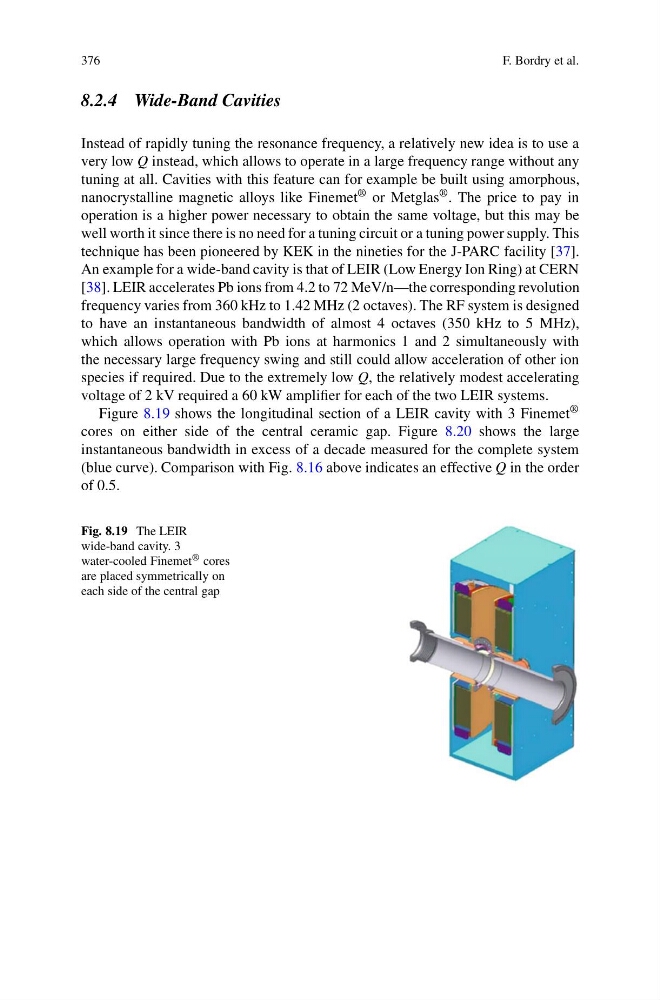
Figure 8.19 shows the longitudinal section of a LEIR cavity with 3 Finemet ®
cores on either side of the central ceramic gap. Figure 8.20 shows the large
instantaneous bandwidth in excess of a decade measured for the complete system
(blue curve). Comparison with Fig. 8.16 above indicates an effective Q in the order
of 0.5.
Fig. 8.19 The LEIR
wide-band cavity. 3
water-cooled Finemet ® cores
are placed symmetrically on
each side of the central gap
F. Bordry et al.
8.2.4 Wide-Band Cavities
Instead of rapidly tuning the resonance frequency, a relatively new idea is to use a
very low Q instead, which allows to operate in a large frequency range without any
tuning at all. Cavities with this feature can for example be built using amorphous,
nanocrystalline magnetic alloys like Finemet ® or Metglas ® . The price to pay in
operation is a higher power necessary to obtain the same voltage, but this may be
well worth it since there is no need for a tuning circuit or a tuning power supply. This
technique has been pioneered by KEK in the nineties for the J-PARC facility [37].
An example for a wide-band cavity is that of LEIR (Low Energy Ion Ring) at CERN
[38]. LEIR accelerates Pb ions from 4.2 to 72 MeV/n—the corresponding revolution
frequency varies from 360 kHz to 1.42 MHz (2 octaves). The RF system is designed
to have an instantaneous bandwidth of almost 4 octaves (350 kHz to 5 MHz),
which allows operation with Pb ions at harmonics 1 and 2 simultaneously with
the necessary large frequency swing and still could allow acceleration of other ion
species if required. Due to the extremely low Q, the relatively modest accelerating
voltage of 2 kV required a 60 kW amplifier for each of the two LEIR systems.
Figure 8.19 shows the longitudinal section of a LEIR cavity with 3 Finemet ®
cores on either side of the central ceramic gap. Figure 8.20 shows the large
instantaneous bandwidth in excess of a decade measured for the complete system
(blue curve). Comparison with Fig. 8.16 above indicates an effective Q in the order
of 0.5.
Fig. 8.19 The LEIR
wide-band cavity. 3
water-cooled Finemet ® cores
are placed symmetrically on
each side of the central gap